
1989 NBA Draft Revisited: Mock vs Actual vs Hindsight
Compare the historical 1989 NBA mock market, the actual first round and a full-career hindsight redraft for every pick.
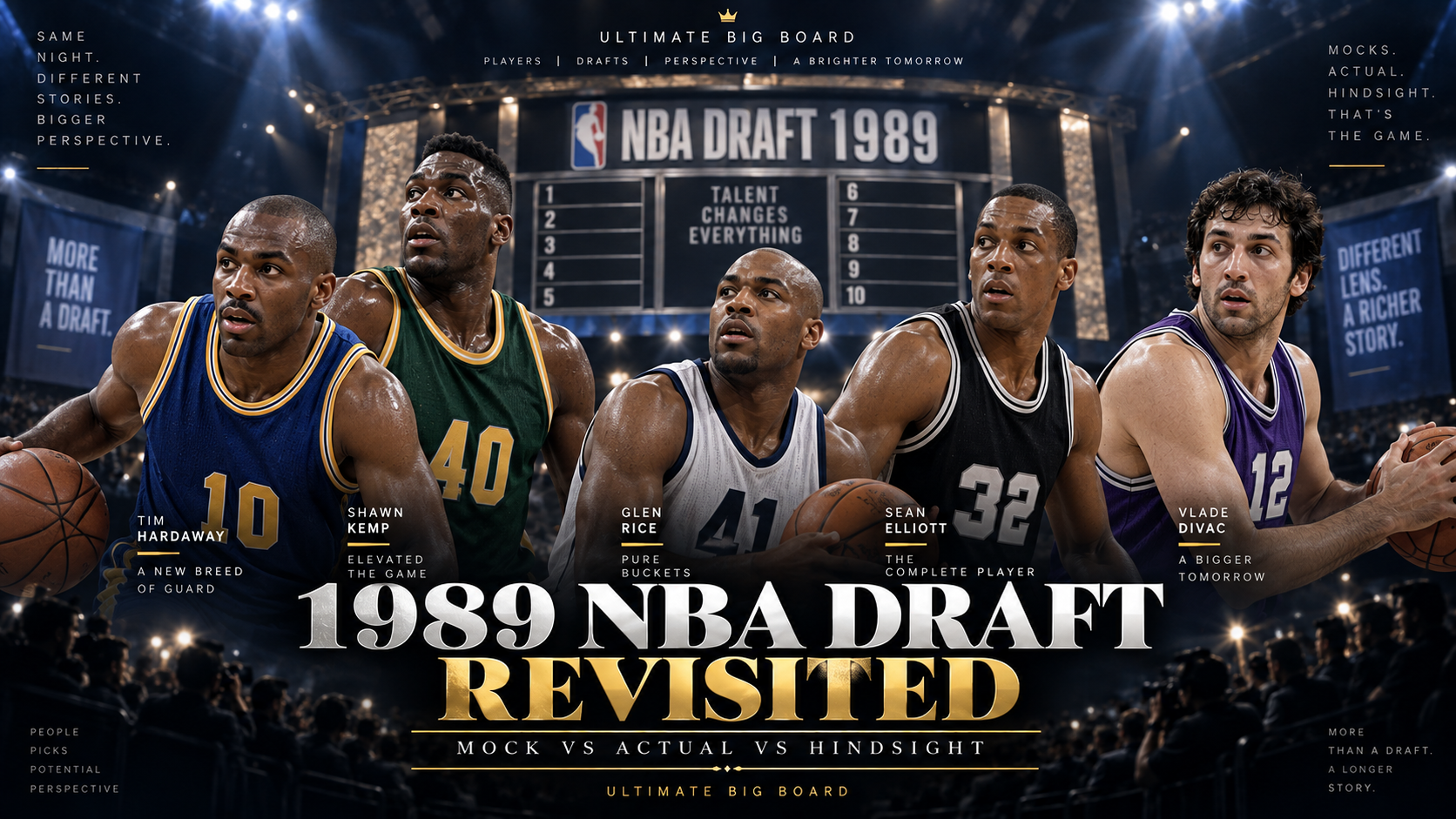
The 1989 draft is remembered as one where nobody knew who should go first, and the teams at the top guessed wrong. There was no clear No. 1 prospect. The Sacramento Kings took Louisville center Pervis Ellison. The Clippers took Duke's Danny Ferry, who refused to sign and went to play in Italy instead. Eight of the first 10 picks are generally considered disappointments.
The stars came later. Tim Hardaway went 14th, Vlade Divac 26th, and Shawn Kemp 17th after never playing a college game. Clifford Robinson went in the second round and played 18 seasons. The public mocks were as confused as the teams: their archive rank No. 1 was Sean Elliott, whom 12 of 15 mocks placed second and none placed first, and they were split almost evenly on whether Sacramento should take Ferry or Ellison.
This was the first draft for the expansion Minnesota Timberwolves and Orlando Magic, the first draft cut to two rounds, and the first shown in prime time on national television.
This article compares three timelines for every first-round pick. The first is what the public mock market expected, using The Draft Review's 15-mock consensus. The second is who teams actually took. The third is who they should have taken, knowing how every career turned out. With 27 teams in the league, the 1989 first round had 27 picks.
Three-timeline overview
How to read the mock baseline: The Draft Review orders its archive by median projected pick, with average pick as a tiebreaker. Its consensus rank labels, including A/B groups, are separate from projected pick numbers. Each row below shows the actual selection's archive rank, median projected slot, earliest-to-latest projection band and number of mocks listing that player. Medians can be fractional and exclude mocks that omit the player. A missing projection is reported explicitly.
Using actual overall pick equal to median projected slot as the definition of a match, 9 of 27 first-round selections matched; 9 came earlier and 9 later. This is a slot comparison, not a claim that all mocks or a particular team agreed.
| Pick | Team | Actual player's archived mock profile | Actual pick (archive rank) | Hindsight pick |
|---|---|---|---|---|
| 1 | Kings | Archive rank 2-B; median slot 3; band 1–8; 15/15 mocks | Pervis Ellison (2) | Tim Hardaway |
| 2 | Clippers | Archive rank 2-A; median slot 3; band 1–3; 15/15 mocks | Danny Ferry (2) | Shawn Kemp |
| 3 | Spurs | Archive rank 1; median slot 2; band 2–6; 15/15 mocks | Sean Elliott (1) | Glen Rice |
| 4 | Heat | Archive rank 3; median slot 4; band 2–4; 15/15 mocks | Glen Rice (3) | Vlade Divac |
| 5 | Hornets | Archive rank 4; median slot 5; band 5–8; 15/15 mocks | J.R. Reid (4) | Clifford Robinson |
| 6 | Bulls | Archive rank 5; median slot 6; band 1–8; 15/15 mocks | Stacey King (5) | Sean Elliott |
| 7 | Pacers | Archive rank 6-B; median slot 7; band 7–12; 15/15 mocks | George McCloud (6) | Mookie Blaylock |
| 8 | Mavericks | Archive rank 6-A; median slot 7; band 5–9; 15/15 mocks | Randy White (6) | Nick Anderson |
| 9 | Bullets | Archive rank 7; median slot 9; band 8–11; 15/15 mocks | Tom Hammonds (7) | Dana Barros |
| 10 | Timberwolves | Archive rank 13-A; median slot 17; band 10–25; 15/15 mocks | Pooh Richardson (13) | B.J. Armstrong |
| 11 | Magic | Archive rank 11-B; median slot 14; band 10–24; 15/15 mocks | Nick Anderson (11) | Sherman Douglas |
| 12 | Nets | Archive rank 9; median slot 12; band 9–17; 15/15 mocks | Mookie Blaylock (9) | Pooh Richardson |
| 13 | Celtics | Archive rank 10-B; median slot 13; band 13–22; 15/15 mocks | Michael Smith (10) | Danny Ferry |
| 14 | Warriors | Archive rank 10-A; median slot 13; band 7–20; 15/15 mocks | Tim Hardaway (10) | Dino Radja |
| 15 | Nuggets | Archive rank 8; median slot 11; band 10–15; 15/15 mocks | Todd Lichti (8) | George McCloud |
| 16 | SuperSonics | Archive rank 16; median slot 20; band 17–25; 5/15 mocks | Dana Barros (16) | Pervis Ellison |
| 17 | SuperSonics | Archive rank 26; median slot 26; band 16–27; 7/15 mocks | Shawn Kemp (26) | Doug West |
| 18 | Bulls | Archive rank 13-B; median slot 17; band 12–20; 13/15 mocks | B.J. Armstrong (13) | Blue Edwards |
| 19 | 76ers | Archive rank 25-D; median slot 25; band 25; 1/15 mocks | Kenny Payne (25*) | Stacey King |
| 20 | Bulls | Archive rank 19-B; median slot 22; band 18–27; 6/15 mocks | Jeff Sanders (19) | J.R. Reid |
| 21 | Jazz | Archive rank 21-A; median slot 23; band 23–25; 7/15 mocks | Blue Edwards (21) | Chucky Brown |
| 22 | Trail Blazers | Archive rank 19-A; median slot 22; band 18–25; 11/15 mocks | Byron Irvin (19) | Tom Hammonds |
| 23 | Hawks | Archive rank 17-A; median slot 21; band 12–25; 15/15 mocks | Roy Marble (17) | Todd Lichti |
| 24 | Suns | Archive rank 15; median slot 19; band 15–19; 13/15 mocks | Anthony Cook (15) | Roy Marble |
| 25 | Cavaliers | Archive rank 25-B; median slot 25; band 21–26; 9/15 mocks | John Morton (25) | Randy White |
| 26 | Lakers | Archive rank 11-A; median slot 14; band 9–19; 15/15 mocks | Vlade Divac (11) | Byron Irvin |
| 27 | Pistons | Archive rank 17-C; median slot 21; band 16–24; 11/15 mocks | Kenny Battle (17) | Michael Smith |
Pick-by-pick: Mock vs Actual vs Hindsight
No. 1: Sacramento Kings — Pervis Ellison
What the mock market was saying: Pervis Ellison: Archive rank 2-B; median slot 3; band 1–8; 15/15 mocks. He was known as "Never Nervous Pervis." Scouts liked his shot-blocking and footwork and questioned his strength.
Why the Kings made the pick: Sacramento wanted a center, and in the late 1980s most teams believed a franchise was built around one. Ellison was the best center in the draft.
Actual pick versus mock median: The actual selection at No. 1 was 2 places earlier than the median projected slot of 3. 6 of 15 listed mocks placed Pervis Ellison at that exact pick. This compares overall slots, rather than inferring a team-specific prediction from the archive rank.
What hindsight changes: Ellison was injured for most of his rookie season, and Sacramento traded him to Washington a year later. He won Most Improved Player in 1992, but injuries shortened his career. He ranks 16th on the hindsight board.
Tim Hardaway is the hindsight pick. He was a 6-0 guard from UTEP whose median projected slot was 13 (archive rank 10-A). He became a five-time All-Star, one of the best point guards of the 1990s, and a Hall of Famer. In 1989 teams wanted size at the top of the draft, and a small guard from a mid-major program wasn't considered a No. 1 pick.
No. 2: Los Angeles Clippers — Danny Ferry
What the mock market was saying: Danny Ferry: Archive rank 2-A; median slot 3; band 1–3; 15/15 mocks. He was a 6-10 senior from Duke and the national player of the year, a skilled forward who could shoot, pass and handle the ball.
Why the Clippers made the pick: The Clippers wanted the most skilled player available.
Actual pick versus mock median: The actual selection at No. 2 was 1 place earlier than the median projected slot of 3. 0 of 15 listed mocks placed Danny Ferry at that exact pick. This compares overall slots, rather than inferring a team-specific prediction from the archive rank.
What hindsight changes: Ferry refused to sign and played a season in Italy. The Clippers traded his rights to Cleveland, where he signed a large contract and became a long-time role player. He later won a title with San Antonio in 2003 and became an NBA executive. He ranks 13th.
Shawn Kemp is the hindsight pick. The Clippers would have gotten a six-time All-Star power forward and one of the most athletic players of his era. In 1989 Kemp was a mystery, which is part of why he lasted until No. 17.
No. 3: San Antonio Spurs — Sean Elliott
What the mock market was saying: Sean Elliott: Archive rank 1; median slot 2; band 2–6; 15/15 mocks. He was a 6-8 senior from Arizona and a two-time All-American with a smooth, versatile game.
Why the Spurs made the pick: San Antonio had David Robinson arriving after his Navy service and needed a wing to play with him. Elliott was the best wing in the draft.
Actual pick versus mock median: The actual selection at No. 3 was 1 place later than the median projected slot of 2. 0 of 15 listed mocks placed Sean Elliott at that exact pick. This compares overall slots, rather than inferring a team-specific prediction from the archive rank.
What hindsight changes: Elliott made two All-Star teams and hit the "Memorial Day Miracle" shot during the Spurs' 1999 title run. He had a kidney transplant after that season and returned to play. He ranks sixth. Glen Rice is the redraft pick here.
No. 4: Miami Heat — Glen Rice
What the mock market was saying: Glen Rice: Archive rank 3; median slot 4; band 2–4; 15/15 mocks. He was a senior from Michigan who had just set the NCAA tournament scoring record while leading the Wolverines to the 1989 title.
Why the Heat made the pick: Miami, heading into its second season, needed a scorer.
Actual pick versus mock median: The actual selection at No. 4 matched the median projected slot of 4. 12 of 15 listed mocks placed Glen Rice at that exact pick. This compares overall slots, rather than inferring a team-specific prediction from the archive rank.
What hindsight changes: Rice became one of the best shooters of the 1990s, made three All-Star teams, and won a title with the Lakers in 2000. He ranks third. Vlade Divac is the redraft pick here.
No. 5: Charlotte Hornets — J.R. Reid
What the mock market was saying: J.R. Reid: Archive rank 4; median slot 5; band 5–8; 15/15 mocks. He was a strong power forward from North Carolina who had been one of the most famous high school players in the country.
Why the Hornets made the pick: Charlotte, heading into its second season, wanted a big man, and Reid was a North Carolina star playing in North Carolina.
Actual pick versus mock median: The actual selection at No. 5 matched the median projected slot of 5. 13 of 15 listed mocks placed J.R. Reid at that exact pick. This compares overall slots, rather than inferring a team-specific prediction from the archive rank.
What hindsight changes: Reid had a journeyman career. He ranks 20th. Clifford Robinson, who went 36th and played 18 seasons, is the redraft pick here.
No. 6: Chicago Bulls — Stacey King
What the mock market was saying: Stacey King: Archive rank 5; median slot 6; band 1–8; 15/15 mocks. He was a 6-11 senior from Oklahoma who had been one of the best scorers in college.
Why the Bulls made the pick: Chicago wanted a big man to play with Michael Jordan and Scottie Pippen.
Actual pick versus mock median: The actual selection at No. 6 matched the median projected slot of 6. 6 of 15 listed mocks placed Stacey King at that exact pick. This compares overall slots, rather than inferring a team-specific prediction from the archive rank.
What hindsight changes: King won three titles with Chicago as a reserve but never became a starter. He ranks 19th. Elliott is the redraft pick here.
No. 7: Indiana Pacers — George McCloud
What the mock market was saying: George McCloud: Archive rank 6-B; median slot 7; band 7–12; 15/15 mocks. He was a shooter from Florida State.
Why the Pacers made the pick: Indiana wanted a shooter.
Actual pick versus mock median: The actual selection at No. 7 matched the median projected slot of 7. 8 of 15 listed mocks placed George McCloud at that exact pick. This compares overall slots, rather than inferring a team-specific prediction from the archive rank.
What hindsight changes: McCloud struggled in Indiana but later became a three-point specialist in Dallas. He ranks 15th. Mookie Blaylock is the redraft pick here.
No. 8: Dallas Mavericks — Randy White
What the mock market was saying: Randy White: Archive rank 6-A; median slot 7; band 5–9; 15/15 mocks. He was a 6-8 power forward from Louisiana Tech who was compared to Karl Malone, another Louisiana Tech star.
Why the Mavericks made the pick: Dallas wanted a power forward.
Actual pick versus mock median: The actual selection at No. 8 was 1 place later than the median projected slot of 7. 5 of 15 listed mocks placed Randy White at that exact pick. This compares overall slots, rather than inferring a team-specific prediction from the archive rank.
What hindsight changes: White never approached the Malone comparisons and played only a few NBA seasons. He ranks 25th. Nick Anderson is the redraft pick here.
No. 9: Washington Bullets — Tom Hammonds
What the mock market was saying: Tom Hammonds: Archive rank 7; median slot 9; band 8–11; 15/15 mocks. He was a senior forward from Georgia Tech.
Why the Bullets made the pick: Washington wanted a forward.
Actual pick versus mock median: The actual selection at No. 9 matched the median projected slot of 9. 9 of 15 listed mocks placed Tom Hammonds at that exact pick. This compares overall slots, rather than inferring a team-specific prediction from the archive rank.
What hindsight changes: Hammonds had a long career as a backup. He ranks 22nd. Dana Barros is the redraft pick here.
No. 10: Minnesota Timberwolves — Pooh Richardson
What the mock market was saying: Pooh Richardson: Archive rank 13-A; median slot 17; band 10–25; 15/15 mocks. He was a point guard from UCLA.
Why the Timberwolves made the pick: Minnesota's first-ever draft pick was a point guard to run its new team.
Actual pick versus mock median: The actual selection at No. 10 was 7 places earlier than the median projected slot of 17. 2 of 15 listed mocks placed Pooh Richardson at that exact pick. This compares overall slots, rather than inferring a team-specific prediction from the archive rank.
What hindsight changes: Richardson made the All-Rookie First Team and had a solid career. He ranks 12th. B.J. Armstrong is the redraft pick here.
No. 11: Orlando Magic — Nick Anderson
What the mock market was saying: Nick Anderson: Archive rank 11-B; median slot 14; band 10–24; 15/15 mocks. He was a junior wing from Illinois.
Why the Magic made the pick: Orlando's first-ever draft pick was an athletic wing who could score.
Actual pick versus mock median: The actual selection at No. 11 was 3 places earlier than the median projected slot of 14. 1 of 15 listed mocks placed Nick Anderson at that exact pick. This compares overall slots, rather than inferring a team-specific prediction from the archive rank.
What hindsight changes: Anderson played 13 seasons and was a key player on Orlando's 1995 Finals team, though he's also remembered for missing four straight free throws in Game 1 of that series. He ranks eighth. Sherman Douglas, a second-round pick who became a starter in Miami, is the redraft pick here.
No. 12: New Jersey Nets — Mookie Blaylock
What the mock market was saying: Mookie Blaylock: Archive rank 9; median slot 12; band 9–17; 15/15 mocks. He was a quick, defensive point guard from Oklahoma.
Why the Nets made the pick: New Jersey needed a point guard.
Actual pick versus mock median: The actual selection at No. 12 matched the median projected slot of 12. 5 of 15 listed mocks placed Mookie Blaylock at that exact pick. This compares overall slots, rather than inferring a team-specific prediction from the archive rank.
What hindsight changes: Blaylock became one of the league's best defenders, making the 1994 All-Star team and several All-Defensive teams, mostly with Atlanta. He ranks seventh. Richardson is the redraft pick here.
No. 13: Boston Celtics — Michael Smith
What the mock market was saying: Michael Smith: Archive rank 10-B; median slot 13; band 13–22; 15/15 mocks. He was a 6-10 forward from BYU who could shoot.
Why the Celtics made the pick: Boston's stars were aging, and the Celtics wanted a skilled forward.
Actual pick versus mock median: The actual selection at No. 13 matched the median projected slot of 13. 10 of 15 listed mocks placed Michael Smith at that exact pick. This compares overall slots, rather than inferring a team-specific prediction from the archive rank.
What hindsight changes: Smith played only a few NBA seasons. He ranks 27th. Ferry is the redraft pick here.
No. 14: Golden State Warriors — Tim Hardaway
What the mock market was saying: Tim Hardaway: Archive rank 10-A; median slot 13; band 7–20; 15/15 mocks. He was a 6-0 senior point guard from UTEP with a devastating crossover dribble.
Why the Warriors made the pick: Don Nelson wanted a quick point guard to run his up-tempo offense.
Actual pick versus mock median: The actual selection at No. 14 was 1 place later than the median projected slot of 13. 2 of 15 listed mocks placed Tim Hardaway at that exact pick. This compares overall slots, rather than inferring a team-specific prediction from the archive rank.
What hindsight changes: Hardaway formed "Run TMC" with Mitch Richmond and Chris Mullin, made five All-Star teams, and entered the Hall of Fame in 2022. He ranks first on the hindsight board. Dino Radja, a Croatian second-round pick who later starred for Boston and entered the Hall of Fame, is the redraft pick here.
No. 15: Denver Nuggets — Todd Lichti
What the mock market was saying: Todd Lichti: Archive rank 8; median slot 11; band 10–15; 15/15 mocks. He was a senior scorer from Stanford.
Why the Nuggets made the pick: Denver's high-scoring team wanted another shooter.
Actual pick versus mock median: The actual selection at No. 15 was 4 places later than the median projected slot of 11. 2 of 15 listed mocks placed Todd Lichti at that exact pick. This compares overall slots, rather than inferring a team-specific prediction from the archive rank.
What hindsight changes: Lichti played a few NBA seasons and ranks 23rd. McCloud is the redraft pick here.
No. 16: Seattle SuperSonics — Dana Barros
What the mock market was saying: Dana Barros: Archive rank 16; median slot 20; band 17–25; 5/15 mocks. He was a 5-11 shooter from Boston College.
Why the SuperSonics made the pick: Seattle wanted a shooter.
Actual pick versus mock median: The actual selection at No. 16 was 4 places earlier than the median projected slot of 20. 0 of 5 listed mocks placed Dana Barros at that exact pick. This compares overall slots, rather than inferring a team-specific prediction from the archive rank.
What hindsight changes: Barros won Most Improved Player and made the All-Star team with Philadelphia in 1995. He ranks ninth. Ellison is the redraft pick here.
No. 17: Seattle SuperSonics — Shawn Kemp
What the mock market was saying: Shawn Kemp: Archive rank 26; median slot 26; band 16–27; 7/15 mocks. He had been a high school star in Indiana, signed with Kentucky, left without playing a game, and spent time at a Texas junior college without playing there either. No one had seen him play against good competition in more than a year.
Why the SuperSonics made the pick: Seattle took a chance on Kemp's size and athleticism. The Sonics had also agreed with Chicago not to take B.J. Armstrong at No. 16 or 17 in exchange for a future second-round pick.
Actual pick versus mock median: The actual selection at No. 17 was 9 places earlier than the median projected slot of 26. 0 of 7 listed mocks placed Shawn Kemp at that exact pick. This compares overall slots, rather than inferring a team-specific prediction from the archive rank.
What hindsight changes: Kemp became a six-time All-Star and, with Gary Payton, led Seattle to the 1996 Finals. He ranks second, the biggest steal in the draft. Doug West is the redraft pick here.
No. 18: Chicago Bulls — B.J. Armstrong
What the mock market was saying: B.J. Armstrong: Archive rank 13-B; median slot 17; band 12–20; 13/15 mocks. He was a senior point guard from Iowa.
Why the Bulls made the pick: Chicago wanted a point guard and had arranged with Seattle to make sure he'd still be available.
Actual pick versus mock median: The actual selection at No. 18 was 1 place later than the median projected slot of 17. 0 of 13 listed mocks placed B.J. Armstrong at that exact pick. This compares overall slots, rather than inferring a team-specific prediction from the archive rank.
What hindsight changes: Armstrong won three titles with Chicago and made the 1994 All-Star team. He ranks 10th. Blue Edwards is the redraft pick here.
No. 19: Philadelphia 76ers — Kenny Payne
What the mock market was saying: Kenny Payne: Archive rank 25-D; median slot 25; band 25; 1/15 mocks. He was a forward from Louisville.
Why the 76ers made the pick: Philadelphia took a Louisville forward it rated far higher than the public did.
Actual pick versus mock median: The actual selection at No. 19 was 6 places earlier than the median projected slot of 25. 0 of 1 listed mock placed Kenny Payne at that exact pick. This compares overall slots, rather than inferring a team-specific prediction from the archive rank.
What hindsight changes: Payne played four seasons and later became a college coach. He falls outside the hindsight board's top 27. Stacey King is the redraft pick here.
No. 20: Chicago Bulls — Jeff Sanders
What the mock market was saying: Jeff Sanders: Archive rank 19-B; median slot 22; band 18–27; 6/15 mocks. He was a forward from Georgia Southern.
Why the Bulls made the pick: With its third pick, Chicago took a forward.
Actual pick versus mock median: The actual selection at No. 20 was 2 places earlier than the median projected slot of 22. 0 of 6 listed mocks placed Jeff Sanders at that exact pick. This compares overall slots, rather than inferring a team-specific prediction from the archive rank.
What hindsight changes: Sanders played only a few NBA games. He falls outside the hindsight board's top 27. J.R. Reid is the redraft pick here.
No. 21: Utah Jazz — Blue Edwards
What the mock market was saying: Blue Edwards: Archive rank 21-A; median slot 23; band 23–25; 7/15 mocks. He was an athletic wing from East Carolina.
Why the Jazz made the pick: Utah wanted an athletic wing.
Actual pick versus mock median: The actual selection at No. 21 was 2 places earlier than the median projected slot of 23. 0 of 7 listed mocks placed Blue Edwards at that exact pick. This compares overall slots, rather than inferring a team-specific prediction from the archive rank.
What hindsight changes: Edwards had a solid career as a scorer. He ranks 18th. Chucky Brown, a second-round forward who played for a dozen teams, is the redraft pick here.
No. 22: Portland Trail Blazers — Byron Irvin
What the mock market was saying: Byron Irvin: Archive rank 19-A; median slot 22; band 18–25; 11/15 mocks. He was a guard from Missouri.
Why the Trail Blazers made the pick: Portland wanted guard depth.
Actual pick versus mock median: The actual selection at No. 22 matched the median projected slot of 22. 2 of 11 listed mocks placed Byron Irvin at that exact pick. This compares overall slots, rather than inferring a team-specific prediction from the archive rank.
What hindsight changes: Irvin played only a few NBA seasons. He ranks 26th. Hammonds is the redraft pick here.
No. 23: Atlanta Hawks — Roy Marble
What the mock market was saying: Roy Marble: Archive rank 17-A; median slot 21; band 12–25; 15/15 mocks. He was a scorer from Iowa.
Why the Hawks made the pick: Atlanta wanted a scorer.
Actual pick versus mock median: The actual selection at No. 23 was 2 places later than the median projected slot of 21. 0 of 15 listed mocks placed Roy Marble at that exact pick. This compares overall slots, rather than inferring a team-specific prediction from the archive rank.
What hindsight changes: Marble played only a few NBA seasons. He ranks 24th. Lichti is the redraft pick here.
No. 24: Phoenix Suns — Anthony Cook
What the mock market was saying: Anthony Cook: Archive rank 15; median slot 19; band 15–19; 13/15 mocks. He was a forward from Arizona.
Why the Suns made the pick: Phoenix drafted Cook and traded his rights to Detroit, receiving Kenny Battle, the No. 27 pick, in return.
Actual pick versus mock median: The actual selection at No. 24 was 5 places later than the median projected slot of 19. 0 of 13 listed mocks placed Anthony Cook at that exact pick. This compares overall slots, rather than inferring a team-specific prediction from the archive rank.
What hindsight changes: Cook played only a few NBA seasons. He falls outside the hindsight board's top 27. Marble is the redraft pick here.
No. 25: Cleveland Cavaliers — John Morton
What the mock market was saying: John Morton: Archive rank 25-B; median slot 25; band 21–26; 9/15 mocks. He was a guard from Seton Hall who had scored 35 points in the 1989 national title game.
Why the Cavaliers made the pick: Cleveland wanted a scoring guard.
Actual pick versus mock median: The actual selection at No. 25 matched the median projected slot of 25. 3 of 9 listed mocks placed John Morton at that exact pick. This compares overall slots, rather than inferring a team-specific prediction from the archive rank.
What hindsight changes: Morton played only a few NBA seasons. He falls outside the hindsight board's top 27. White is the redraft pick here.
No. 26: Los Angeles Lakers — Vlade Divac
What the mock market was saying: Vlade Divac: Archive rank 11-A; median slot 14; band 9–19; 15/15 mocks. He was a 7-1 center from Partizan Belgrade, one of the best young big men in Europe, and a skilled passer. In 1989 few European players had succeeded in the NBA, and teams were unsure whether he could adapt or even get out of his contract.
Why the Lakers made the pick: Kareem Abdul-Jabbar had just retired, and Jerry West saw Divac as a skilled center who could replace him.
Actual pick versus mock median: The actual selection at No. 26 was 12 places later than the median projected slot of 14. 0 of 15 listed mocks placed Vlade Divac at that exact pick. This compares overall slots, rather than inferring a team-specific prediction from the archive rank.
What hindsight changes: Divac played 16 seasons, made the 2001 All-Star team with Sacramento, and entered the Hall of Fame in 2019. He ranks fourth. Irvin is the redraft pick here.
No. 27: Detroit Pistons — Kenny Battle
What the mock market was saying: Kenny Battle: Archive rank 17-C; median slot 21; band 16–24; 11/15 mocks. He was an athletic forward from Illinois.
Why the Pistons made the pick: Detroit, which had just won its first title, drafted Battle and traded him to Phoenix.
Actual pick versus mock median: The actual selection at No. 27 was 6 places later than the median projected slot of 21. 0 of 11 listed mocks placed Kenny Battle at that exact pick. This compares overall slots, rather than inferring a team-specific prediction from the archive rank.
What hindsight changes: Battle played only a few NBA seasons. He falls outside the hindsight board's top 27. Michael Smith is the redraft pick here.
Why the three timelines split
No one agreed on the top pick. The mocks split almost evenly between Ellison and Ferry for Sacramento, with Stacey King a distant third. The public's top-rated player, Elliott, went third.
Teams wanted size, and the best players were guards. Hardaway, Blaylock and Barros all became better players than most of the big men taken ahead of them.
The two biggest steals were players teams couldn't evaluate. Kemp hadn't played in more than a year, and Divac played in Yugoslavia. Both became far better than most of the lottery.
The second round was unusually strong. Clifford Robinson, Sherman Douglas, Dino Radja and Doug West all became better players than many first-rounders.
What the mock market got right
The consensus correctly identified Glen Rice, Sean Elliott and J.R. Reid as top-five talents. It rated Divac as a lottery talent, much higher than the teams did.
Where teams beat the mocks
Seattle's gamble on Kemp was the best pick relative to the mocks. The Lakers' patience with Divac and Golden State's choice of Hardaway also paid off.
Hindsight top five
- Tim Hardaway
- Shawn Kemp
- Glen Rice
- Vlade Divac
- Clifford Robinson
FAQ
Who should go No. 1 in a 1989 NBA redraft?
Tim Hardaway. He was a five-time All-Star and a Hall of Famer.
What did mock drafts predict in the 1989 NBA Draft?
The Draft Review's archive separates rank labels from median projected slots. Sean Elliott has archive rank 1, median slot 2 and band 2–6; none of the 15 listed mocks projected him first. Using actual overall pick equal to median projected slot as the definition of a match, 9 of 27 first-round selections matched; 9 came earlier and 9 later. This is a slot comparison, not a claim that all mocks or a particular team agreed.
Who was the biggest draft-night slide in 1989?
Among first-round selections with an archived projection, the largest difference below the mock median was 12 places: Vlade Divac (median slot 14, actual No. 26, archive rank 11-A; 15 mocks). This uses median projected slot, not the archive rank number.
What is the biggest lesson from the 1989 NBA Draft?
When the top of a draft is uncertain, the best players may be the ones nobody has seen enough of. Kemp and Divac were the proof.
Full hindsight board
| Hindsight rank | Player |
|---|---|
| 1 | Tim Hardaway |
| 2 | Shawn Kemp |
| 3 | Glen Rice |
| 4 | Vlade Divac |
| 5 | Clifford Robinson |
| 6 | Sean Elliott |
| 7 | Mookie Blaylock |
| 8 | Nick Anderson |
| 9 | Dana Barros |
| 10 | B.J. Armstrong |
| 11 | Sherman Douglas |
| 12 | Pooh Richardson |
| 13 | Danny Ferry |
| 14 | Dino Radja |
| 15 | George McCloud |
| 16 | Pervis Ellison |
| 17 | Doug West |
| 18 | Blue Edwards |
| 19 | Stacey King |
| 20 | J.R. Reid |
| 21 | Chucky Brown |
| 22 | Tom Hammonds |
| 23 | Todd Lichti |
| 24 | Roy Marble |
| 25 | Randy White |
| 26 | Byron Irvin |
| 27 | Michael Smith |
Sources and methodology
- Historical mock baseline: The Draft Review's 1989 consensus mock draft, built from 15 mock drafts. https://www.thedraftreview.com/consensus-mock-draft-archive/1989-nba-draft-consensus-mock-draft
- Actual first-round order and transaction context: historical NBA draft records.
- Hindsight rankings are Ultimate Big Board editorial judgments built around peak value, longevity, two-way impact, postseason utility, role portability, and overall career production.
- Alternate-history notes are interpretive and do not assume every downstream roster move remains unchanged.