
1990 NBA Draft Revisited: Mock vs Actual vs Hindsight
Compare the historical 1990 NBA mock market, the actual first round and a full-career hindsight redraft for every pick.
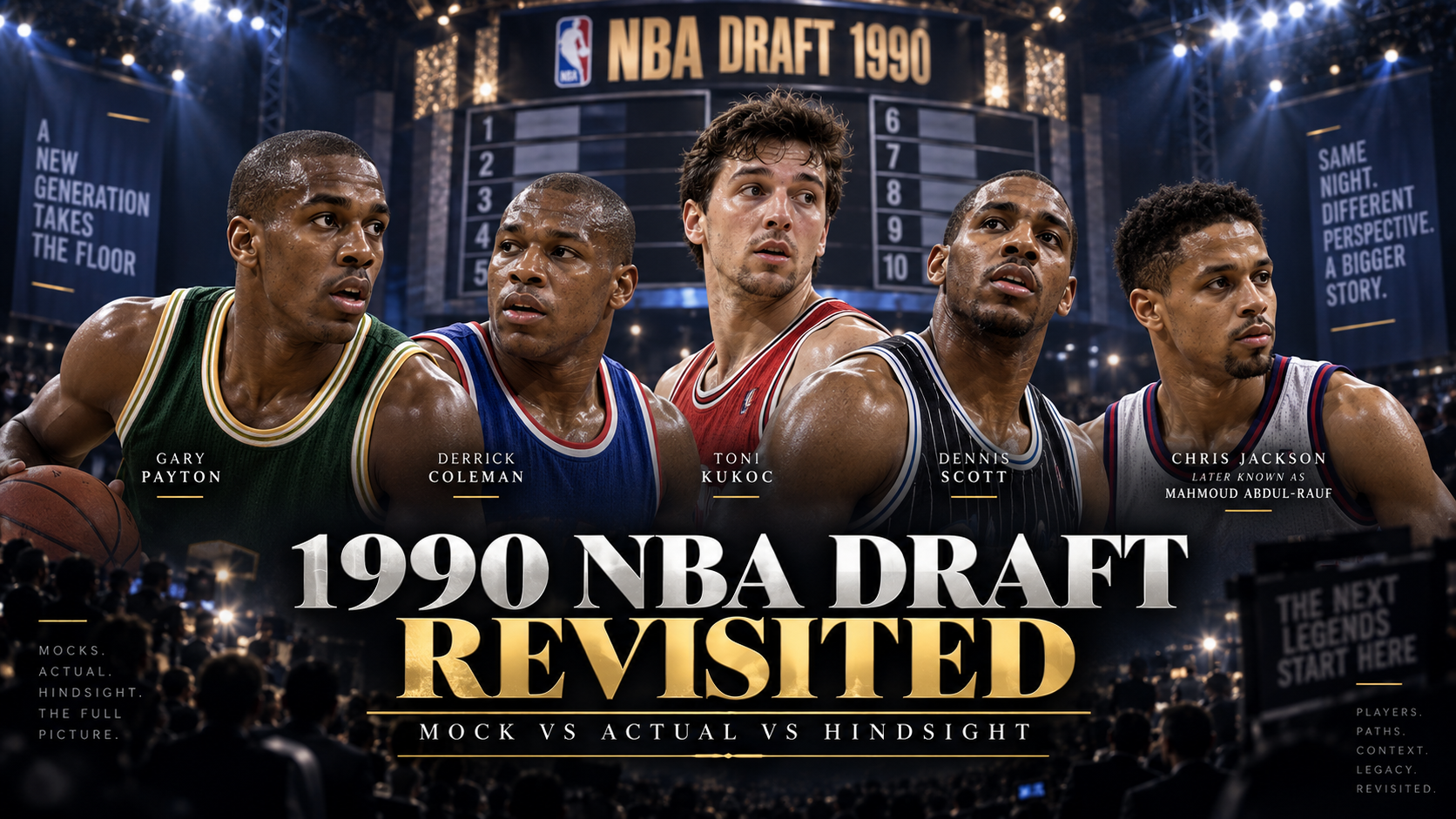
The 1990 draft opened with two picks everyone agreed on. All 15 mocks in The Draft Review's consensus had Derrick Coleman going first to New Jersey and Gary Payton going second to Seattle, and that's exactly what happened. Payton became a Hall of Famer, a nine-time All-Star and one of the best defensive guards in history. Coleman was talented but inconsistent and made one All-Star team.
The rest of the draft is remembered for two things. The Sacramento Kings held four first-round picks after a series of trades and used none of them on a player who became a star. And the best value came in the second round, where Chicago took Toni Kukoc at No. 29, Indiana took Antonio Davis at No. 45 and Phoenix took Cedric Ceballos at No. 48. All three became better players than most of the first round.
This article compares three timelines for every first-round pick. The first is what the public mock market expected, using The Draft Review's 15-mock consensus. The second is who teams actually took. The third is who they should have taken, knowing how every career turned out. With 27 teams in the league, the 1990 first round had 27 picks.
Three-timeline overview
How to read the mock baseline: The Draft Review orders its archive by median projected pick, with average pick as a tiebreaker. Its consensus rank labels, including A/B groups, are separate from projected pick numbers. Each row below shows the actual selection's archive rank, median projected slot, earliest-to-latest projection band and number of mocks listing that player. Medians can be fractional and exclude mocks that omit the player. A missing projection is reported explicitly.
Using actual overall pick equal to median projected slot as the definition of a match, 4 of 27 first-round selections matched; 13 came earlier and 9 later. 1 selection has no archived projection. This is a slot comparison, not a claim that all mocks or a particular team agreed.
| Pick | Team | Actual player's archived mock profile | Actual pick (archive rank) | Hindsight pick |
|---|---|---|---|---|
| 1 | Nets | Archive rank 1; median slot 1; band 1; 15/15 mocks | Derrick Coleman (1) | Gary Payton |
| 2 | SuperSonics | Archive rank 2; median slot 2; band 2; 15/15 mocks | Gary Payton (2) | Derrick Coleman |
| 3 | Nuggets | Archive rank 4; median slot 4; band 3–4; 15/15 mocks | Chris Jackson (4) | Toni Kukoc |
| 4 | Magic | Archive rank 3; median slot 3; band 3–5; 15/15 mocks | Dennis Scott (3) | Chris Jackson |
| 5 | Hornets | Archive rank 5; median slot 6; band 5–12; 15/15 mocks | Kendall Gill (5) | Dennis Scott |
| 6 | Timberwolves | Archive rank 8-A; median slot 9; band 4–20; 15/15 mocks | Felton Spencer (8) | Kendall Gill |
| 7 | Kings | Archive rank 10; median slot 11; band 5–14; 15/15 mocks | Lionel Simmons (10) | Tyrone Hill |
| 8 | Clippers | Archive rank 7; median slot 8; band 8–13; 15/15 mocks | Bo Kimble (7) | Antonio Davis |
| 9 | Heat | Archive rank 8-B; median slot 9; band 6–17; 15/15 mocks | Willie Burton (8) | Elden Campbell |
| 10 | Hawks | Archive rank 6; median slot 7; band 7–11; 15/15 mocks | Rumeal Robinson (6) | Cedric Ceballos |
| 11 | Warriors | Archive rank 12; median slot 13; band 10–18; 15/15 mocks | Tyrone Hill (12) | Jayson Williams |
| 12 | Rockets | Archive rank 13; median slot 14; band 6–16; 15/15 mocks | Alec Kessler (13) | Dee Brown |
| 13 | Clippers | Archive rank 14; median slot 15; band 14–20; 15/15 mocks | Loy Vaught (14) | Loy Vaught |
| 14 | Kings | Archive rank 11; median slot 12; band 6–25; 15/15 mocks | Travis Mays (11) | Bimbo Coles |
| 15 | Heat | Archive rank 17-A; median slot 18.5; band 12–26; 14/15 mocks | Dave Jamerson (17) | Terry Mills |
| 16 | Bucks | Archive rank 18; median slot 19; band 8–25; 12/15 mocks | Terry Mills (18) | Willie Burton |
| 17 | Knicks | Archive rank 20-A; median slot 21; band 17–26; 12/15 mocks | Jerrod Mustaf (20) | Duane Causwell |
| 18 | Kings | Archive rank 15; median slot 17; band 14–23; 15/15 mocks | Duane Causwell (15) | Lionel Simmons |
| 19 | Celtics | Archive rank 19; median slot 19.5; band 19–24; 10/15 mocks | Dee Brown (19) | Felton Spencer |
| 20 | Timberwolves | Archive rank 23-B; median slot 23; band 14–26; 11/15 mocks | Gerald Glass (23) | Alaa Abdelnaby |
| 21 | Suns | Archive rank 16; median slot 18; band 18–22; 3/15 mocks | Jayson Williams (16) | Dwayne Schintzius |
| 22 | Nets | No projection in the archived 15 mocks | Tate George (not mocked) | Negele Knight |
| 23 | Kings | Archive rank 21; median slot 22; band 11–26; 10/15 mocks | Anthony Bonner (21) | Travis Mays |
| 24 | Spurs | Archive rank 9; median slot 10; band 5–15; 15/15 mocks | Dwayne Schintzius (9) | Rumeal Robinson |
| 25 | Trail Blazers | Archive rank 17-B; median slot 18.5; band 13–24; 14/15 mocks | Alaa Abdelnaby (17) | Bo Kimble |
| 26 | Pistons | Archive rank 28-A; median slot 26.5; band 24–27; 4/15 mocks | Lance Blanks (28) | Kevin Pritchard |
| 27 | Lakers | Archive rank 22; median slot 22.5; band 22–27; 6/15 mocks | Elden Campbell (22) | Alec Kessler |
Pick-by-pick: Mock vs Actual vs Hindsight
No. 1: New Jersey Nets — Derrick Coleman
What the mock market was saying: Derrick Coleman: Archive rank 1; median slot 1; band 1; 15/15 mocks. He was a 6-10 senior from Syracuse, a skilled power forward who could score inside and out, pass and handle the ball. The only concerns were about his work ethic.
Why the Nets made the pick: New Jersey had been one of the league's worst teams and needed a franchise player. Coleman was the most talented big man in the draft.
Actual pick versus mock median: The actual selection at No. 1 matched the median projected slot of 1. 15 of 15 listed mocks placed Derrick Coleman at that exact pick. This compares overall slots, rather than inferring a team-specific prediction from the archive rank.
What hindsight changes: Coleman won Rookie of the Year and made the 1994 All-Star team, but he never became the dominant player his talent suggested, and questions about his effort followed him. He ranks second on the hindsight board.
Payton is the hindsight pick. The Nets needed a franchise player, and Payton became one: a nine-time All-Star, the 1996 Defensive Player of the Year, and a Hall of Famer. In 1990, scouts rated Coleman's size and skill above Payton's. Payton's defense and competitiveness turned out to matter more.
No. 2: Seattle SuperSonics — Gary Payton
What the mock market was saying: Gary Payton: Archive rank 2; median slot 2; band 2; 15/15 mocks. He was a senior point guard from Oregon State, a tough defender and a confident talker. Scouts questioned only his outside shooting.
Why the SuperSonics made the pick: Seattle needed a point guard.
Actual pick versus mock median: The actual selection at No. 2 matched the median projected slot of 2. 15 of 15 listed mocks placed Gary Payton at that exact pick. This compares overall slots, rather than inferring a team-specific prediction from the archive rank.
What hindsight changes: Payton led Seattle to the 1996 Finals and won a title with Miami in 2006. He ranks first. Seattle made the right pick, and hindsight only moves Payton up one spot. Coleman is the redraft pick here.
No. 3: Denver Nuggets — Chris Jackson (Mahmoud Abdul-Rauf)
What the mock market was saying: Chris Jackson: Archive rank 4; median slot 4; band 3–4; 15/15 mocks. He was a sophomore guard from LSU, one of the best pure scorers in college, who had Tourette syndrome. Scouts worried about his size.
Why the Nuggets made the pick: Denver wanted a scorer.
Actual pick versus mock median: The actual selection at No. 3 was 1 place earlier than the median projected slot of 4. 6 of 15 listed mocks placed Chris Jackson at that exact pick. This compares overall slots, rather than inferring a team-specific prediction from the archive rank.
What hindsight changes: Jackson, who changed his name to Mahmoud Abdul-Rauf in 1993, won Most Improved Player that year and was one of the league's best shooters. He ranks fourth. Toni Kukoc, a Croatian forward who went 29th, is the redraft pick here. Kukoc stayed in Europe until 1993, then won three titles with Chicago and was the 1996 Sixth Man of the Year.
No. 4: Orlando Magic — Dennis Scott
What the mock market was saying: Dennis Scott: Archive rank 3; median slot 3; band 3–5; 15/15 mocks. He was a junior from Georgia Tech and one of the best shooters in the country.
Why the Magic made the pick: Orlando, heading into its second season, wanted a shooter.
Actual pick versus mock median: The actual selection at No. 4 was 1 place later than the median projected slot of 3. 5 of 15 listed mocks placed Dennis Scott at that exact pick. This compares overall slots, rather than inferring a team-specific prediction from the archive rank.
What hindsight changes: Scott set a single-season record for three-pointers in 1995–96 and was a key part of Orlando's 1995 Finals team. He ranks fifth. Abdul-Rauf is the redraft pick here.
No. 5: Charlotte Hornets — Kendall Gill
What the mock market was saying: Kendall Gill: Archive rank 5; median slot 6; band 5–12; 15/15 mocks. He was a senior guard from Illinois.
Why the Hornets made the pick: Charlotte wanted a scorer.
Actual pick versus mock median: The actual selection at No. 5 was 1 place earlier than the median projected slot of 6. 7 of 15 listed mocks placed Kendall Gill at that exact pick. This compares overall slots, rather than inferring a team-specific prediction from the archive rank.
What hindsight changes: Gill played 15 seasons and led the league in steals in 1999. He ranks sixth. Scott is the redraft pick here.
No. 6: Minnesota Timberwolves — Felton Spencer
What the mock market was saying: Felton Spencer: Archive rank 8-A; median slot 9; band 4–20; 15/15 mocks. He was a seven-foot senior center from Louisville.
Why the Timberwolves made the pick: Minnesota, heading into its second season, needed a center.
Actual pick versus mock median: The actual selection at No. 6 was 3 places earlier than the median projected slot of 9. 3 of 15 listed mocks placed Felton Spencer at that exact pick. This compares overall slots, rather than inferring a team-specific prediction from the archive rank.
What hindsight changes: Spencer had a long career as a backup center. He ranks 19th. Gill is the redraft pick here.
No. 7: Sacramento Kings — Lionel Simmons
What the mock market was saying: Lionel Simmons: Archive rank 10; median slot 11; band 5–14; 15/15 mocks. He was the 1990 national player of the year at La Salle.
Why the Kings made the pick: Sacramento had four first-round picks after trades that sent away Pervis Ellison and Rodney McCray, and wanted to rebuild quickly. Simmons was the most productive college player available.
Actual pick versus mock median: The actual selection at No. 7 was 4 places earlier than the median projected slot of 11. 2 of 15 listed mocks placed Lionel Simmons at that exact pick. This compares overall slots, rather than inferring a team-specific prediction from the archive rank.
What hindsight changes: Simmons played seven seasons before injuries ended his career. He ranks 18th. Tyrone Hill is the redraft pick here.
No. 8: Los Angeles Clippers — Bo Kimble
What the mock market was saying: Bo Kimble: Archive rank 7; median slot 8; band 8–13; 15/15 mocks. He was a senior scorer from Loyola Marymount, whose teammate Hank Gathers had collapsed and died during a game that March. Kimble had honored Gathers by shooting his first free throw of each game left-handed during the NCAA tournament.
Why the Clippers made the pick: The Clippers wanted a scorer.
Actual pick versus mock median: The actual selection at No. 8 matched the median projected slot of 8. 10 of 15 listed mocks placed Bo Kimble at that exact pick. This compares overall slots, rather than inferring a team-specific prediction from the archive rank.
What hindsight changes: Kimble played only a few NBA seasons. He ranks 25th. Antonio Davis, a second-round pick who played in Europe before becoming an All-Star in Toronto, is the redraft pick here.
No. 9: Miami Heat — Willie Burton
What the mock market was saying: Willie Burton: Archive rank 8-B; median slot 9; band 6–17; 15/15 mocks. He was a senior forward from Minnesota.
Why the Heat made the pick: Miami, heading into its third season, wanted a scorer.
Actual pick versus mock median: The actual selection at No. 9 matched the median projected slot of 9. 10 of 15 listed mocks placed Willie Burton at that exact pick. This compares overall slots, rather than inferring a team-specific prediction from the archive rank.
What hindsight changes: Burton once scored 53 points in a game for Philadelphia but had an inconsistent career. He ranks 16th. Elden Campbell is the redraft pick here.
No. 10: Atlanta Hawks — Rumeal Robinson
What the mock market was saying: Rumeal Robinson: Archive rank 6; median slot 7; band 7–11; 15/15 mocks. He was a senior guard who had hit the winning free throws for Michigan in the 1989 national title game.
Why the Hawks made the pick: Atlanta wanted a point guard.
Actual pick versus mock median: The actual selection at No. 10 was 3 places later than the median projected slot of 7. 1 of 15 listed mocks placed Rumeal Robinson at that exact pick. This compares overall slots, rather than inferring a team-specific prediction from the archive rank.
What hindsight changes: Robinson played only a few NBA seasons and ranks 24th. Cedric Ceballos, a second-round pick who became an All-Star, is the redraft pick here.
No. 11: Golden State Warriors — Tyrone Hill
What the mock market was saying: Tyrone Hill: Archive rank 12; median slot 13; band 10–18; 15/15 mocks. He was a strong power forward from Xavier.
Why the Warriors made the pick: Don Nelson's Warriors needed a rebounder.
Actual pick versus mock median: The actual selection at No. 11 was 2 places earlier than the median projected slot of 13. 1 of 15 listed mocks placed Tyrone Hill at that exact pick. This compares overall slots, rather than inferring a team-specific prediction from the archive rank.
What hindsight changes: Hill played 14 seasons as a rebounder and made the 1995 All-Star team with Cleveland. He ranks seventh. Jayson Williams is the redraft pick here.
No. 12: Houston Rockets — Alec Kessler
What the mock market was saying: Alec Kessler: Archive rank 13; median slot 14; band 6–16; 15/15 mocks. He was a 6-11 senior from Georgia.
Why the Rockets made the pick: Houston drafted Kessler for Miami, which sent Dave Jamerson, the No. 15 pick, to Houston.
Actual pick versus mock median: The actual selection at No. 12 was 2 places earlier than the median projected slot of 14. 0 of 15 listed mocks placed Alec Kessler at that exact pick. This compares overall slots, rather than inferring a team-specific prediction from the archive rank.
What hindsight changes: Kessler played only a few NBA seasons and ranks 27th. Dee Brown is the redraft pick here.
No. 13: Los Angeles Clippers — Loy Vaught
What the mock market was saying: Loy Vaught: Archive rank 14; median slot 15; band 14–20; 15/15 mocks. He was a power forward from Michigan's 1989 championship team.
Why the Clippers made the pick: With its second pick, the Clippers wanted a rebounder.
Actual pick versus mock median: The actual selection at No. 13 was 2 places earlier than the median projected slot of 15. 0 of 15 listed mocks placed Loy Vaught at that exact pick. This compares overall slots, rather than inferring a team-specific prediction from the archive rank.
What hindsight changes: Vaught had several double-double seasons with the Clippers. He ranks 13th, and the sequential redraft keeps him here.
No. 14: Sacramento Kings — Travis Mays
What the mock market was saying: Travis Mays: Archive rank 11; median slot 12; band 6–25; 15/15 mocks. He was a senior guard from Texas.
Why the Kings made the pick: With its second pick, Sacramento wanted a guard.
Actual pick versus mock median: The actual selection at No. 14 was 2 places later than the median projected slot of 12. 0 of 15 listed mocks placed Travis Mays at that exact pick. This compares overall slots, rather than inferring a team-specific prediction from the archive rank.
What hindsight changes: Mays played only a few NBA seasons. He ranks 23rd. Bimbo Coles, a second-round pick Sacramento drafted and traded that night, is the redraft pick here.
No. 15: Miami Heat — Dave Jamerson
What the mock market was saying: Dave Jamerson: Archive rank 17-A; median slot 18.5; band 12–26; 14/15 mocks. He was a shooter from Ohio University.
Why the Heat made the pick: Miami drafted Jamerson for Houston as part of the Kessler swap.
Actual pick versus mock median: The actual selection at No. 15 was 3.5 places earlier than the median projected slot of 18.5. 0 of 14 listed mocks placed Dave Jamerson at that exact pick. This compares overall slots, rather than inferring a team-specific prediction from the archive rank.
What hindsight changes: Jamerson played only a few NBA seasons. He falls outside the hindsight board's top 27. Terry Mills is the redraft pick here.
No. 16: Milwaukee Bucks — Terry Mills
What the mock market was saying: Terry Mills: Archive rank 18; median slot 19; band 8–25; 12/15 mocks. He was a power forward from Michigan's 1989 championship team.
Why the Bucks made the pick: Milwaukee drafted Mills and traded him to Denver.
Actual pick versus mock median: The actual selection at No. 16 was 3 places earlier than the median projected slot of 19. 2 of 12 listed mocks placed Terry Mills at that exact pick. This compares overall slots, rather than inferring a team-specific prediction from the archive rank.
What hindsight changes: Mills became a floor-spacing power forward for New Jersey and Detroit. He ranks 15th. Burton is the redraft pick here.
No. 17: New York Knicks — Jerrod Mustaf
What the mock market was saying: Jerrod Mustaf: Archive rank 20-A; median slot 21; band 17–26; 12/15 mocks. He was a sophomore forward from Maryland.
Why the Knicks made the pick: New York took a young forward with upside.
Actual pick versus mock median: The actual selection at No. 17 was 4 places earlier than the median projected slot of 21. 2 of 12 listed mocks placed Jerrod Mustaf at that exact pick. This compares overall slots, rather than inferring a team-specific prediction from the archive rank.
What hindsight changes: Mustaf played only a few NBA seasons. He falls outside the hindsight board's top 27. Duane Causwell is the redraft pick here.
No. 18: Sacramento Kings — Duane Causwell
What the mock market was saying: Duane Causwell: Archive rank 15; median slot 17; band 14–23; 15/15 mocks. He was a seven-foot center from Temple.
Why the Kings made the pick: With its third pick, Sacramento wanted a center.
Actual pick versus mock median: The actual selection at No. 18 was 1 place later than the median projected slot of 17. 2 of 15 listed mocks placed Duane Causwell at that exact pick. This compares overall slots, rather than inferring a team-specific prediction from the archive rank.
What hindsight changes: Causwell played 11 seasons as a backup center. He ranks 17th. Simmons is the redraft pick here.
No. 19: Boston Celtics — Dee Brown
What the mock market was saying: Dee Brown: Archive rank 19; median slot 19.5; band 19–24; 10/15 mocks. He was a quick, athletic guard from Jacksonville.
Why the Celtics made the pick: Boston's stars were aging, and the Celtics wanted an athletic guard.
Actual pick versus mock median: The actual selection at No. 19 was 0.5 places earlier than the median projected slot of 19.5. 5 of 10 listed mocks placed Dee Brown at that exact pick. This compares overall slots, rather than inferring a team-specific prediction from the archive rank.
What hindsight changes: Brown won the 1991 dunk contest and played 12 seasons. He ranks 12th. Spencer is the redraft pick here.
No. 20: Minnesota Timberwolves — Gerald Glass
What the mock market was saying: Gerald Glass: Archive rank 23-B; median slot 23; band 14–26; 11/15 mocks. He was a scorer from Ole Miss.
Why the Timberwolves made the pick: Minnesota wanted scoring.
Actual pick versus mock median: The actual selection at No. 20 was 3 places earlier than the median projected slot of 23. 1 of 11 listed mocks placed Gerald Glass at that exact pick. This compares overall slots, rather than inferring a team-specific prediction from the archive rank.
What hindsight changes: Glass played only a few NBA seasons. He falls outside the hindsight board's top 27. Alaa Abdelnaby is the redraft pick here.
No. 21: Phoenix Suns — Jayson Williams
What the mock market was saying: Jayson Williams: Archive rank 16; median slot 18; band 18–22; 3/15 mocks. He was a power forward from St. John's.
Why the Suns made the pick: Phoenix drafted Williams and traded him to Philadelphia.
Actual pick versus mock median: The actual selection at No. 21 was 3 places later than the median projected slot of 18. 0 of 3 listed mocks placed Jayson Williams at that exact pick. This compares overall slots, rather than inferring a team-specific prediction from the archive rank.
What hindsight changes: Williams became one of the league's best rebounders with New Jersey and made the 1998 All-Star team before a leg injury ended his career. He ranks 11th. Dwayne Schintzius is the redraft pick here.
No. 22: New Jersey Nets — Tate George
What the mock market was saying: Tate George: No projection in the archived 15 mocks. He was a guard from Connecticut who had hit a famous buzzer-beater against Clemson in the 1990 NCAA tournament.
Why the Nets made the pick: New Jersey took a guard with its second pick.
Actual pick versus mock median: The archive does not list a projection for Tate George, so no median-slot comparison is available for the actual selection at No. 22.
What hindsight changes: George played only a few NBA seasons. He falls outside the hindsight board's top 27. Negele Knight is the redraft pick here.
No. 23: Sacramento Kings — Anthony Bonner
What the mock market was saying: Anthony Bonner: Archive rank 21; median slot 22; band 11–26; 10/15 mocks. He was a forward from Saint Louis.
Why the Kings made the pick: With its fourth pick, Sacramento took a forward.
Actual pick versus mock median: The actual selection at No. 23 was 1 place later than the median projected slot of 22. 1 of 10 listed mocks placed Anthony Bonner at that exact pick. This compares overall slots, rather than inferring a team-specific prediction from the archive rank.
What hindsight changes: Bonner played only a few NBA seasons. He falls outside the hindsight board's top 27. Mays is the redraft pick here.
No. 24: San Antonio Spurs — Dwayne Schintzius
What the mock market was saying: Dwayne Schintzius: Archive rank 9; median slot 10; band 5–15; 15/15 mocks. He was a 7-2 center from Florida with good skills, but scouts questioned his maturity after a turbulent senior season at Florida.
Why the Spurs made the pick: San Antonio took a chance on size at No. 24.
Actual pick versus mock median: The actual selection at No. 24 was 14 places later than the median projected slot of 10. 0 of 15 listed mocks placed Dwayne Schintzius at that exact pick. This compares overall slots, rather than inferring a team-specific prediction from the archive rank.
What hindsight changes: Schintzius played several seasons as a backup. He ranks 21st. Rumeal Robinson is the redraft pick here.
No. 25: Portland Trail Blazers — Alaa Abdelnaby
What the mock market was saying: Alaa Abdelnaby: Archive rank 17-B; median slot 18.5; band 13–24; 14/15 mocks. He was a forward from Duke.
Why the Trail Blazers made the pick: Portland, which had just reached the Finals, wanted front-court depth.
Actual pick versus mock median: The actual selection at No. 25 was 6.5 places later than the median projected slot of 18.5. 0 of 14 listed mocks placed Alaa Abdelnaby at that exact pick. This compares overall slots, rather than inferring a team-specific prediction from the archive rank.
What hindsight changes: Abdelnaby played several seasons as a backup. He ranks 20th. Kimble is the redraft pick here.
No. 26: Detroit Pistons — Lance Blanks
What the mock market was saying: Lance Blanks: Archive rank 28-A; median slot 26.5; band 24–27; 4/15 mocks. He was a guard from Texas.
Why the Pistons made the pick: Detroit had just won its second straight title and needed only a bench player.
Actual pick versus mock median: The actual selection at No. 26 was 0.5 places earlier than the median projected slot of 26.5. 1 of 4 listed mocks placed Lance Blanks at that exact pick. This compares overall slots, rather than inferring a team-specific prediction from the archive rank.
What hindsight changes: Blanks played only a few NBA seasons and later became an NBA executive. He falls outside the hindsight board's top 27. Kevin Pritchard, a second-round pick who also became an executive, is the redraft pick here.
No. 27: Los Angeles Lakers — Elden Campbell
What the mock market was saying: Elden Campbell: Archive rank 22; median slot 22.5; band 22–27; 6/15 mocks. He was a 6-11 center from Clemson.
Why the Lakers made the pick: The Lakers wanted a young big man.
Actual pick versus mock median: The actual selection at No. 27 was 4.5 places later than the median projected slot of 22.5. 2 of 6 listed mocks placed Elden Campbell at that exact pick. This compares overall slots, rather than inferring a team-specific prediction from the archive rank.
What hindsight changes: Campbell played 15 seasons and won a title with Detroit in 2004. He ranks ninth, the best value of the first round. Kessler is the redraft pick here.
Why the three timelines split
The archive ranked the same five players at the top. Jackson and Scott went in the reverse order of their archive ranks. Gill's median projected slot was 6, while Charlotte took him fifth.
Sacramento's four picks. The Kings had four first-round picks and used them on college players they believed would help quickly. None became a star, and the best of them, Lionel Simmons, had his career cut short by injuries.
The best value was in the second round. Kukoc, Antonio Davis and Ceballos all became better players than most of the first round. Kukoc was an international player the league couldn't yet evaluate well, and Davis started his career in Europe.
What the mock market got right
The archive ranked the same five players in its top five, with Jackson and Scott reversed in the actual order. Those rank labels are distinct from median projected slots; Gill's median was 6. Kukoc's median projected slot was 18.5.
Where teams beat the mocks
Chicago's pick of Kukoc was the best value in the draft. The Lakers' pick of Elden Campbell at No. 27 was the best value in the first round.
Hindsight top five
- Gary Payton
- Derrick Coleman
- Toni Kukoc
- Mahmoud Abdul-Rauf
- Dennis Scott
FAQ
Who should go No. 1 in a 1990 NBA redraft?
Gary Payton. He was a nine-time All-Star, a Defensive Player of the Year and a Hall of Famer.
What did mock drafts predict in the 1990 NBA Draft?
The Draft Review's archive separates rank labels from median projected slots. Using actual overall pick equal to median projected slot as the definition of a match, 4 of 27 first-round selections matched; 13 came earlier and 9 later. 1 selection has no archived projection. This is a slot comparison, not a claim that all mocks or a particular team agreed.
Who was the biggest draft-night slide in 1990?
Among first-round selections with an archived projection, the largest difference below the mock median was 14 places: Dwayne Schintzius (median slot 10, actual No. 24, archive rank 9; 15 mocks). This uses median projected slot, not the archive rank number.
What is the biggest lesson from the 1990 NBA Draft?
Having more picks doesn't guarantee a better draft. Sacramento had four first-round picks and didn't find a star.
Full hindsight board
| Hindsight rank | Player |
|---|---|
| 1 | Gary Payton |
| 2 | Derrick Coleman |
| 3 | Toni Kukoc |
| 4 | Mahmoud Abdul-Rauf |
| 5 | Dennis Scott |
| 6 | Kendall Gill |
| 7 | Tyrone Hill |
| 8 | Antonio Davis |
| 9 | Elden Campbell |
| 10 | Cedric Ceballos |
| 11 | Jayson Williams |
| 12 | Dee Brown |
| 13 | Loy Vaught |
| 14 | Bimbo Coles |
| 15 | Terry Mills |
| 16 | Willie Burton |
| 17 | Duane Causwell |
| 18 | Lionel Simmons |
| 19 | Felton Spencer |
| 20 | Alaa Abdelnaby |
| 21 | Dwayne Schintzius |
| 22 | Negele Knight |
| 23 | Travis Mays |
| 24 | Rumeal Robinson |
| 25 | Bo Kimble |
| 26 | Kevin Pritchard |
| 27 | Alec Kessler |
Sources and methodology
- Historical mock baseline: The Draft Review's 1990 consensus mock draft, built from 15 mock drafts. https://www.thedraftreview.com/consensus-mock-draft-archive/test-consensus
- Actual first-round order and transaction context: historical NBA draft records.
- Hindsight rankings are Ultimate Big Board editorial judgments built around peak value, longevity, two-way impact, postseason utility, role portability, and overall career production.
- Alternate-history notes are interpretive and do not assume every downstream roster move remains unchanged.