
1991 NBA Draft Revisited: Mock vs Actual vs Hindsight
Compare the historical 1991 NBA mock market, the actual first round and a full-career hindsight redraft for every pick.
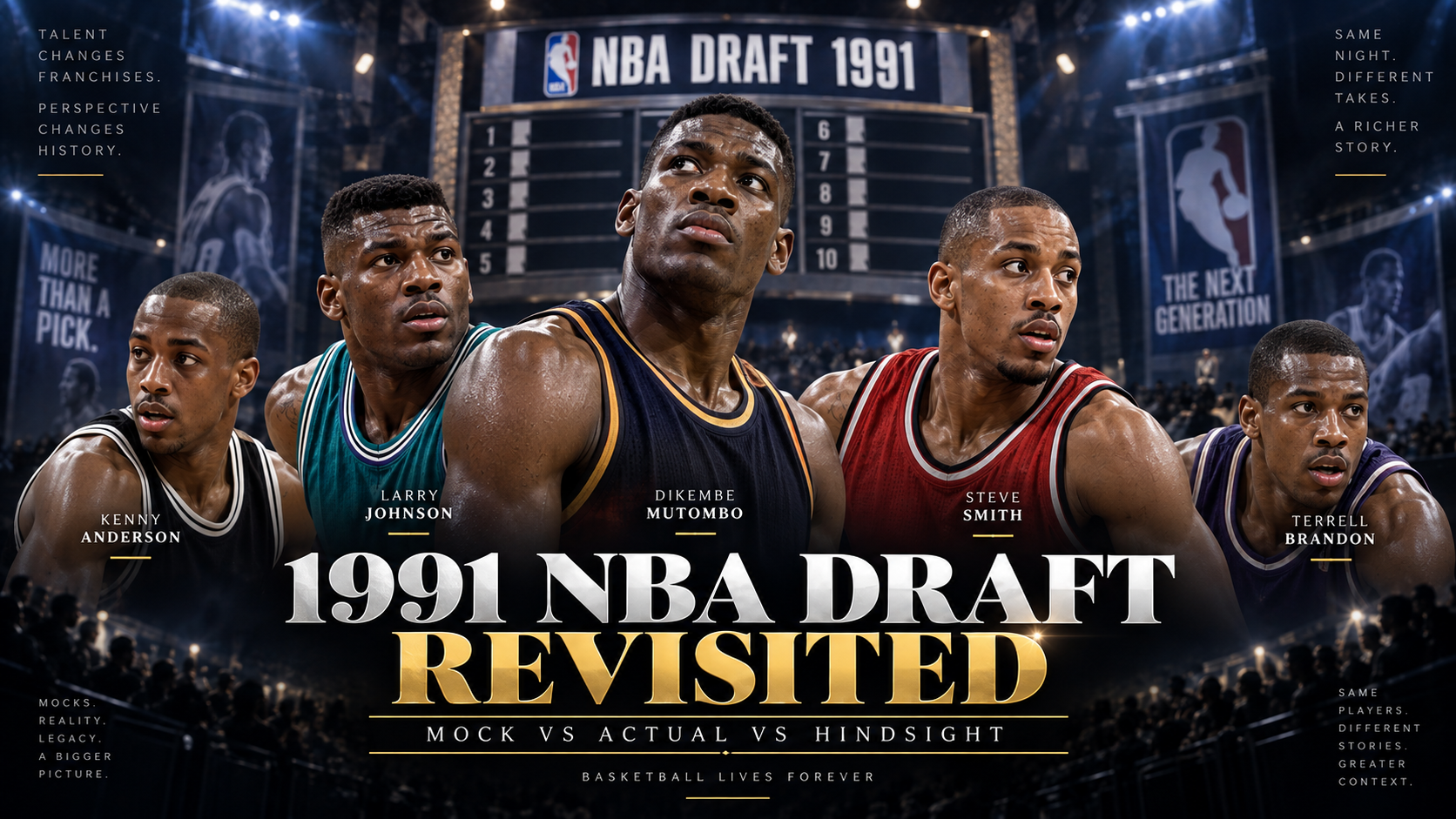
The 1991 draft, held at the Felt Forum in Madison Square Garden, was dominated by one college program. UNLV had won the 1990 national title and gone undefeated until the 1991 Final Four, and three of its players went in the first 12 picks: Larry Johnson first, Stacey Augmon ninth and Greg Anthony 12th. The mocks expected all three to go in the lottery, and they were right.
In fact, the public and the teams agreed on almost everything at the top. The mock medians matched the first pick and the fourth through tenth, while Anderson and Owens went one spot away from their medians. The disagreements came in how the careers turned out. The best player in the class was Dikembe Mutombo, a 25-year-old center from Georgetown who went fourth and became a four-time Defensive Player of the Year and a Hall of Famer.
This article compares three timelines for every first-round pick. The first is what the public mock market expected, using The Draft Review's 15-mock consensus. The second is who teams actually took. The third is who they should have taken, knowing how every career turned out. With 27 teams in the league, the 1991 first round had 27 picks.
Three-timeline overview
How to read the mock baseline: The Draft Review orders its archive by median projected pick, with average pick as a tiebreaker. Its consensus rank labels, including A/B groups, are separate from projected pick numbers. Each row below shows the actual selection's archive rank, median projected slot, earliest-to-latest projection band and number of mocks listing that player. Medians can be fractional and exclude mocks that omit the player. A missing projection is reported explicitly.
Using actual overall pick equal to median projected slot as the definition of a match, 12 of 27 first-round selections matched; 6 came earlier and 9 later. This is a slot comparison, not a claim that all mocks or a particular team agreed.
| Pick | Team | Actual player's archived mock profile | Actual pick (archive rank) | Hindsight pick |
|---|---|---|---|---|
| 1 | Hornets | Archive rank 1; median slot 1; band 1–2; 15/15 mocks | Larry Johnson (1) | Dikembe Mutombo |
| 2 | Nets | Archive rank 3; median slot 3; band 2–3; 15/15 mocks | Kenny Anderson (3) | Larry Johnson |
| 3 | Kings | Archive rank 2; median slot 2; band 1–3; 15/15 mocks | Billy Owens (2) | Steve Smith |
| 4 | Nuggets | Archive rank 4; median slot 4; band 4–8; 15/15 mocks | Dikembe Mutombo (4) | Terrell Brandon |
| 5 | Heat | Archive rank 5; median slot 5; band 5–9; 15/15 mocks | Steve Smith (5) | Kenny Anderson |
| 6 | Mavericks | Archive rank 6; median slot 6; band 5–6; 15/15 mocks | Doug Smith (6) | Dale Davis |
| 7 | Timberwolves | Archive rank 7; median slot 7; band 7–15; 15/15 mocks | Luc Longley (7) | Stacey Augmon |
| 8 | Nuggets | Archive rank 8; median slot 8; band 7–11; 15/15 mocks | Mark Macon (8) | Chris Gatling |
| 9 | Hawks | Archive rank 9-A; median slot 9; band 4–12; 15/15 mocks | Stacey Augmon (9) | Rick Fox |
| 10 | Magic | Archive rank 10; median slot 10; band 7–18; 15/15 mocks | Brian Williams (10) | Billy Owens |
| 11 | Cavaliers | Archive rank 14-A; median slot 15; band 11–23; 15/15 mocks | Terrell Brandon (14) | Greg Anthony |
| 12 | Knicks | Archive rank 9-B; median slot 9; band 8–21; 15/15 mocks | Greg Anthony (9) | Luc Longley |
| 13 | Pacers | Archive rank 16; median slot 16.5; band 13–23; 14/15 mocks | Dale Davis (16) | Brian Williams |
| 14 | SuperSonics | Archive rank 12; median slot 13; band 10–22; 15/15 mocks | Rich King (12) | Eric Murdock |
| 15 | Hawks | Archive rank 15-A; median slot 16; band 13–24; 13/15 mocks | Anthony Avent (15) | Randy Brown |
| 16 | Warriors | Archive rank 18; median slot 18; band 11–24; 14/15 mocks | Chris Gatling (18) | Pete Chilcutt |
| 17 | Warriors | Archive rank 13; median slot 14; band 14–27; 11/15 mocks | Victor Alexander (13) | Bobby Phills |
| 18 | Bucks | Archive rank 21-B; median slot 21; band 18–26; 5/15 mocks | Kevin Brooks (21) | Elliot Perry |
| 19 | Bullets | Archive rank 19; median slot 19; band 19–26; 13/15 mocks | LaBradford Smith (19) | Doug Overton |
| 20 | Rockets | Archive rank 17-B; median slot 17; band 12–27; 15/15 mocks | John Turner (17) | Stanley Roberts |
| 21 | Jazz | Archive rank 21-A; median slot 21; band 12–24; 11/15 mocks | Eric Murdock (21) | Victor Alexander |
| 22 | Clippers | Archive rank 22-B; median slot 22; band 22–25; 5/15 mocks | LeRon Ellis (22) | Mark Macon |
| 23 | Magic | Archive rank 17-A; median slot 17; band 10–27; 15/15 mocks | Stanley Roberts (17) | Anthony Avent |
| 24 | Celtics | Archive rank 22; median slot 22; band 18–27; 11/15 mocks | Rick Fox (22) | Doug Smith |
| 25 | Warriors | Archive rank 25-A; median slot 25; band 13–27; 11/15 mocks | Shaun Vandiver (25) | LaBradford Smith |
| 26 | Bulls | Archive rank 23-A; median slot 23; band 21–26; 9/15 mocks | Mark Randall (23) | Rich King |
| 27 | Kings | Archive rank 24; median slot 24.5; band 18–27; 8/15 mocks | Pete Chilcutt (24) | LeRon Ellis |
Pick-by-pick: Mock vs Actual vs Hindsight
No. 1: Charlotte Hornets — Larry Johnson
What the mock market was saying: Larry Johnson: Archive rank 1; median slot 1; band 1–2; 15/15 mocks. He was the national player of the year at UNLV, a 6-7, 250-pound power forward with guard skills and a relentless motor. Scouts questioned only his height for his position.
Why the Hornets made the pick: Charlotte, heading into its fourth season, needed a franchise player. Johnson was the most proven college player in the country and a leader on a championship team.
Actual pick versus mock median: The actual selection at No. 1 matched the median projected slot of 1. 14 of 15 listed mocks placed Larry Johnson at that exact pick. This compares overall slots, rather than inferring a team-specific prediction from the archive rank.
What hindsight changes: Johnson won Rookie of the Year and became the first Hornet to play in an All-Star Game, making two. A back injury then changed his game, though he remained a key player for the Knicks, including their 1999 Finals run. He ranks second on the hindsight board.
Mutombo is the hindsight pick. Charlotte needed a franchise player, and Mutombo became one of the best defensive players in history, winning Defensive Player of the Year four times and playing 18 seasons. In 1991, scouts saw him as a raw offensive player who would need years to develop. His defense turned out to be enough.
No. 2: New Jersey Nets — Kenny Anderson
What the mock market was saying: Kenny Anderson: Archive rank 3; median slot 3; band 2–3; 15/15 mocks. He was a sophomore point guard from Georgia Tech and one of the most famous players from New York City's high school scene.
Why the Nets made the pick: New Jersey wanted a point guard, and Anderson was a local star who would help sell tickets.
Actual pick versus mock median: The actual selection at No. 2 was 1 place earlier than the median projected slot of 3. 5 of 15 listed mocks placed Kenny Anderson at that exact pick. This compares overall slots, rather than inferring a team-specific prediction from the archive rank.
What hindsight changes: Anderson made the 1994 All-Star team and played 14 seasons, but never became the star his college career suggested. He ranks fifth. Larry Johnson is the redraft pick here.
No. 3: Sacramento Kings — Billy Owens
What the mock market was saying: Billy Owens: Archive rank 2; median slot 2; band 1–3; 15/15 mocks. He was a 6-9 junior from Syracuse who could play several positions. Some teams considered him the best all-around player in the draft.
Why the Kings made the pick: Sacramento took the most versatile player available.
Actual pick versus mock median: The actual selection at No. 3 was 1 place later than the median projected slot of 2. 5 of 15 listed mocks placed Billy Owens at that exact pick. This compares overall slots, rather than inferring a team-specific prediction from the archive rank.
What hindsight changes: Owens didn't sign with Sacramento, and the Kings traded him to Golden State for Mitch Richmond, who became a six-time All-Star in Sacramento. Owens had a good start but faded. He ranks 10th. Steve Smith is the redraft pick here.
No. 4: Denver Nuggets — Dikembe Mutombo
What the mock market was saying: Dikembe Mutombo: Archive rank 4; median slot 4; band 4–8; 15/15 mocks. He was a 7-2 center from the Congo who had come to Georgetown on an academic scholarship. He was an elite shot-blocker but limited offensively, and at 25 he was older than most prospects.
Why the Nuggets made the pick: Denver needed a center, and Mutombo was the best one in the draft.
Actual pick versus mock median: The actual selection at No. 4 matched the median projected slot of 4. 14 of 15 listed mocks placed Dikembe Mutombo at that exact pick. This compares overall slots, rather than inferring a team-specific prediction from the archive rank.
What hindsight changes: Mutombo led Denver to one of the greatest playoff upsets in history, beating top-seeded Seattle in 1994. He won four Defensive Player of the Year awards and made eight All-Star teams. He ranks first. Terrell Brandon is the redraft pick here.
No. 5: Miami Heat — Steve Smith
What the mock market was saying: Steve Smith: Archive rank 5; median slot 5; band 5–9; 15/15 mocks. He was a 6-8 senior guard from Michigan State with an all-around game.
Why the Heat made the pick: Miami wanted a big guard who could score and pass.
Actual pick versus mock median: The actual selection at No. 5 matched the median projected slot of 5. 11 of 15 listed mocks placed Steve Smith at that exact pick. This compares overall slots, rather than inferring a team-specific prediction from the archive rank.
What hindsight changes: Smith made the 1998 All-Star team, won Olympic gold in 2000 and a title with San Antonio in 2003. He ranks third. Anderson is the redraft pick here.
No. 6: Dallas Mavericks — Doug Smith
What the mock market was saying: Doug Smith: Archive rank 6; median slot 6; band 5–6; 15/15 mocks. He was a 6-10 senior forward from Missouri who could score inside and out.
Why the Mavericks made the pick: Dallas wanted a young forward to rebuild around.
Actual pick versus mock median: The actual selection at No. 6 matched the median projected slot of 6. 11 of 15 listed mocks placed Doug Smith at that exact pick. This compares overall slots, rather than inferring a team-specific prediction from the archive rank.
What hindsight changes: Smith never developed and was taken by Toronto in the 1995 expansion draft. He ranks 24th. Dale Davis is the redraft pick here.
No. 7: Minnesota Timberwolves — Luc Longley
What the mock market was saying: Luc Longley: Archive rank 7; median slot 7; band 7–15; 15/15 mocks. He was a 7-2 Australian center from New Mexico, skilled and a good passer, though some scouts questioned his intensity.
Why the Timberwolves made the pick: Minnesota needed a center.
Actual pick versus mock median: The actual selection at No. 7 matched the median projected slot of 7. 10 of 15 listed mocks placed Luc Longley at that exact pick. This compares overall slots, rather than inferring a team-specific prediction from the archive rank.
What hindsight changes: Longley became the first Australian to play in the NBA and won three titles as Chicago's starting center. He ranks 12th. Stacey Augmon is the redraft pick here.
No. 8: Denver Nuggets — Mark Macon
What the mock market was saying: Mark Macon: Archive rank 8; median slot 8; band 7–11; 15/15 mocks. He was a senior guard from Temple.
Why the Nuggets made the pick: With its second pick, Denver wanted a guard to play with Mutombo.
Actual pick versus mock median: The actual selection at No. 8 matched the median projected slot of 8. 9 of 15 listed mocks placed Mark Macon at that exact pick. This compares overall slots, rather than inferring a team-specific prediction from the archive rank.
What hindsight changes: Macon played several seasons as a backup. He ranks 22nd. Chris Gatling is the redraft pick here.
No. 9: Atlanta Hawks — Stacey Augmon
What the mock market was saying: Stacey Augmon: Archive rank 9-A; median slot 9; band 4–12; 15/15 mocks. He was a 6-8 defensive specialist known as "Plastic Man."
Why the Hawks made the pick: Atlanta wanted a wing defender to play with Dominique Wilkins.
Actual pick versus mock median: The actual selection at No. 9 matched the median projected slot of 9. 2 of 15 listed mocks placed Stacey Augmon at that exact pick. This compares overall slots, rather than inferring a team-specific prediction from the archive rank.
What hindsight changes: Augmon played 15 seasons as a defensive wing. He ranks seventh. Rick Fox is the redraft pick here.
No. 10: Orlando Magic — Brian Williams
What the mock market was saying: Brian Williams: Archive rank 10; median slot 10; band 7–18; 15/15 mocks. He was a 6-11 junior from Arizona, athletic but inconsistent.
Why the Magic made the pick: Orlando wanted a big man.
Actual pick versus mock median: The actual selection at No. 10 matched the median projected slot of 10. 8 of 15 listed mocks placed Brian Williams at that exact pick. This compares overall slots, rather than inferring a team-specific prediction from the archive rank.
What hindsight changes: Williams, who later changed his name to Bison Dele, won a title with Chicago in 1997. He ranks 13th. Owens is the redraft pick here.
No. 11: Cleveland Cavaliers — Terrell Brandon
What the mock market was saying: Terrell Brandon: Archive rank 14-A; median slot 15; band 11–23; 15/15 mocks. He was a junior point guard from Oregon. At 5-11, his size concerned scouts.
Why the Cavaliers made the pick: Cleveland valued Brandon's scoring and ball-handling. Brandon had said publicly that he wanted to play for the Cavaliers and coach Lenny Wilkens.
Actual pick versus mock median: The actual selection at No. 11 was 4 places earlier than the median projected slot of 15. 3 of 15 listed mocks placed Terrell Brandon at that exact pick. This compares overall slots, rather than inferring a team-specific prediction from the archive rank.
What hindsight changes: Brandon made two All-Star teams. He ranks fourth. Greg Anthony is the redraft pick here.
No. 12: New York Knicks — Greg Anthony
What the mock market was saying: Greg Anthony: Archive rank 9-B; median slot 9; band 8–21; 15/15 mocks. He was a senior point guard from UNLV.
Why the Knicks made the pick: Pat Riley's Knicks wanted a tough defensive guard, and Anthony wanted to play in New York.
Actual pick versus mock median: The actual selection at No. 12 was 3 places later than the median projected slot of 9. 0 of 15 listed mocks placed Greg Anthony at that exact pick. This compares overall slots, rather than inferring a team-specific prediction from the archive rank.
What hindsight changes: Anthony played 11 seasons as a backup and later became a television analyst. He ranks 11th. Longley is the redraft pick here.
No. 13: Indiana Pacers — Dale Davis
What the mock market was saying: Dale Davis: Archive rank 16; median slot 16.5; band 13–23; 14/15 mocks. He was a 6-11 senior from Clemson, a strong rebounder and defender.
Why the Pacers made the pick: Indiana needed toughness in the front court.
Actual pick versus mock median: The actual selection at No. 13 was 3.5 places earlier than the median projected slot of 16.5. 2 of 14 listed mocks placed Dale Davis at that exact pick. This compares overall slots, rather than inferring a team-specific prediction from the archive rank.
What hindsight changes: Davis played 16 seasons as a rebounder and defender and made the 2000 All-Star team. He ranks sixth. Brian Williams is the redraft pick here.
No. 14: Seattle SuperSonics — Rich King
What the mock market was saying: Rich King: Archive rank 12; median slot 13; band 10–22; 15/15 mocks. He was a 7-2 senior from Nebraska who had played well in a pre-draft camp. Some expected Orlando to take him at No. 10.
Why the SuperSonics made the pick: Seattle wanted size.
Actual pick versus mock median: The actual selection at No. 14 was 1 place later than the median projected slot of 13. 2 of 15 listed mocks placed Rich King at that exact pick. This compares overall slots, rather than inferring a team-specific prediction from the archive rank.
What hindsight changes: King played only a few NBA seasons and ranks 26th. Eric Murdock is the redraft pick here.
No. 15: Atlanta Hawks — Anthony Avent
What the mock market was saying: Anthony Avent: Archive rank 15-A; median slot 16; band 13–24; 13/15 mocks. He was a power forward from Seton Hall.
Why the Hawks made the pick: Atlanta drafted Avent and traded him to Denver, which sent him to Milwaukee.
Actual pick versus mock median: The actual selection at No. 15 was 1 place earlier than the median projected slot of 16. 0 of 13 listed mocks placed Anthony Avent at that exact pick. This compares overall slots, rather than inferring a team-specific prediction from the archive rank.
What hindsight changes: Avent had a journeyman career and ranks 23rd. Randy Brown, a second-round pick who won three titles with Chicago, is the redraft pick here.
No. 16: Golden State Warriors — Chris Gatling
What the mock market was saying: Chris Gatling: Archive rank 18; median slot 18; band 11–24; 14/15 mocks. He was a power forward from Old Dominion.
Why the Warriors made the pick: Don Nelson's Warriors wanted athletic big men.
Actual pick versus mock median: The actual selection at No. 16 was 2 places earlier than the median projected slot of 18. 1 of 14 listed mocks placed Chris Gatling at that exact pick. This compares overall slots, rather than inferring a team-specific prediction from the archive rank.
What hindsight changes: Gatling made the 1997 All-Star team. He ranks eighth. Pete Chilcutt is the redraft pick here.
No. 17: Golden State Warriors — Victor Alexander
What the mock market was saying: Victor Alexander: Archive rank 13; median slot 14; band 14–27; 11/15 mocks. He was a strong center from Iowa State.
Why the Warriors made the pick: Golden State used its second pick on another big man.
Actual pick versus mock median: The actual selection at No. 17 was 3 places later than the median projected slot of 14. 1 of 11 listed mocks placed Victor Alexander at that exact pick. This compares overall slots, rather than inferring a team-specific prediction from the archive rank.
What hindsight changes: Alexander played a few NBA seasons and ranks 21st. Bobby Phills, a second-round wing who became a starter in Cleveland and Charlotte, is the redraft pick here.
No. 18: Milwaukee Bucks — Kevin Brooks
What the mock market was saying: Kevin Brooks: Archive rank 21-B; median slot 21; band 18–26; 5/15 mocks. He was a forward from Southwestern Louisiana.
Why the Bucks made the pick: Milwaukee drafted Brooks and traded him to Denver for Avent.
Actual pick versus mock median: The actual selection at No. 18 was 3 places earlier than the median projected slot of 21. 1 of 5 listed mocks placed Kevin Brooks at that exact pick. This compares overall slots, rather than inferring a team-specific prediction from the archive rank.
What hindsight changes: Brooks played only a few NBA seasons. He falls outside the hindsight board's top 27. Elliot Perry is the redraft pick here.
No. 19: Washington Bullets — LaBradford Smith
What the mock market was saying: LaBradford Smith: Archive rank 19; median slot 19; band 19–26; 13/15 mocks. He was a guard from Louisville.
Why the Bullets made the pick: Washington needed guard help.
Actual pick versus mock median: The actual selection at No. 19 matched the median projected slot of 19. 9 of 13 listed mocks placed LaBradford Smith at that exact pick. This compares overall slots, rather than inferring a team-specific prediction from the archive rank.
What hindsight changes: Smith played a few NBA seasons and ranks 25th. Doug Overton is the redraft pick here.
No. 20: Houston Rockets — John Turner
What the mock market was saying: John Turner: Archive rank 17-B; median slot 17; band 12–27; 15/15 mocks. He was a forward from Phillips University.
Why the Rockets made the pick: Houston wanted front-court depth.
Actual pick versus mock median: The actual selection at No. 20 was 3 places later than the median projected slot of 17. 1 of 15 listed mocks placed John Turner at that exact pick. This compares overall slots, rather than inferring a team-specific prediction from the archive rank.
What hindsight changes: Turner played only a few NBA seasons. He falls outside the hindsight board's top 27. Stanley Roberts is the redraft pick here.
No. 21: Utah Jazz — Eric Murdock
What the mock market was saying: Eric Murdock: Archive rank 21-A; median slot 21; band 12–24; 11/15 mocks. He was a quick guard from Providence and one of the best defensive guards in college.
Why the Jazz made the pick: Utah wanted a backup to John Stockton.
Actual pick versus mock median: The actual selection at No. 21 matched the median projected slot of 21. 4 of 11 listed mocks placed Eric Murdock at that exact pick. This compares overall slots, rather than inferring a team-specific prediction from the archive rank.
What hindsight changes: Murdock became a starting point guard for Milwaukee. He ranks 14th. Victor Alexander is the redraft pick here.
No. 22: Los Angeles Clippers — LeRon Ellis
What the mock market was saying: LeRon Ellis: Archive rank 22-B; median slot 22; band 22–25; 5/15 mocks. He was a center from Syracuse.
Why the Clippers made the pick: The Clippers wanted size.
Actual pick versus mock median: The actual selection at No. 22 matched the median projected slot of 22. 4 of 5 listed mocks placed LeRon Ellis at that exact pick. This compares overall slots, rather than inferring a team-specific prediction from the archive rank.
What hindsight changes: Ellis played only a few NBA seasons and ranks 27th. Mark Macon is the redraft pick here.
No. 23: Orlando Magic — Stanley Roberts
What the mock market was saying: Stanley Roberts: Archive rank 17-A; median slot 17; band 10–27; 15/15 mocks. He was a seven-foot center who had played at LSU with Shaquille O'Neal, then spent a season with Real Madrid in Spain.
Why the Magic made the pick: Orlando got a talented center at No. 23.
Actual pick versus mock median: The actual selection at No. 23 was 6 places later than the median projected slot of 17. 2 of 15 listed mocks placed Stanley Roberts at that exact pick. This compares overall slots, rather than inferring a team-specific prediction from the archive rank.
What hindsight changes: Roberts was traded to the Clippers a year later, after Orlando drafted O'Neal. He ranks 20th. Avent is the redraft pick here.
No. 24: Boston Celtics — Rick Fox
What the mock market was saying: Rick Fox: Archive rank 22; median slot 22; band 18–27; 11/15 mocks. He was a senior forward from North Carolina.
Why the Celtics made the pick: Boston wanted a versatile wing.
Actual pick versus mock median: The actual selection at No. 24 was 2 places later than the median projected slot of 22. 1 of 11 listed mocks placed Rick Fox at that exact pick. This compares overall slots, rather than inferring a team-specific prediction from the archive rank.
What hindsight changes: Fox won three titles with the Lakers and played 13 seasons. He ranks ninth. Doug Smith is the redraft pick here.
No. 25: Golden State Warriors — Shaun Vandiver
What the mock market was saying: Shaun Vandiver: Archive rank 25-A; median slot 25; band 13–27; 11/15 mocks. He was a forward from Colorado.
Why the Warriors made the pick: Golden State used its third pick on another big man.
Actual pick versus mock median: The actual selection at No. 25 matched the median projected slot of 25. 2 of 11 listed mocks placed Shaun Vandiver at that exact pick. This compares overall slots, rather than inferring a team-specific prediction from the archive rank.
What hindsight changes: Vandiver never played in the NBA. He falls outside the hindsight board's top 27. LaBradford Smith is the redraft pick here.
No. 26: Chicago Bulls — Mark Randall
What the mock market was saying: Mark Randall: Archive rank 23-A; median slot 23; band 21–26; 9/15 mocks. He was a forward from Kansas.
Why the Bulls made the pick: Chicago had just won its first title and needed only a bench player.
Actual pick versus mock median: The actual selection at No. 26 was 3 places later than the median projected slot of 23. 1 of 9 listed mocks placed Mark Randall at that exact pick. This compares overall slots, rather than inferring a team-specific prediction from the archive rank.
What hindsight changes: Randall played only a few NBA seasons. He falls outside the hindsight board's top 27. Rich King is the redraft pick here.
No. 27: Sacramento Kings — Pete Chilcutt
What the mock market was saying: Pete Chilcutt: Archive rank 24; median slot 24.5; band 18–27; 8/15 mocks. He was a forward from North Carolina.
Why the Kings made the pick: Sacramento, using a pick acquired from Portland in the Danny Ainge trade, took a forward who could shoot.
Actual pick versus mock median: The actual selection at No. 27 was 2.5 places later than the median projected slot of 24.5. 1 of 8 listed mocks placed Pete Chilcutt at that exact pick. This compares overall slots, rather than inferring a team-specific prediction from the archive rank.
What hindsight changes: Chilcutt played 10 seasons as a stretch forward. He ranks 16th. LeRon Ellis is the redraft pick here.
Why the three timelines split
The mocks and the teams agreed almost completely. The median projected slots matched the first pick and the fourth through tenth, along with several later selections.
The age question. Mutombo was 25 at the draft, older than most prospects. He was also the best player in the class.
The best value came in the second round. Randy Brown, Bobby Phills, Elliot Perry and Doug Overton all became better players than several first-rounders.
What the mock market got right
The median projected slots matched the first pick and picks four through ten. The overview also shows the differences at the other first-round slots.
Where teams beat the mocks
Cleveland took Brandon four places earlier than his median projected slot of 15, and Indiana took Dale Davis 3.5 places earlier than his median of 16.5. Both became All-Stars.
Hindsight top five
- Dikembe Mutombo
- Larry Johnson
- Steve Smith
- Terrell Brandon
- Kenny Anderson
FAQ
Who should go No. 1 in a 1991 NBA redraft?
Dikembe Mutombo. He was a four-time Defensive Player of the Year and a Hall of Famer.
What did mock drafts predict in the 1991 NBA Draft?
The Draft Review's archive separates rank labels from median projected slots. Using actual overall pick equal to median projected slot as the definition of a match, 12 of 27 first-round selections matched; 6 came earlier and 9 later. This is a slot comparison, not a claim that all mocks or a particular team agreed.
Who was the biggest draft-night slide in 1991?
Among first-round selections with an archived projection, the largest difference below the mock median was 6 places: Stanley Roberts (median slot 17, actual No. 23, archive rank 17-A; 15 mocks). This uses median projected slot, not the archive rank number.
What is the biggest lesson from the 1991 NBA Draft?
The mocks can agree with the teams and still miss the best player. Mutombo went where he was expected, but he was worth the first pick.
Full hindsight board
| Hindsight rank | Player |
|---|---|
| 1 | Dikembe Mutombo |
| 2 | Larry Johnson |
| 3 | Steve Smith |
| 4 | Terrell Brandon |
| 5 | Kenny Anderson |
| 6 | Dale Davis |
| 7 | Stacey Augmon |
| 8 | Chris Gatling |
| 9 | Rick Fox |
| 10 | Billy Owens |
| 11 | Greg Anthony |
| 12 | Luc Longley |
| 13 | Brian Williams |
| 14 | Eric Murdock |
| 15 | Randy Brown |
| 16 | Pete Chilcutt |
| 17 | Bobby Phills |
| 18 | Elliot Perry |
| 19 | Doug Overton |
| 20 | Stanley Roberts |
| 21 | Victor Alexander |
| 22 | Mark Macon |
| 23 | Anthony Avent |
| 24 | Doug Smith |
| 25 | LaBradford Smith |
| 26 | Rich King |
| 27 | LeRon Ellis |
Sources and methodology
- Historical mock baseline: The Draft Review's 1991 consensus mock draft, built from 15 mock drafts. https://www.thedraftreview.com/consensus-mock-draft-archive/1991-nba-draft-consensus-mock-draft
- Actual first-round order and transaction context: historical NBA draft records.
- Hindsight rankings are Ultimate Big Board editorial judgments built around peak value, longevity, two-way impact, postseason utility, role portability, and overall career production.
- Alternate-history notes are interpretive and do not assume every downstream roster move remains unchanged.