
1992 NBA Draft Revisited: Mock vs Actual vs Hindsight
Compare the historical 1992 NBA mock market, the actual first round and a full-career hindsight redraft for every pick.
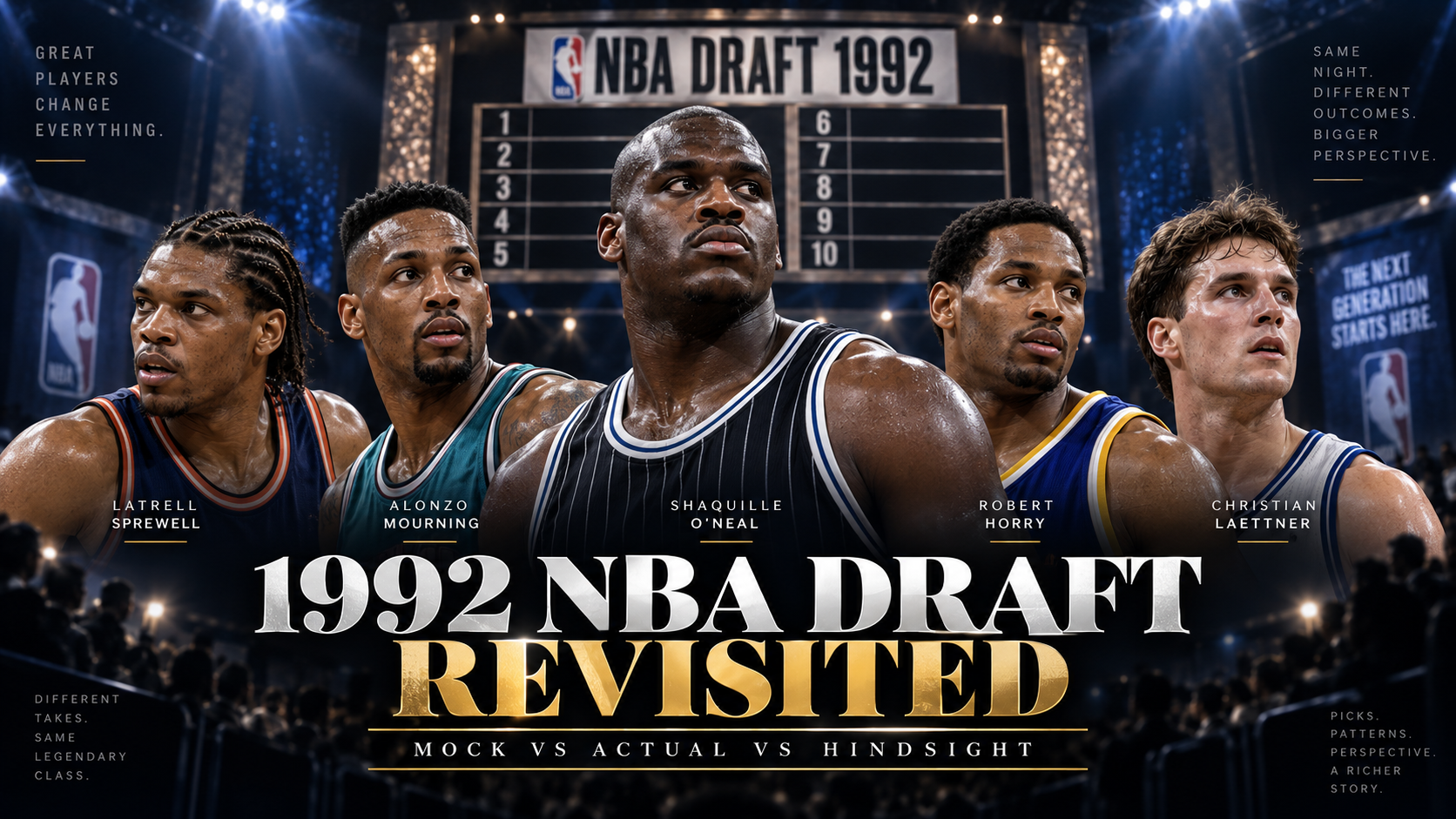
The 1992 draft was held in Portland a month before the Dream Team played in Barcelona, and its top three picks were seen as can't-miss prospects. Shaquille O'Neal, Alonzo Mourning and Christian Laettner went first, second and third, matching their median projected slots in The Draft Review's archive. All 15 mocks had O'Neal first and Mourning second; 14 had Laettner third. O'Neal and Mourning became Hall of Famers. Laettner, the only college player on the Dream Team, made one All-Star team.
The more interesting story is further down. The public and the teams both badly underrated two players who became stars in very different ways. Robert Horry, taken 11th, won seven championships. Latrell Sprewell, taken 24th after appearing in just two mocks, made four All-Star teams and the All-NBA First Team. P.J. Brown, a second-round pick who started his career in Greece, lasted 15 seasons.
This article compares three timelines for every first-round pick. The first is what the public mock market expected, using The Draft Review's 15-mock consensus. The second is who teams actually took. The third is who they should have taken, knowing how every career turned out. With 27 teams in the league, the 1992 first round had 27 picks.
Three-timeline overview
How to read the mock baseline: The Draft Review orders its archive by median projected pick, with average pick as a tiebreaker. Its consensus rank labels, including A/B groups, are separate from projected pick numbers. Each row below shows the actual selection's archive rank, median projected slot, earliest-to-latest projection band and number of mocks listing that player. Medians can be fractional and exclude mocks that omit the player. A missing projection is reported explicitly.
Using actual overall pick equal to median projected slot as the definition of a match, 11 of 27 first-round selections matched; 7 came earlier and 9 later. This is a slot comparison, not a claim that all mocks or a particular team agreed.
| Pick | Team | Actual player's archived mock profile | Actual pick (archive rank) | Hindsight pick |
|---|---|---|---|---|
| 1 | Magic | Archive rank 1; median slot 1; band 1; 15/15 mocks | Shaquille O'Neal (1) | Shaquille O'Neal |
| 2 | Hornets | Archive rank 2; median slot 2; band 2; 15/15 mocks | Alonzo Mourning (2) | Alonzo Mourning |
| 3 | Timberwolves | Archive rank 3; median slot 3; band 3–5; 15/15 mocks | Christian Laettner (3) | Latrell Sprewell |
| 4 | Mavericks | Archive rank 4; median slot 4; band 3–5; 15/15 mocks | Jimmy Jackson (4) | Robert Horry |
| 5 | Nuggets | Archive rank 5; median slot 5; band 5–13; 15/15 mocks | LaPhonso Ellis (5) | Tom Gugliotta |
| 6 | Bullets | Archive rank 6; median slot 6; band 6–14; 15/15 mocks | Tom Gugliotta (6) | Christian Laettner |
| 7 | Kings | Archive rank 8; median slot 8; band 7–10; 15/15 mocks | Walt Williams (8) | Jimmy Jackson |
| 8 | Bucks | Archive rank 11; median slot 11; band 8–13; 15/15 mocks | Todd Day (11) | Doug Christie |
| 9 | 76ers | Archive rank 9; median slot 9; band 9–12; 14/15 mocks | Clarence Weatherspoon (9) | P.J. Brown |
| 10 | Hawks | Archive rank 7; median slot 7; band 5–12; 15/15 mocks | Adam Keefe (7) | Clarence Weatherspoon |
| 11 | Rockets | Archive rank 13; median slot 13; band 11–23; 15/15 mocks | Robert Horry (13) | LaPhonso Ellis |
| 12 | Heat | Archive rank 10; median slot 10; band 4–13; 15/15 mocks | Harold Miner (10) | Walt Williams |
| 13 | Nuggets | Archive rank 12; median slot 12; band 10–27; 15/15 mocks | Bryant Stith (12) | Hubert Davis |
| 14 | Pacers | Archive rank 14; median slot 14; band 9–21; 15/15 mocks | Malik Sealy (14) | Malik Sealy |
| 15 | Lakers | Archive rank 15; median slot 15.5; band 15–25; 12/15 mocks | Anthony Peeler (15) | Don MacLean |
| 16 | Clippers | Archive rank 25-A; median slot 25; band 23–27; 7/15 mocks | Randy Woods (25) | Anthony Peeler |
| 17 | SuperSonics | Archive rank 16; median slot 16; band 13–18; 15/15 mocks | Doug Christie (16) | Tracy Murray |
| 18 | Spurs | Archive rank 17-A; median slot 17; band 8–23; 15/15 mocks | Tracy Murray (17) | Bryant Stith |
| 19 | Pistons | Archive rank 19-A; median slot 19; band 10–24; 14/15 mocks | Don MacLean (19) | Jon Barry |
| 20 | Knicks | Archive rank 20; median slot 20; band 15–27; 15/15 mocks | Hubert Davis (20) | Matt Geiger |
| 21 | Celtics | Archive rank 26-A; median slot 26; band 18–27; 11/15 mocks | Jon Barry (26) | Popeye Jones |
| 22 | Suns | Archive rank 22-A; median slot 22; band 22; 2/15 mocks | Oliver Miller (22) | Todd Day |
| 23 | Bucks | Archive rank 18; median slot 18; band 15–25; 13/15 mocks | Lee Mayberry (18) | Adam Keefe |
| 24 | Warriors | Archive rank 26-B; median slot 26; band 26; 2/15 mocks | Latrell Sprewell (26) | Oliver Miller |
| 25 | Clippers | Archive rank 23-A; median slot 23; band 16–25; 15/15 mocks | Elmore Spencer (23) | Brent Price |
| 26 | Trail Blazers | Archive rank 23-B; median slot 23; band 18–27; 10/15 mocks | Dave Johnson (23) | Harold Miner |
| 27 | Bulls | Archive rank 24-A; median slot 23.5; band 14–27; 10/15 mocks | Byron Houston (24) | Lee Mayberry |
Pick-by-pick: Mock vs Actual vs Hindsight
No. 1: Orlando Magic — Shaquille O'Neal
What the mock market was saying: Shaquille O'Neal: Archive rank 1; median slot 1; band 1; 15/15 mocks. He was a 7-1, 300-pound junior from LSU, with a combination of size, strength and athleticism the league had rarely seen.
Why the Magic made the pick: Orlando had joined the league in 1989 and won the lottery in its third season. O'Neal was the most obvious No. 1 pick in years.
Actual pick versus mock median: The actual selection at No. 1 matched the median projected slot of 1. 15 of 15 listed mocks placed Shaquille O'Neal at that exact pick. This compares overall slots, rather than inferring a team-specific prediction from the archive rank.
What hindsight changes: Nothing. O'Neal won Rookie of the Year, led Orlando to the 1995 Finals, and later won four titles, three Finals MVPs and the 2000 MVP. He ranks first on the hindsight board.
No. 2: Charlotte Hornets — Alonzo Mourning
What the mock market was saying: Alonzo Mourning: Archive rank 2; median slot 2; band 2; 15/15 mocks. He was a 6-10 senior center from Georgetown, a fierce shot-blocker and rebounder.
Why the Hornets made the pick: Charlotte had drafted Larry Johnson first overall the year before and wanted a center to pair with him.
Actual pick versus mock median: The actual selection at No. 2 matched the median projected slot of 2. 15 of 15 listed mocks placed Alonzo Mourning at that exact pick. This compares overall slots, rather than inferring a team-specific prediction from the archive rank.
What hindsight changes: Mourning was traded to Miami in 1995, where he won Defensive Player of the Year twice. After a serious kidney condition interrupted his career, he returned and won a title with Miami in 2006. He ranks second, and the sequential redraft keeps him here.
No. 3: Minnesota Timberwolves — Christian Laettner
What the mock market was saying: Christian Laettner: Archive rank 3; median slot 3; band 3–5; 15/15 mocks. He had won two national titles at Duke, hit one of the most famous shots in college history against Kentucky, and was the only college player on the Dream Team.
Why the Timberwolves made the pick: Minnesota, heading into its fourth season, wanted a polished big man who could help right away.
Actual pick versus mock median: The actual selection at No. 3 matched the median projected slot of 3. 14 of 15 listed mocks placed Christian Laettner at that exact pick. This compares overall slots, rather than inferring a team-specific prediction from the archive rank.
What hindsight changes: Laettner was a solid player for 13 seasons and made the 1997 All-Star team with Atlanta, but he never became the star his college career suggested. He ranks sixth.
Latrell Sprewell is the hindsight pick. He was a senior from Alabama who had started his college career at a junior college, and only two mocks projected him in the first round. He became a four-time All-Star and made the All-NBA First Team in 1994.
No. 4: Dallas Mavericks — Jimmy Jackson
What the mock market was saying: Jimmy Jackson: Archive rank 4; median slot 4; band 3–5; 15/15 mocks. He was a junior from Ohio State and the Big Ten Player of the Year, a strong, versatile scorer.
Why the Mavericks made the pick: Dallas had one of the worst records in the league and needed a scorer to build around.
Actual pick versus mock median: The actual selection at No. 4 matched the median projected slot of 4. 13 of 15 listed mocks placed Jimmy Jackson at that exact pick. This compares overall slots, rather than inferring a team-specific prediction from the archive rank.
What hindsight changes: Jackson held out until March of his rookie season, then became a 25-points-a-game scorer before becoming a journeyman who played for 12 teams. He ranks seventh. Robert Horry is the redraft pick here.
No. 5: Denver Nuggets — LaPhonso Ellis
What the mock market was saying: LaPhonso Ellis: Archive rank 5; median slot 5; band 5–13; 15/15 mocks. He was an athletic senior forward from Notre Dame.
Why the Nuggets made the pick: Denver wanted a young power forward.
Actual pick versus mock median: The actual selection at No. 5 matched the median projected slot of 5. 8 of 15 listed mocks placed LaPhonso Ellis at that exact pick. This compares overall slots, rather than inferring a team-specific prediction from the archive rank.
What hindsight changes: Ellis helped Denver to its famous 1994 playoff upset of top-seeded Seattle, but knee injuries limited his career. He ranks 11th. Tom Gugliotta is the redraft pick here.
No. 6: Washington Bullets — Tom Gugliotta
What the mock market was saying: Tom Gugliotta: Archive rank 6; median slot 6; band 6–14; 15/15 mocks. He was a 6-10 senior from North Carolina State who could shoot and pass.
Why the Bullets made the pick: Washington wanted a versatile forward.
Actual pick versus mock median: The actual selection at No. 6 matched the median projected slot of 6. 13 of 15 listed mocks placed Tom Gugliotta at that exact pick. This compares overall slots, rather than inferring a team-specific prediction from the archive rank.
What hindsight changes: Washington traded Gugliotta to Golden State in 1994 in the deal for Chris Webber. He later made the 1997 All-Star team with Minnesota. He ranks fifth. Laettner is the redraft pick here.
No. 7: Sacramento Kings — Walt Williams
What the mock market was saying: Walt Williams: Archive rank 8; median slot 8; band 7–10; 15/15 mocks. He was a 6-8 senior guard from Maryland.
Why the Kings made the pick: Sacramento wanted a big, versatile guard.
Actual pick versus mock median: The actual selection at No. 7 was 1 place earlier than the median projected slot of 8. 3 of 15 listed mocks placed Walt Williams at that exact pick. This compares overall slots, rather than inferring a team-specific prediction from the archive rank.
What hindsight changes: Williams had a long career as a scorer off the bench. He ranks 12th. Jimmy Jackson is the redraft pick here.
No. 8: Milwaukee Bucks — Todd Day
What the mock market was saying: Todd Day: Archive rank 11; median slot 11; band 8–13; 15/15 mocks. He was a senior scorer from Arkansas.
Why the Bucks made the pick: Milwaukee wanted a scorer, and later in the round took Day's Arkansas teammate Lee Mayberry. A third Razorback, Oliver Miller, went 22nd.
Actual pick versus mock median: The actual selection at No. 8 was 3 places earlier than the median projected slot of 11. 1 of 15 listed mocks placed Todd Day at that exact pick. This compares overall slots, rather than inferring a team-specific prediction from the archive rank.
What hindsight changes: Day scored well for a few seasons but faded quickly. He ranks 22nd. Doug Christie is the redraft pick here.
No. 9: Philadelphia 76ers — Clarence Weatherspoon
What the mock market was saying: Clarence Weatherspoon: Archive rank 9; median slot 9; band 9–12; 14/15 mocks. He was a powerful, undersized forward from Southern Mississippi, nicknamed "Baby Barkley."
Why the 76ers made the pick: Philadelphia had just traded Charles Barkley to Phoenix and wanted a similar player.
Actual pick versus mock median: The actual selection at No. 9 matched the median projected slot of 9. 12 of 14 listed mocks placed Clarence Weatherspoon at that exact pick. This compares overall slots, rather than inferring a team-specific prediction from the archive rank.
What hindsight changes: Weatherspoon had a solid 14-season career as a tough rebounder. He ranks 10th. P.J. Brown is the redraft pick here.
No. 10: Atlanta Hawks — Adam Keefe
What the mock market was saying: Adam Keefe: Archive rank 7; median slot 7; band 5–12; 15/15 mocks. He was a senior forward from Stanford.
Why the Hawks made the pick: Atlanta wanted a physical forward.
Actual pick versus mock median: The actual selection at No. 10 was 3 places later than the median projected slot of 7. 0 of 15 listed mocks placed Adam Keefe at that exact pick. This compares overall slots, rather than inferring a team-specific prediction from the archive rank.
What hindsight changes: Keefe was a backup on Utah's Finals teams. He ranks 23rd. Weatherspoon is the redraft pick here.
No. 11: Houston Rockets — Robert Horry
What the mock market was saying: Robert Horry: Archive rank 13; median slot 13; band 11–23; 15/15 mocks. He was a 6-10 senior forward from Alabama who could shoot and defend.
Why the Rockets made the pick: Houston wanted a versatile forward to play with Hakeem Olajuwon.
Actual pick versus mock median: The actual selection at No. 11 was 2 places earlier than the median projected slot of 13. 1 of 15 listed mocks placed Robert Horry at that exact pick. This compares overall slots, rather than inferring a team-specific prediction from the archive rank.
What hindsight changes: Horry won seven championships with three teams and hit so many big playoff shots that he became known as "Big Shot Rob." He ranks fourth. Ellis is the redraft pick here.
No. 12: Miami Heat — Harold Miner
What the mock market was saying: Harold Miner: Archive rank 10; median slot 10; band 4–13; 15/15 mocks. He was an explosive scorer from USC known as "Baby Jordan."
Why the Heat made the pick: Miami wanted a scorer with star potential.
Actual pick versus mock median: The actual selection at No. 12 was 2 places later than the median projected slot of 10. 1 of 15 listed mocks placed Harold Miner at that exact pick. This compares overall slots, rather than inferring a team-specific prediction from the archive rank.
What hindsight changes: Miner won two dunk contests but played only four NBA seasons. He ranks 26th. Walt Williams is the redraft pick here.
No. 13: Denver Nuggets — Bryant Stith
What the mock market was saying: Bryant Stith: Archive rank 12; median slot 12; band 10–27; 15/15 mocks. He was a senior guard from Virginia.
Why the Nuggets made the pick: Denver, using a pick acquired from New Jersey, wanted a guard to go with Ellis.
Actual pick versus mock median: The actual selection at No. 13 was 1 place later than the median projected slot of 12. 0 of 15 listed mocks placed Bryant Stith at that exact pick. This compares overall slots, rather than inferring a team-specific prediction from the archive rank.
What hindsight changes: Stith played 10 seasons as a solid guard. He ranks 18th. Hubert Davis is the redraft pick here.
No. 14: Indiana Pacers — Malik Sealy
What the mock market was saying: Malik Sealy: Archive rank 14; median slot 14; band 9–21; 15/15 mocks. He was a 6-8 wing from St. John's.
Why the Pacers made the pick: Indiana wanted a wing who could score.
Actual pick versus mock median: The actual selection at No. 14 matched the median projected slot of 14. 7 of 15 listed mocks placed Malik Sealy at that exact pick. This compares overall slots, rather than inferring a team-specific prediction from the archive rank.
What hindsight changes: Sealy was traded to the Clippers in 1994 and was a productive player for Minnesota when he was killed in a car accident in 2000. He ranks 14th, and the sequential redraft keeps him here.
No. 15: Los Angeles Lakers — Anthony Peeler
What the mock market was saying: Anthony Peeler: Archive rank 15; median slot 15.5; band 15–25; 12/15 mocks. He was a senior guard from Missouri.
Why the Lakers made the pick: The Lakers wanted a young guard as they rebuilt after Magic Johnson's retirement.
Actual pick versus mock median: The actual selection at No. 15 was 0.5 places earlier than the median projected slot of 15.5. 6 of 12 listed mocks placed Anthony Peeler at that exact pick. This compares overall slots, rather than inferring a team-specific prediction from the archive rank.
What hindsight changes: Peeler played 13 seasons as a reliable shooter. He ranks 16th. Don MacLean is the redraft pick here.
No. 16: Los Angeles Clippers — Randy Woods
What the mock market was saying: Randy Woods: Archive rank 25-A; median slot 25; band 23–27; 7/15 mocks. He was a quick point guard from La Salle.
Why the Clippers made the pick: The Clippers wanted a point guard.
Actual pick versus mock median: The actual selection at No. 16 was 9 places earlier than the median projected slot of 25. 0 of 7 listed mocks placed Randy Woods at that exact pick. This compares overall slots, rather than inferring a team-specific prediction from the archive rank.
What hindsight changes: Woods played only a few NBA seasons and was part of the 1995 trade that sent Antonio McDyess to Denver. He falls outside the hindsight board's top 27. Anthony Peeler is the redraft pick here.
No. 17: Seattle SuperSonics — Doug Christie
What the mock market was saying: Doug Christie: Archive rank 16; median slot 16; band 13–18; 15/15 mocks. He was a long, athletic guard from Pepperdine.
Why the SuperSonics made the pick: Seattle wanted an athletic defender.
Actual pick versus mock median: The actual selection at No. 17 was 1 place later than the median projected slot of 16. 2 of 15 listed mocks placed Doug Christie at that exact pick. This compares overall slots, rather than inferring a team-specific prediction from the archive rank.
What hindsight changes: Christie held out and was traded to the Lakers during his rookie season. He later became one of the league's best perimeter defenders in Sacramento. He ranks eighth. Tracy Murray is the redraft pick here.
No. 18: San Antonio Spurs — Tracy Murray
What the mock market was saying: Tracy Murray: Archive rank 17-A; median slot 17; band 8–23; 15/15 mocks. He was a junior shooter from UCLA.
Why the Spurs made the pick: San Antonio drafted Murray and sent him to Portland in a three-team trade that brought Dale Ellis to the Spurs.
Actual pick versus mock median: The actual selection at No. 18 was 1 place later than the median projected slot of 17. 3 of 15 listed mocks placed Tracy Murray at that exact pick. This compares overall slots, rather than inferring a team-specific prediction from the archive rank.
What hindsight changes: Murray played 12 seasons as a shooter. He ranks 17th. Bryant Stith is the redraft pick here.
No. 19: Detroit Pistons — Don MacLean
What the mock market was saying: Don MacLean: Archive rank 19-A; median slot 19; band 10–24; 14/15 mocks. He was UCLA's career scoring leader.
Why the Pistons made the pick: Detroit drafted MacLean and traded him to the Clippers, who sent him on to Washington.
Actual pick versus mock median: The actual selection at No. 19 matched the median projected slot of 19. 2 of 14 listed mocks placed Don MacLean at that exact pick. This compares overall slots, rather than inferring a team-specific prediction from the archive rank.
What hindsight changes: MacLean won Most Improved Player in 1994. He ranks 15th. Jon Barry is the redraft pick here.
No. 20: New York Knicks — Hubert Davis
What the mock market was saying: Hubert Davis: Archive rank 20; median slot 20; band 15–27; 15/15 mocks. He was a senior shooter from North Carolina.
Why the Knicks made the pick: Pat Riley's Knicks wanted a shooter.
Actual pick versus mock median: The actual selection at No. 20 matched the median projected slot of 20. 7 of 15 listed mocks placed Hubert Davis at that exact pick. This compares overall slots, rather than inferring a team-specific prediction from the archive rank.
What hindsight changes: Davis played 12 seasons as one of the league's best three-point shooters and later became North Carolina's head coach. He ranks 13th. Matt Geiger, a second-round center who played 10 seasons, is the redraft pick here.
No. 21: Boston Celtics — Jon Barry
What the mock market was saying: Jon Barry: Archive rank 26-A; median slot 26; band 18–27; 11/15 mocks. He was a guard from Georgia Tech and the son of Hall of Famer Rick Barry.
Why the Celtics made the pick: Boston drafted Barry and later traded him to Milwaukee.
Actual pick versus mock median: The actual selection at No. 21 was 5 places earlier than the median projected slot of 26. 0 of 11 listed mocks placed Jon Barry at that exact pick. This compares overall slots, rather than inferring a team-specific prediction from the archive rank.
What hindsight changes: Barry played 14 seasons as a backup guard. He ranks 19th. Popeye Jones, a second-round forward, is the redraft pick here.
No. 22: Phoenix Suns — Oliver Miller
What the mock market was saying: Oliver Miller: Archive rank 22-A; median slot 22; band 22; 2/15 mocks. He was a skilled center from Arkansas whose weight concerned scouts.
Why the Suns made the pick: Phoenix wanted a big man to go with Charles Barkley.
Actual pick versus mock median: The actual selection at No. 22 matched the median projected slot of 22. 2 of 2 listed mocks placed Oliver Miller at that exact pick. This compares overall slots, rather than inferring a team-specific prediction from the archive rank.
What hindsight changes: Miller played on Phoenix's 1993 Finals team but struggled with his weight. He ranks 24th. Todd Day is the redraft pick here.
No. 23: Milwaukee Bucks — Lee Mayberry
What the mock market was saying: Lee Mayberry: Archive rank 18; median slot 18; band 15–25; 13/15 mocks. He was a senior point guard from Arkansas.
Why the Bucks made the pick: Milwaukee paired him with his college teammate Todd Day.
Actual pick versus mock median: The actual selection at No. 23 was 5 places later than the median projected slot of 18. 1 of 13 listed mocks placed Lee Mayberry at that exact pick. This compares overall slots, rather than inferring a team-specific prediction from the archive rank.
What hindsight changes: Mayberry played several seasons as a backup and ranks 27th. Keefe is the redraft pick here.
No. 24: Golden State Warriors — Latrell Sprewell
What the mock market was saying: Latrell Sprewell: Archive rank 26-B; median slot 26; band 26; 2/15 mocks. He was a senior guard from Alabama, athletic and a strong defender.
Why the Warriors made the pick: Don Nelson's Warriors valued athleticism and defense.
Actual pick versus mock median: The actual selection at No. 24 was 2 places earlier than the median projected slot of 26. 0 of 2 listed mocks placed Latrell Sprewell at that exact pick. This compares overall slots, rather than inferring a team-specific prediction from the archive rank.
What hindsight changes: Sprewell became a four-time All-Star and made the All-NBA First Team in 1994. He was suspended for choking coach P.J. Carlesimo in 1997, then helped the Knicks reach the 1999 Finals. He ranks third, the biggest steal of the draft. Oliver Miller is the redraft pick here.
No. 25: Los Angeles Clippers — Elmore Spencer
What the mock market was saying: Elmore Spencer: Archive rank 23-A; median slot 23; band 16–25; 15/15 mocks. He was a seven-foot center from UNLV.
Why the Clippers made the pick: The Clippers wanted size.
Actual pick versus mock median: The actual selection at No. 25 was 2 places later than the median projected slot of 23. 2 of 15 listed mocks placed Elmore Spencer at that exact pick. This compares overall slots, rather than inferring a team-specific prediction from the archive rank.
What hindsight changes: Spencer played only a few NBA seasons. He falls outside the hindsight board's top 27. Brent Price is the redraft pick here.
No. 26: Portland Trail Blazers — Dave Johnson
What the mock market was saying: Dave Johnson: Archive rank 23-B; median slot 23; band 18–27; 10/15 mocks. He was a forward from Syracuse.
Why the Trail Blazers made the pick: Portland, which had just reached the Finals, wanted a young wing.
Actual pick versus mock median: The actual selection at No. 26 was 3 places later than the median projected slot of 23. 0 of 10 listed mocks placed Dave Johnson at that exact pick. This compares overall slots, rather than inferring a team-specific prediction from the archive rank.
What hindsight changes: Johnson played only a few NBA games. He falls outside the hindsight board's top 27. Miner is the redraft pick here.
No. 27: Chicago Bulls — Byron Houston
What the mock market was saying: Byron Houston: Archive rank 24-A; median slot 23.5; band 14–27; 10/15 mocks. He was a powerful, undersized forward from Oklahoma State.
Why the Bulls made the pick: Chicago had just won its second straight title and needed only a bench player.
Actual pick versus mock median: The actual selection at No. 27 was 3.5 places later than the median projected slot of 23.5. 1 of 10 listed mocks placed Byron Houston at that exact pick. This compares overall slots, rather than inferring a team-specific prediction from the archive rank.
What hindsight changes: Houston played a few NBA seasons. He falls outside the hindsight board's top 27. Mayberry is the redraft pick here.
Why the three timelines split
The mocks and the teams agreed on almost the entire lottery. Eight of the first 15 actual selections matched their median projected slots. Peeler's median was 15.5, so his actual No. 15 is a half-slot difference.
Both the public and the teams underrated two future stars. Horry was projected 13th and Sprewell barely appeared in the mocks. Both became far better players than most of the lottery.
The top three were right about talent but not about Laettner. O'Neal and Mourning became Hall of Famers. Laettner was a good player who never became a star.
What the mock market got right
The consensus correctly predicted the top six picks in order and was accurate through most of the lottery.
Where teams beat the mocks
Houston's pick of Horry and Golden State's pick of Sprewell were the best values of the draft.
Hindsight top five
- Shaquille O'Neal
- Alonzo Mourning
- Latrell Sprewell
- Robert Horry
- Tom Gugliotta
FAQ
Who should go No. 1 in a 1992 NBA redraft?
Shaquille O'Neal. He was one of the most dominant players in history.
What did mock drafts predict in the 1992 NBA Draft?
The Draft Review's archive separates rank labels from median projected slots. Using actual overall pick equal to median projected slot as the definition of a match, 11 of 27 first-round selections matched; 7 came earlier and 9 later. This is a slot comparison, not a claim that all mocks or a particular team agreed.
Who was the biggest draft-night slide in 1992?
Among first-round selections with an archived projection, the largest difference below the mock median was 5 places: Lee Mayberry (median slot 18, actual No. 23, archive rank 18; 13 mocks). This uses median projected slot, not the archive rank number. Two second-round examples were Popeye Jones (median 24, actual 41; 17 places later, four mocks) and P.J. Brown (median 21, actual 29; eight places later, 11 mocks).
What is the biggest lesson from the 1992 NBA Draft?
The public and the teams agreed on the top of the draft, and they were mostly right. The biggest misses were players who became stars in roles nobody projected.
Full hindsight board
| Hindsight rank | Player |
|---|---|
| 1 | Shaquille O'Neal |
| 2 | Alonzo Mourning |
| 3 | Latrell Sprewell |
| 4 | Robert Horry |
| 5 | Tom Gugliotta |
| 6 | Christian Laettner |
| 7 | Jimmy Jackson |
| 8 | Doug Christie |
| 9 | P.J. Brown |
| 10 | Clarence Weatherspoon |
| 11 | LaPhonso Ellis |
| 12 | Walt Williams |
| 13 | Hubert Davis |
| 14 | Malik Sealy |
| 15 | Don MacLean |
| 16 | Anthony Peeler |
| 17 | Tracy Murray |
| 18 | Bryant Stith |
| 19 | Jon Barry |
| 20 | Matt Geiger |
| 21 | Popeye Jones |
| 22 | Todd Day |
| 23 | Adam Keefe |
| 24 | Oliver Miller |
| 25 | Brent Price |
| 26 | Harold Miner |
| 27 | Lee Mayberry |
Sources and methodology
- Historical mock baseline: The Draft Review's 1992 consensus mock draft, built from 15 mock drafts. https://www.thedraftreview.com/consensus-mock-draft-archive/1992-nba-draft-consensus-mock-draft
- Actual first-round order and transaction context: historical NBA draft records.
- Hindsight rankings are Ultimate Big Board editorial judgments built around peak value, longevity, two-way impact, postseason utility, role portability, and overall career production.
- Alternate-history notes are interpretive and do not assume every downstream roster move remains unchanged.