
1993 NBA Draft Revisited: Mock vs Actual vs Hindsight
Compare the historical 1993 NBA mock market, the actual first round and a full-career hindsight redraft for every pick.
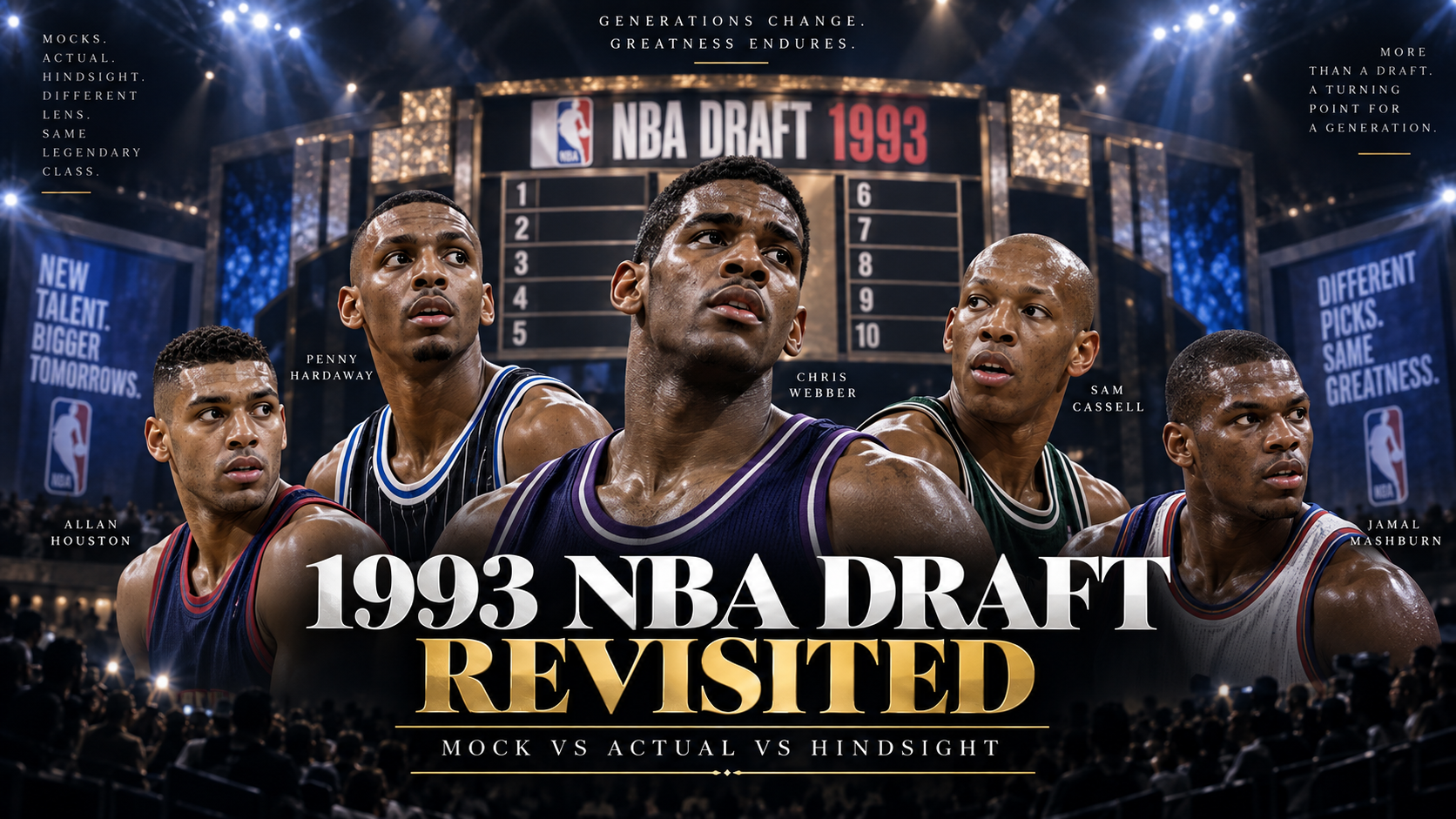
The 1993 draft was defined by a trade made minutes after the first pick. The Orlando Magic won the lottery with the worst odds of any team, their second straight lottery win, and took Chris Webber first. They then sent him to Golden State for Penny Hardaway, the No. 3 pick, and three future first-round picks. Webber was the better player over a full career. Penny was the better player for Orlando, forming one of the league's best duos with Shaquille O'Neal and reaching the 1995 Finals.
The rest of the class is remembered for talent that faded early. Hardaway, Jamal Mashburn and Allan Houston had careers shortened by injuries. Isaiah Rider and Vin Baker showed great promise but struggled off the court. Bobby Hurley's career was changed by a car accident in his rookie season. The best value came late: Sam Cassell at No. 24, Nick Van Exel in the second round, and Bruce Bowen, who went undrafted.
This article compares three timelines for every first-round pick. The first is what the public mock market expected, using The Draft Review's 15-mock consensus. The second is who teams actually took. The third is who they should have taken, knowing how every career turned out. With 27 teams in the league, the 1993 first round had 27 picks.
Three-timeline overview
How to read the mock baseline: The Draft Review orders its archive by median projected pick, with average pick as a tiebreaker. Its consensus rank labels, including A/B groups, are separate from projected pick numbers. Each row below shows the actual selection's archive rank, median projected slot, earliest-to-latest projection band and number of mocks listing that player. Medians can be fractional and exclude mocks that omit the player. A missing projection is reported explicitly.
Using actual overall pick equal to median projected slot as the definition of a match, 7 of 27 first-round selections matched; 11 came earlier and 8 later. 1 selection has no archived projection. This is a slot comparison, not a claim that all mocks or a particular team agreed.
| Pick | Team | Actual player's archived mock profile | Actual pick (archive rank) | Hindsight pick |
|---|---|---|---|---|
| 1 | Magic | Archive rank 1; median slot 1; band 1; 15/15 mocks | Chris Webber (1) | Chris Webber |
| 2 | 76ers | Archive rank 2; median slot 2; band 2; 15/15 mocks | Shawn Bradley (2) | Penny Hardaway |
| 3 | Warriors | Archive rank 4; median slot 4; band 3–4; 15/15 mocks | Penny Hardaway (4) | Allan Houston |
| 4 | Mavericks | Archive rank 3; median slot 3; band 3–4; 15/15 mocks | Jamal Mashburn (3) | Vin Baker |
| 5 | Timberwolves | Archive rank 5; median slot 5; band 5–6; 15/15 mocks | Isaiah Rider (5) | Jamal Mashburn |
| 6 | Bullets | Archive rank 6; median slot 6; band 5–8; 15/15 mocks | Calbert Cheaney (6) | Sam Cassell |
| 7 | Kings | Archive rank 7; median slot 7; band 7–12; 15/15 mocks | Bobby Hurley (7) | Nick Van Exel |
| 8 | Bucks | Archive rank 9; median slot 9; band 8–13; 15/15 mocks | Vin Baker (9) | Lindsey Hunter |
| 9 | Nuggets | Archive rank 8; median slot 8; band 5–9; 15/15 mocks | Rodney Rogers (8) | Rodney Rogers |
| 10 | Pistons | Archive rank 12; median slot 12; band 10–20; 15/15 mocks | Lindsey Hunter (12) | Isaiah Rider |
| 11 | Pistons | Archive rank 10; median slot 10; band 9–14; 15/15 mocks | Allan Houston (10) | Bryon Russell |
| 12 | Lakers | Archive rank 21-A; median slot 22; band 15–25; 12/15 mocks | George Lynch (21) | Chris Mills |
| 13 | Clippers | Archive rank 14; median slot 15; band 13–16; 15/15 mocks | Terry Dehere (14) | Calbert Cheaney |
| 14 | Pacers | Archive rank 16-B; median slot 18; band 14–24; 12/15 mocks | Scott Haskin (16) | Ervin Johnson |
| 15 | Hawks | Archive rank 20; median slot 21; band 12–27; 14/15 mocks | Doug Edwards (20) | Shawn Bradley |
| 16 | Nets | Archive rank 23-B; median slot 23; band 16–27; 13/15 mocks | Rex Walters (23) | Gheorghe Muresan |
| 17 | Hornets | Archive rank 19; median slot 20; band 16–24; 14/15 mocks | Greg Graham (19) | George Lynch |
| 18 | Jazz | Archive rank 16-A; median slot 18; band 11–21; 15/15 mocks | Luther Wright (16) | Scott Burrell |
| 19 | Celtics | Archive rank 11; median slot 11; band 8–17; 15/15 mocks | Acie Earl (11) | Lucious Harris |
| 20 | Hornets | Archive rank 17-A; median slot 19; band 14–26; 15/15 mocks | Scott Burrell (17) | Terry Dehere |
| 21 | Trail Blazers | Archive rank 23-A; median slot 23; band 14–27; 13/15 mocks | James Robinson (23) | Chris Whitney |
| 22 | Cavaliers | Archive rank 13; median slot 13; band 11–17; 15/15 mocks | Chris Mills (13) | Bobby Hurley |
| 23 | SuperSonics | Archive rank 18; median slot 19.5; band 9–25; 14/15 mocks | Ervin Johnson (18) | Greg Graham |
| 24 | Rockets | Archive rank 27-A; median slot 26; band 26; 8/15 mocks | Sam Cassell (27) | Rex Walters |
| 25 | Bulls | Archive rank 26-B; median slot 25; band 21–27; 3/15 mocks | Corie Blount (26) | Corie Blount |
| 26 | Magic | No projection in the archived 15 mocks | Geert Hammink (not mocked) | Doug Edwards |
| 27 | Suns | Archive rank 17-B; median slot 19; band 8–27; 15/15 mocks | Malcolm Mackey (17) | James Robinson |
Pick-by-pick: Mock vs Actual vs Hindsight
No. 1: Orlando Magic — Chris Webber
What the mock market was saying: Chris Webber: Archive rank 1; median slot 1; band 1; 15/15 mocks. He was a sophomore power forward from Michigan's Fab Five, strong, athletic and skilled, a player who could pass and handle the ball like a guard. He was also remembered for calling a timeout his team didn't have in the final seconds of the 1993 national title game.
Why the Magic made the pick: Orlando took Webber and immediately traded him to Golden State for Penny Hardaway and three future first-round picks. The Magic already had Shaquille O'Neal and wanted a guard who could get him the ball. O'Neal and Hardaway had played together while filming the movie Blue Chips, and Orlando believed Hardaway was the better fit.
Actual pick versus mock median: The actual selection at No. 1 matched the median projected slot of 1. 15 of 15 listed mocks placed Chris Webber at that exact pick. This compares overall slots, rather than inferring a team-specific prediction from the archive rank.
What hindsight changes: Webber won Rookie of the Year with Golden State, then clashed with coach Don Nelson and was traded to Washington early in his second season. He became a five-time All-Star in Sacramento and is in the Hall of Fame. He ranks first on the hindsight board.
The Magic's trade still looks reasonable. Webber was the better player over his career, but Hardaway fit perfectly next to O'Neal, and the Magic reached the Finals in 1995. The trade gave Orlando the right player for its window and three extra first-round picks.
No. 2: Philadelphia 76ers — Shawn Bradley
What the mock market was saying: Shawn Bradley: Archive rank 2; median slot 2; band 2; 15/15 mocks. He was a 7-6 center who had played one season at BYU, then spent two years on a Mormon mission in Australia. Scouts saw a remarkable shot-blocker and worried about his strength and lack of recent competition.
Why the 76ers made the pick: Philadelphia needed a franchise center and was willing to gamble on Bradley's size.
Actual pick versus mock median: The actual selection at No. 2 matched the median projected slot of 2. 15 of 15 listed mocks placed Shawn Bradley at that exact pick. This compares overall slots, rather than inferring a team-specific prediction from the archive rank.
What hindsight changes: Bradley became an effective shot-blocker but never developed offensively. He was traded to New Jersey in his third season and later played for Dallas. He ranks 15th. Hardaway is the hindsight pick. The 76ers needed a star, and Penny was one of the best players in the league in the mid-1990s.
No. 3: Golden State Warriors — Penny Hardaway
What the mock market was saying: Penny Hardaway: Archive rank 4; median slot 4; band 3–4; 15/15 mocks. He was a 6-7 point guard from Memphis State with unusual size and skill.
Why the Warriors made the pick: Golden State took Hardaway for Orlando as part of the Webber trade.
Actual pick versus mock median: The actual selection at No. 3 was 1 place earlier than the median projected slot of 4. 2 of 15 listed mocks placed Penny Hardaway at that exact pick. This compares overall slots, rather than inferring a team-specific prediction from the archive rank.
What hindsight changes: Hardaway made four All-Star teams and two All-NBA First Teams in Orlando and reached the 1995 Finals, but knee injuries shortened his prime. He ranks second. Allan Houston is the redraft pick here.
No. 4: Dallas Mavericks — Jamal Mashburn
What the mock market was saying: Jamal Mashburn: Archive rank 3; median slot 3; band 3–4; 15/15 mocks. He was a strong, skilled forward from Kentucky.
Why the Mavericks made the pick: Dallas needed a scorer and was glad to get the consensus rank No. 3 player at No. 4.
Actual pick versus mock median: The actual selection at No. 4 was 1 place later than the median projected slot of 3. 2 of 15 listed mocks placed Jamal Mashburn at that exact pick. This compares overall slots, rather than inferring a team-specific prediction from the archive rank.
What hindsight changes: Mashburn made the 2003 All-Star team, but knee injuries ended his career early. He ranks fifth. Vin Baker is the redraft pick here.
No. 5: Minnesota Timberwolves — Isaiah Rider
What the mock market was saying: Isaiah Rider: Archive rank 5; median slot 5; band 5–6; 15/15 mocks. He was a senior scorer from UNLV, athletic and explosive.
Why the Timberwolves made the pick: Minnesota wanted a scorer and took the one most mocks expected.
Actual pick versus mock median: The actual selection at No. 5 matched the median projected slot of 5. 10 of 15 listed mocks placed Isaiah Rider at that exact pick. This compares overall slots, rather than inferring a team-specific prediction from the archive rank.
What hindsight changes: Rider won the 1994 dunk contest and averaged around 20 points a game for several seasons, but off-court problems followed him to several teams. He won a title with the Lakers in 2001 as a reserve. He ranks 10th. Mashburn is the redraft pick here.
No. 6: Washington Bullets — Calbert Cheaney
What the mock market was saying: Calbert Cheaney: Archive rank 6; median slot 6; band 5–8; 15/15 mocks. He was the 1993 national player of the year at Indiana and the Big Ten's career scoring leader.
Why the Bullets made the pick: Washington wanted a proven scorer on the wing.
Actual pick versus mock median: The actual selection at No. 6 matched the median projected slot of 6. 10 of 15 listed mocks placed Calbert Cheaney at that exact pick. This compares overall slots, rather than inferring a team-specific prediction from the archive rank.
What hindsight changes: Cheaney was a solid starter for several seasons and then a journeyman. He ranks 13th. Sam Cassell is the redraft pick here.
No. 7: Sacramento Kings — Bobby Hurley
What the mock market was saying: Bobby Hurley: Archive rank 7; median slot 7; band 7–12; 15/15 mocks. He was a point guard who had won two national titles at Duke and set the NCAA career assists record.
Why the Kings made the pick: Sacramento needed a point guard to run its offense.
Actual pick versus mock median: The actual selection at No. 7 matched the median projected slot of 7. 14 of 15 listed mocks placed Bobby Hurley at that exact pick. This compares overall slots, rather than inferring a team-specific prediction from the archive rank.
What hindsight changes: Hurley was badly injured in a car accident in December of his rookie season. He returned but was never the same player. He ranks 22nd. Nick Van Exel, a second-round pick who became an All-Star, is the redraft pick here.
No. 8: Milwaukee Bucks — Vin Baker
What the mock market was saying: Vin Baker: Archive rank 9; median slot 9; band 8–13; 15/15 mocks. He was a 6-11 forward from Hartford, a small school, with a smooth offensive game.
Why the Bucks made the pick: Milwaukee wanted a skilled big man and valued Baker's offensive potential.
Actual pick versus mock median: The actual selection at No. 8 was 1 place earlier than the median projected slot of 9. 1 of 15 listed mocks placed Vin Baker at that exact pick. This compares overall slots, rather than inferring a team-specific prediction from the archive rank.
What hindsight changes: Baker made four straight All-Star teams, the last after a trade to Seattle, and then his career declined sharply. He later spoke publicly about his struggles with alcohol. He ranks fourth. Lindsey Hunter is the redraft pick here.
No. 9: Denver Nuggets — Rodney Rogers
What the mock market was saying: Rodney Rogers: Archive rank 8; median slot 8; band 5–9; 15/15 mocks. He was a strong forward from Wake Forest.
Why the Nuggets made the pick: Denver wanted a versatile forward.
Actual pick versus mock median: The actual selection at No. 9 was 1 place later than the median projected slot of 8. 2 of 15 listed mocks placed Rodney Rogers at that exact pick. This compares overall slots, rather than inferring a team-specific prediction from the archive rank.
What hindsight changes: Rogers was traded to the Clippers in 1995 in the Antonio McDyess deal and won Sixth Man of the Year with Phoenix in 2000. He ranks ninth, and the sequential redraft keeps him here.
No. 10: Detroit Pistons — Lindsey Hunter
What the mock market was saying: Lindsey Hunter: Archive rank 12; median slot 12; band 10–20; 15/15 mocks. He was a quick guard from Jackson State, a small school.
Why the Pistons made the pick: Detroit, rebuilding after the Bad Boys era, had two lottery picks and wanted a point guard.
Actual pick versus mock median: The actual selection at No. 10 was 2 places earlier than the median projected slot of 12. 1 of 15 listed mocks placed Lindsey Hunter at that exact pick. This compares overall slots, rather than inferring a team-specific prediction from the archive rank.
What hindsight changes: Hunter played 17 seasons as a defensive guard and won titles with the Lakers and Pistons. He ranks eighth. Rider is the redraft pick here.
No. 11: Detroit Pistons — Allan Houston
What the mock market was saying: Allan Houston: Archive rank 10; median slot 10; band 9–14; 15/15 mocks. He was a senior shooter from Tennessee.
Why the Pistons made the pick: With its second pick, Detroit took the best shooter in the draft.
Actual pick versus mock median: The actual selection at No. 11 was 1 place later than the median projected slot of 10. 1 of 15 listed mocks placed Allan Houston at that exact pick. This compares overall slots, rather than inferring a team-specific prediction from the archive rank.
What hindsight changes: Houston left for the Knicks in 1996, made two All-Star teams, and hit the series-winning shot against Miami in the 1999 playoffs. He ranks third. Bryon Russell, a second-round pick who became a starter for Utah's Finals teams, is the redraft pick here.
No. 12: Los Angeles Lakers — George Lynch
What the mock market was saying: George Lynch: Archive rank 21-A; median slot 22; band 15–25; 12/15 mocks. He was a tough forward from North Carolina's 1993 championship team.
Why the Lakers made the pick: The Lakers valued Lynch's toughness and winning experience.
Actual pick versus mock median: The actual selection at No. 12 was 10 places earlier than the median projected slot of 22. 0 of 12 listed mocks placed George Lynch at that exact pick. This compares overall slots, rather than inferring a team-specific prediction from the archive rank.
What hindsight changes: Lynch had a solid career as a role player and ranks 17th. Chris Mills is the redraft pick here.
No. 13: Los Angeles Clippers — Terry Dehere
What the mock market was saying: Terry Dehere: Archive rank 14; median slot 15; band 13–16; 15/15 mocks. He was a scoring guard from Seton Hall.
Why the Clippers made the pick: The Clippers needed a scorer.
Actual pick versus mock median: The actual selection at No. 13 was 2 places earlier than the median projected slot of 15. 1 of 15 listed mocks placed Terry Dehere at that exact pick. This compares overall slots, rather than inferring a team-specific prediction from the archive rank.
What hindsight changes: Dehere played several seasons as a bench scorer. He ranks 20th. Cheaney is the redraft pick here.
No. 14: Indiana Pacers — Scott Haskin
What the mock market was saying: Scott Haskin: Archive rank 16-B; median slot 18; band 14–24; 12/15 mocks. He was a 6-11 center from Oregon State.
Why the Pacers made the pick: Indiana wanted a backup center.
Actual pick versus mock median: The actual selection at No. 14 was 4 places earlier than the median projected slot of 18. 1 of 12 listed mocks placed Scott Haskin at that exact pick. This compares overall slots, rather than inferring a team-specific prediction from the archive rank.
What hindsight changes: Injuries limited Haskin to one NBA season. He falls outside the hindsight board's top 27. Ervin Johnson is the redraft pick here.
No. 15: Atlanta Hawks — Doug Edwards
What the mock market was saying: Doug Edwards: Archive rank 20; median slot 21; band 12–27; 14/15 mocks. He was a forward from Florida State.
Why the Hawks made the pick: Atlanta wanted front-court depth.
Actual pick versus mock median: The actual selection at No. 15 was 6 places earlier than the median projected slot of 21. 1 of 14 listed mocks placed Doug Edwards at that exact pick. This compares overall slots, rather than inferring a team-specific prediction from the archive rank.
What hindsight changes: Edwards played only a few NBA seasons and ranks 26th. Bradley is the redraft pick here.
No. 16: New Jersey Nets — Rex Walters
What the mock market was saying: Rex Walters: Archive rank 23-B; median slot 23; band 16–27; 13/15 mocks. He was a senior guard from Kansas.
Why the Nets made the pick: New Jersey needed a shooter.
Actual pick versus mock median: The actual selection at No. 16 was 7 places earlier than the median projected slot of 23. 3 of 13 listed mocks placed Rex Walters at that exact pick. This compares overall slots, rather than inferring a team-specific prediction from the archive rank.
What hindsight changes: Walters played several seasons as a backup and ranks 24th. Gheorghe Muresan, a second-round pick who won Most Improved Player in 1996, is the redraft pick here.
No. 17: Charlotte Hornets — Greg Graham
What the mock market was saying: Greg Graham: Archive rank 19; median slot 20; band 16–24; 14/15 mocks. He was a guard from Indiana.
Why the Hornets made the pick: Charlotte drafted Graham and traded him to Philadelphia.
Actual pick versus mock median: The actual selection at No. 17 was 3 places earlier than the median projected slot of 20. 1 of 14 listed mocks placed Greg Graham at that exact pick. This compares overall slots, rather than inferring a team-specific prediction from the archive rank.
What hindsight changes: Graham played only a few NBA seasons and ranks 23rd. Lynch is the redraft pick here.
No. 18: Utah Jazz — Luther Wright
What the mock market was saying: Luther Wright: Archive rank 16-A; median slot 18; band 11–21; 15/15 mocks. He was a 7-2 center from Seton Hall.
Why the Jazz made the pick: Utah wanted size behind its veterans.
Actual pick versus mock median: The actual selection at No. 18 matched the median projected slot of 18. 2 of 15 listed mocks placed Luther Wright at that exact pick. This compares overall slots, rather than inferring a team-specific prediction from the archive rank.
What hindsight changes: Wright played only 15 NBA games. He falls outside the hindsight board's top 27. Scott Burrell is the redraft pick here.
No. 19: Boston Celtics — Acie Earl
What the mock market was saying: Acie Earl: Archive rank 11; median slot 11; band 8–17; 15/15 mocks. He was a 6-10 senior center from Iowa and a strong shot-blocker.
Why the Celtics made the pick: Boston needed a big man as its championship core aged.
Actual pick versus mock median: The actual selection at No. 19 was 8 places later than the median projected slot of 11. 0 of 15 listed mocks placed Acie Earl at that exact pick. This compares overall slots, rather than inferring a team-specific prediction from the archive rank.
What hindsight changes: Earl played only a few NBA seasons. He falls outside the hindsight board's top 27. Lucious Harris, a second-round pick who became a reliable scorer for New Jersey's Finals teams, is the redraft pick here.
No. 20: Charlotte Hornets — Scott Burrell
What the mock market was saying: Scott Burrell: Archive rank 17-A; median slot 19; band 14–26; 15/15 mocks. He was an athletic wing from Connecticut.
Why the Hornets made the pick: Charlotte wanted an athletic defender.
Actual pick versus mock median: The actual selection at No. 20 was 1 place later than the median projected slot of 19. 0 of 15 listed mocks placed Scott Burrell at that exact pick. This compares overall slots, rather than inferring a team-specific prediction from the archive rank.
What hindsight changes: Burrell played eight seasons and won a title with the 1998 Bulls. He ranks 18th. Dehere is the redraft pick here.
No. 21: Portland Trail Blazers — James Robinson
What the mock market was saying: James Robinson: Archive rank 23-A; median slot 23; band 14–27; 13/15 mocks. He was a scoring guard from Alabama.
Why the Trail Blazers made the pick: Portland wanted a scorer.
Actual pick versus mock median: The actual selection at No. 21 was 2 places earlier than the median projected slot of 23. 1 of 13 listed mocks placed James Robinson at that exact pick. This compares overall slots, rather than inferring a team-specific prediction from the archive rank.
What hindsight changes: Robinson played several seasons as a bench scorer. He ranks 27th. Chris Whitney, a second-round pick who became a starter in Washington, is the redraft pick here.
No. 22: Cleveland Cavaliers — Chris Mills
What the mock market was saying: Chris Mills: Archive rank 13; median slot 13; band 11–17; 15/15 mocks. He was a senior forward from Arizona.
Why the Cavaliers made the pick: Cleveland got a lottery-level forward at No. 22.
Actual pick versus mock median: The actual selection at No. 22 was 9 places later than the median projected slot of 13. 0 of 15 listed mocks placed Chris Mills at that exact pick. This compares overall slots, rather than inferring a team-specific prediction from the archive rank.
What hindsight changes: Mills played 11 seasons as a solid starting forward. He ranks 12th. Hurley is the redraft pick here.
No. 23: Seattle SuperSonics — Ervin Johnson
What the mock market was saying: Ervin Johnson: Archive rank 18; median slot 19.5; band 9–25; 14/15 mocks. He was a 25-year-old center from New Orleans who had started playing basketball late.
Why the SuperSonics made the pick: Seattle wanted a defensive center.
Actual pick versus mock median: The actual selection at No. 23 was 3.5 places later than the median projected slot of 19.5. 0 of 14 listed mocks placed Ervin Johnson at that exact pick. This compares overall slots, rather than inferring a team-specific prediction from the archive rank.
What hindsight changes: Johnson played 13 seasons as a defensive center. He ranks 14th. Graham is the redraft pick here.
No. 24: Houston Rockets — Sam Cassell
What the mock market was saying: Sam Cassell: Archive rank 27-A; median slot 26; band 26; 8/15 mocks. He was a point guard from Florida State.
Why the Rockets made the pick: Houston was a contender and needed a backup point guard.
Actual pick versus mock median: The actual selection at No. 24 was 2 places earlier than the median projected slot of 26. 0 of 8 listed mocks placed Sam Cassell at that exact pick. This compares overall slots, rather than inferring a team-specific prediction from the archive rank.
What hindsight changes: Cassell won titles with Houston in his first two seasons and another with Boston in 2008. He made the 2004 All-Star team. He ranks sixth, the biggest steal of the first round. Walters is the redraft pick here.
No. 25: Chicago Bulls — Corie Blount
What the mock market was saying: Corie Blount: Archive rank 26-B; median slot 25; band 21–27; 3/15 mocks. He was a forward from Cincinnati.
Why the Bulls made the pick: Chicago needed front-court depth.
Actual pick versus mock median: The actual selection at No. 25 matched the median projected slot of 25. 1 of 3 listed mocks placed Corie Blount at that exact pick. This compares overall slots, rather than inferring a team-specific prediction from the archive rank.
What hindsight changes: Blount had a journeyman career and ranks 25th. The sequential redraft keeps him here.
No. 26: Orlando Magic — Geert Hammink
What the mock market was saying: Geert Hammink: No projection in the archived 15 mocks. He was a Dutch center from LSU, where he had played with O'Neal.
Why the Magic made the pick: Orlando took a big man who knew O'Neal.
Actual pick versus mock median: The archive does not list a projection for Geert Hammink, so no median-slot comparison is available for the actual selection at No. 26.
What hindsight changes: Hammink played only a few NBA games. He falls outside the hindsight board's top 27. Edwards is the redraft pick here.
No. 27: Phoenix Suns — Malcolm Mackey
What the mock market was saying: Malcolm Mackey: Archive rank 17-B; median slot 19; band 8–27; 15/15 mocks. He was a center from Georgia Tech.
Why the Suns made the pick: Phoenix had just reached the Finals and wanted a big man.
Actual pick versus mock median: The actual selection at No. 27 was 8 places later than the median projected slot of 19. 1 of 15 listed mocks placed Malcolm Mackey at that exact pick. This compares overall slots, rather than inferring a team-specific prediction from the archive rank.
What hindsight changes: Mackey played only one NBA season. He falls outside the hindsight board's top 27. Robinson is the redraft pick here.
Why the three timelines split
The mocks and the teams agreed at the top. Five of the first nine picks went exactly as the consensus predicted. The other four were two pairs of players who went one spot apart from their projections, Hardaway and Mashburn because of the Webber trade and Baker and Rogers because Milwaukee preferred Baker.
Many of the top players' careers were shortened. Hardaway, Mashburn and Houston had injuries, and Rider and Baker struggled off the court. The draft looks weaker in hindsight because of what happened after, not because of how teams evaluated the players.
The best value came late. Cassell at No. 24, Van Exel at No. 37, Russell at No. 45 and the undrafted Bruce Bowen all became better players than most of the first round.
What the mock market got right
The consensus correctly identified the top talent. It also rated Chris Mills and Acie Earl higher than the teams did. Mills proved the mocks right.
Where teams beat the mocks
Houston's pick of Cassell was the best value in the first round. Detroit's choice of Lindsey Hunter, two places earlier than his median projected slot of 12, gave the Pistons a player who lasted 17 seasons.
Hindsight top five
- Chris Webber
- Penny Hardaway
- Allan Houston
- Vin Baker
- Jamal Mashburn
FAQ
Who should go No. 1 in a 1993 NBA redraft?
Chris Webber. He was a five-time All-Star and a Hall of Famer.
What did mock drafts predict in the 1993 NBA Draft?
The Draft Review's archive separates rank labels from median projected slots. Using actual overall pick equal to median projected slot as the definition of a match, 7 of 27 first-round selections matched; 11 came earlier and 8 later. 1 selection has no archived projection. This is a slot comparison, not a claim that all mocks or a particular team agreed.
Who was the biggest draft-night slide in 1993?
Among first-round selections with an archived projection, the largest difference below the mock median was 9 places: Chris Mills (median slot 13, actual No. 22, archive rank 13; 15 mocks). This uses median projected slot, not the archive rank number.
What is the biggest lesson from the 1993 NBA Draft?
Talent evaluation is only part of the story. Injuries and off-court problems changed the careers of several of the class's best players.
Full hindsight board
| Hindsight rank | Player |
|---|---|
| 1 | Chris Webber |
| 2 | Penny Hardaway |
| 3 | Allan Houston |
| 4 | Vin Baker |
| 5 | Jamal Mashburn |
| 6 | Sam Cassell |
| 7 | Nick Van Exel |
| 8 | Lindsey Hunter |
| 9 | Rodney Rogers |
| 10 | Isaiah Rider |
| 11 | Bryon Russell |
| 12 | Chris Mills |
| 13 | Calbert Cheaney |
| 14 | Ervin Johnson |
| 15 | Shawn Bradley |
| 16 | Gheorghe Muresan |
| 17 | George Lynch |
| 18 | Scott Burrell |
| 19 | Lucious Harris |
| 20 | Terry Dehere |
| 21 | Chris Whitney |
| 22 | Bobby Hurley |
| 23 | Greg Graham |
| 24 | Rex Walters |
| 25 | Corie Blount |
| 26 | Doug Edwards |
| 27 | James Robinson |
The board includes drafted players only. Bruce Bowen, who went undrafted in 1993 and became a three-time champion and one of the best wing defenders of his era, would rank near the top if undrafted players were included.
Sources and methodology
- Historical mock baseline: The Draft Review's 1993 consensus mock draft, built from 15 mock drafts. https://www.thedraftreview.com/consensus-mock-draft-archive/1993-nba-draft-consensus-mock-draft
- Actual first-round order and transaction context: historical NBA draft records.
- Hindsight rankings are Ultimate Big Board editorial judgments built around peak value, longevity, two-way impact, postseason utility, role portability, and overall career production.
- Alternate-history notes are interpretive and do not assume every downstream roster move remains unchanged.