
1994 NBA Draft Revisited: Mock vs Actual vs Hindsight
Compare the historical 1994 NBA mock market, the actual first round and a full-career hindsight redraft for every pick.
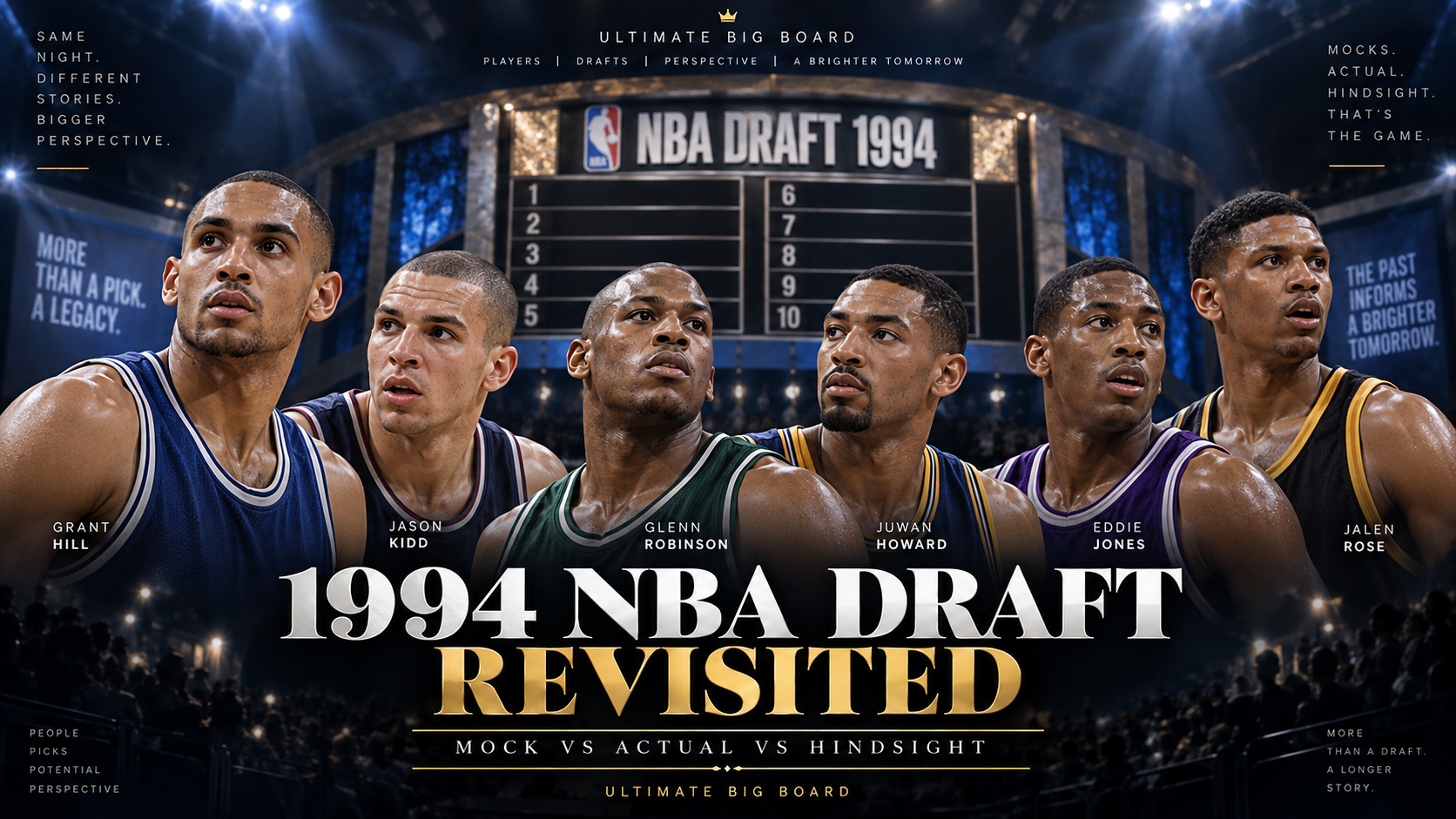
The 1994 draft may have been the most predictable of the decade. Glenn Robinson, Jason Kidd, Grant Hill, Donyell Marshall and Juwan Howard went first through fifth, exactly as nearly every one of the 15 mocks in The Draft Review's consensus predicted. Picks six through nine also matched the consensus. For the first nine picks, the public and the league agreed almost perfectly.
The disagreements came in the order of the top three, which history has reversed, and in the middle of the round, where two teams found players the mocks had rated much lower. Robinson went first and signed a 10-year, $68 million contract after a holdout. The deal was so large that the league introduced a rookie salary scale the next year. Kidd and Hill, the next two picks, shared Rookie of the Year and became Hall of Famers.
This article compares three timelines for every first-round pick. The first is what the public mock market expected, using The Draft Review's 15-mock consensus. The second is who teams actually took. The third is who they should have taken, knowing how every career turned out. With 27 teams in the league, the 1994 first round had 27 picks.
Three-timeline overview
How to read the mock baseline: The Draft Review orders its archive by median projected pick, with average pick as a tiebreaker. Its consensus rank labels, including A/B groups, are separate from projected pick numbers. Each row below shows the actual selection's archive rank, median projected slot, earliest-to-latest projection band and number of mocks listing that player. Medians can be fractional and exclude mocks that omit the player. A missing projection is reported explicitly.
Using actual overall pick equal to median projected slot as the definition of a match, 11 of 27 first-round selections matched; 7 came earlier and 9 later. This is a slot comparison, not a claim that all mocks or a particular team agreed.
| Pick | Team | Actual player's archived mock profile | Actual pick (archive rank) | Hindsight pick |
|---|---|---|---|---|
| 1 | Bucks | Archive rank 1; median slot 1; band 1; 15/15 mocks | Glenn Robinson (1) | Jason Kidd |
| 2 | Mavericks | Archive rank 2; median slot 2; band 2–3; 15/15 mocks | Jason Kidd (2) | Grant Hill |
| 3 | Pistons | Archive rank 3; median slot 3; band 2–3; 15/15 mocks | Grant Hill (3) | Glenn Robinson |
| 4 | Timberwolves | Archive rank 4; median slot 4; band 4; 15/15 mocks | Donyell Marshall (4) | Eddie Jones |
| 5 | Bullets | Archive rank 5; median slot 5; band 5–6; 15/15 mocks | Juwan Howard (5) | Juwan Howard |
| 6 | 76ers | Archive rank 6; median slot 6; band 6–12; 15/15 mocks | Sharone Wright (6) | Jalen Rose |
| 7 | Clippers | Archive rank 7; median slot 7; band 7–11; 15/15 mocks | Lamond Murray (7) | Brian Grant |
| 8 | Kings | Archive rank 8; median slot 8; band 6–18; 15/15 mocks | Brian Grant (8) | Donyell Marshall |
| 9 | Celtics | Archive rank 9; median slot 9; band 8–16; 15/15 mocks | Eric Montross (9) | Aaron McKie |
| 10 | Lakers | Archive rank 11-B; median slot 12; band 11–18; 14/15 mocks | Eddie Jones (11) | Wesley Person |
| 11 | SuperSonics | Archive rank 15; median slot 17; band 7–25; 14/15 mocks | Carlos Rogers (15) | Lamond Murray |
| 12 | Heat | Archive rank 11-A; median slot 12; band 9–22; 15/15 mocks | Khalid Reeves (11) | Eric Piatkowski |
| 13 | Nuggets | Archive rank 10; median slot 11; band 7–15; 15/15 mocks | Jalen Rose (10) | Charlie Ward |
| 14 | Nets | Archive rank 12; median slot 13; band 5–25; 14/15 mocks | Yinka Dare (12) | Howard Eisley |
| 15 | Pacers | Archive rank 13-B; median slot 14; band 10–21; 15/15 mocks | Eric Piatkowski (13) | Voshon Lenard |
| 16 | Warriors | Archive rank 17-A; median slot 19; band 8–23; 12/15 mocks | Clifford Rozier (17) | Monty Williams |
| 17 | Trail Blazers | Archive rank 18; median slot 19.5; band 12–23; 14/15 mocks | Aaron McKie (18) | Eric Montross |
| 18 | Bucks | Archive rank 14; median slot 16; band 12–18; 13/15 mocks | Eric Mobley (14) | Khalid Reeves |
| 19 | Mavericks | Archive rank 22-C; median slot 23; band 21–27; 8/15 mocks | Tony Dumas (22) | Dickey Simpkins |
| 20 | 76ers | Archive rank 19; median slot 20; band 13–27; 15/15 mocks | B.J. Tyler (19) | Carlos Rogers |
| 21 | Bulls | Archive rank 25-A; median slot 26; band 23–27; 10/15 mocks | Dickey Simpkins (25) | Sharone Wright |
| 22 | Spurs | Archive rank 26; median slot 27; band 25–27; 5/15 mocks | Bill Curley (26) | Greg Minor |
| 23 | Suns | Archive rank 13-A; median slot 14; band 11–24; 15/15 mocks | Wesley Person (13) | Jim McIlvaine |
| 24 | Knicks | Archive rank 22-B; median slot 23; band 12–26; 10/15 mocks | Monty Williams (22) | Clifford Rozier |
| 25 | Clippers | Archive rank 22-A; median slot 23; band 21–26; 11/15 mocks | Greg Minor (22) | Tony Dumas |
| 26 | Knicks | Archive rank 20; median slot 22; band 15–27; 14/15 mocks | Charlie Ward (20) | Eric Mobley |
| 27 | Magic | Archive rank 22-D; median slot 23; band 23; 2/15 mocks | Brooks Thompson (22) | Bill Curley |
Pick-by-pick: Mock vs Actual vs Hindsight
No. 1: Milwaukee Bucks — Glenn Robinson
What the mock market was saying: Glenn Robinson: Archive rank 1; median slot 1; band 1; 15/15 mocks. He was the national player of the year at Purdue, a 6-7 forward who led the country in scoring and could score from anywhere. Scouts questioned only his defense.
Why the Bucks made the pick: Milwaukee was one of the league's worst teams and needed a scorer to build around. Robinson was the most productive college player in the country, known as "Big Dog," and the safest pick in the draft.
Actual pick versus mock median: The actual selection at No. 1 matched the median projected slot of 1. 15 of 15 listed mocks placed Glenn Robinson at that exact pick. This compares overall slots, rather than inferring a team-specific prediction from the archive rank.
What hindsight changes: Robinson held out before signing a 10-year, $68 million contract, then averaged more than 20 points a game for most of his career. He made two All-Star teams and won a title with San Antonio in his final season. He ranks third on the hindsight board.
Kidd is the hindsight pick. The Bucks needed a franchise player, and Kidd became one of the best point guards in history: a 10-time All-Star who led New Jersey to two Finals and won a title with Dallas in 2011. In 1994, scouts rated Robinson's scoring above Kidd's playmaking. Over time, the playmaking proved more valuable.
No. 2: Dallas Mavericks — Jason Kidd
What the mock market was saying: Jason Kidd: Archive rank 2; median slot 2; band 2–3; 15/15 mocks. He was a sophomore point guard from California, a brilliant passer and rebounder. The main concern was his outside shooting.
Why the Mavericks made the pick: Dallas had drafted Jamal Mashburn and Jim Jackson in the previous two years and needed a point guard to get them the ball. Kidd completed the "Three J's."
Actual pick versus mock median: The actual selection at No. 2 matched the median projected slot of 2. 14 of 15 listed mocks placed Jason Kidd at that exact pick. This compares overall slots, rather than inferring a team-specific prediction from the archive rank.
What hindsight changes: Kidd shared Rookie of the Year with Grant Hill, but the Three J's never won together. Dallas traded Kidd to Phoenix in 1996. He later returned to Dallas and won the 2011 title. He ranks first on the hindsight board. At No. 2, the sequential redraft takes Hill.
No. 3: Detroit Pistons — Grant Hill
What the mock market was saying: Grant Hill: Archive rank 3; median slot 3; band 2–3; 15/15 mocks. He had won two national titles at Duke and was a 6-8 forward who could pass, handle the ball and defend. Scouts saw one of the most complete players in years and questioned only his outside shooting.
Why the Pistons made the pick: Detroit's "Bad Boys" era had ended, and the Pistons needed a new star. Hill was the most versatile player in the draft and a natural fit for a rebuilding team.
Actual pick versus mock median: The actual selection at No. 3 matched the median projected slot of 3. 14 of 15 listed mocks placed Grant Hill at that exact pick. This compares overall slots, rather than inferring a team-specific prediction from the archive rank.
What hindsight changes: Hill shared Rookie of the Year, made five All-Star teams in six seasons with Detroit, and was one of the best all-around players in the league. Ankle injuries then cost him most of four seasons after he signed with Orlando in 2000. He ranks second. The redraft puts Robinson here.
No. 4: Minnesota Timberwolves — Donyell Marshall
What the mock market was saying: Donyell Marshall: Archive rank 4; median slot 4; band 4; 15/15 mocks. He was a 6-9 junior from Connecticut, a long forward who could shoot and block shots. Scouts worried about his thin frame.
Why the Timberwolves made the pick: Minnesota needed a forward who could score, and Marshall was the best one left.
Actual pick versus mock median: The actual selection at No. 4 matched the median projected slot of 4. 15 of 15 listed mocks placed Donyell Marshall at that exact pick. This compares overall slots, rather than inferring a team-specific prediction from the archive rank.
What hindsight changes: Minnesota traded Marshall to Golden State during his rookie season for Tom Gugliotta. Marshall had a 15-season career as a floor-spacing forward. He ranks eighth. The redraft takes Eddie Jones, a three-time All-Star wing.
No. 5: Washington Bullets — Juwan Howard
What the mock market was saying: Juwan Howard: Archive rank 5; median slot 5; band 5–6; 15/15 mocks. He was a junior from Michigan, one of the "Fab Five," a skilled power forward with a good midrange game.
Why the Bullets made the pick: Washington wanted a young power forward. Howard would be paired with his Michigan teammate Chris Webber, whom the Bullets acquired from Golden State in November 1994.
Actual pick versus mock median: The actual selection at No. 5 matched the median projected slot of 5. 14 of 15 listed mocks placed Juwan Howard at that exact pick. This compares overall slots, rather than inferring a team-specific prediction from the archive rank.
What hindsight changes: Howard made the 1996 All-Star team and played 19 seasons. He won two titles as a veteran with Miami. He ranks fifth, and the sequential redraft keeps him at No. 5.
No. 6: Philadelphia 76ers — Sharone Wright
What the mock market was saying: Sharone Wright: Archive rank 6; median slot 6; band 6–12; 15/15 mocks. He was a 6-11 junior from Clemson, a strong shot-blocker and rebounder.
Why the 76ers made the pick: Philadelphia needed a big man and took the best one available.
Actual pick versus mock median: The actual selection at No. 6 matched the median projected slot of 6. 11 of 15 listed mocks placed Sharone Wright at that exact pick. This compares overall slots, rather than inferring a team-specific prediction from the archive rank.
What hindsight changes: Wright was traded to Toronto in his second season, and his NBA career was over within four seasons. He ranks 21st. The redraft takes Jalen Rose.
No. 7: Los Angeles Clippers — Lamond Murray
What the mock market was saying: Lamond Murray: Archive rank 7; median slot 7; band 7–11; 15/15 mocks. He was Kidd's teammate at California, a 6-7 scoring forward.
Why the Clippers made the pick: The Clippers needed scoring, and Murray was the best scorer available.
Actual pick versus mock median: The actual selection at No. 7 matched the median projected slot of 7. 11 of 15 listed mocks placed Lamond Murray at that exact pick. This compares overall slots, rather than inferring a team-specific prediction from the archive rank.
What hindsight changes: Murray played 11 seasons as a scorer on losing teams. He ranks 11th. Brian Grant is the redraft pick here.
No. 8: Sacramento Kings — Brian Grant
What the mock market was saying: Brian Grant: Archive rank 8; median slot 8; band 6–18; 15/15 mocks. He was a physical senior power forward from Xavier.
Why the Kings made the pick: Sacramento wanted a tough rebounder and defender. Grant fit.
Actual pick versus mock median: The actual selection at No. 8 matched the median projected slot of 8. 7 of 15 listed mocks placed Brian Grant at that exact pick. This compares overall slots, rather than inferring a team-specific prediction from the archive rank.
What hindsight changes: Grant played 12 seasons as a tough rebounder with Sacramento, Portland and Miami. He ranks seventh. The redraft takes Marshall.
No. 9: Boston Celtics — Eric Montross
What the mock market was saying: Eric Montross: Archive rank 9; median slot 9; band 8–16; 15/15 mocks. He was a seven-foot senior who had won a national title at North Carolina.
Why the Celtics made the pick: Boston needed a center to replace Robert Parish.
Actual pick versus mock median: The actual selection at No. 9 matched the median projected slot of 9. 9 of 15 listed mocks placed Eric Montross at that exact pick. This compares overall slots, rather than inferring a team-specific prediction from the archive rank.
What hindsight changes: Montross was a solid rookie but became a journeyman backup. He ranks 17th. The redraft takes Aaron McKie.
No. 10: Los Angeles Lakers — Eddie Jones
What the mock market was saying: Eddie Jones: Archive rank 11-B; median slot 12; band 11–18; 14/15 mocks. He was an athletic, defensive-minded senior from Temple.
Why the Lakers made the pick: The Lakers were rebuilding after the Magic Johnson era and wanted an athletic wing who could defend.
Actual pick versus mock median: The actual selection at No. 10 was 2 places earlier than the median projected slot of 12. 0 of 14 listed mocks placed Eddie Jones at that exact pick. This compares overall slots, rather than inferring a team-specific prediction from the archive rank.
What hindsight changes: Jones made three All-Star teams and several All-Defensive teams. He ranks fourth. Wesley Person is the redraft pick here.
No. 11: Seattle SuperSonics — Carlos Rogers
What the mock market was saying: Carlos Rogers: Archive rank 15; median slot 17; band 7–25; 14/15 mocks. He was an athletic 6-11 forward from Tennessee State.
Why the SuperSonics made the pick: Seattle drafted Rogers and traded him to Golden State.
Actual pick versus mock median: The actual selection at No. 11 was 6 places earlier than the median projected slot of 17. 0 of 14 listed mocks placed Carlos Rogers at that exact pick. This compares overall slots, rather than inferring a team-specific prediction from the archive rank.
What hindsight changes: Rogers had a journeyman career and ranks 20th. Lamond Murray is the redraft pick here.
No. 12: Miami Heat — Khalid Reeves
What the mock market was saying: Khalid Reeves: Archive rank 11-A; median slot 12; band 9–22; 15/15 mocks. He was a scoring guard who had led Arizona to the 1994 Final Four.
Why the Heat made the pick: Miami needed guard help.
Actual pick versus mock median: The actual selection at No. 12 matched the median projected slot of 12. 5 of 15 listed mocks placed Khalid Reeves at that exact pick. This compares overall slots, rather than inferring a team-specific prediction from the archive rank.
What hindsight changes: Reeves had a journeyman career and ranks 18th. Eric Piatkowski is the redraft pick here.
No. 13: Denver Nuggets — Jalen Rose
What the mock market was saying: Jalen Rose: Archive rank 10; median slot 11; band 7–15; 15/15 mocks. He was a 6-8 point guard from Michigan's Fab Five, a playmaker with unusual size.
Why the Nuggets made the pick: Denver was glad to get a lottery-level talent at No. 13.
Actual pick versus mock median: The actual selection at No. 13 was 2 places later than the median projected slot of 11. 5 of 15 listed mocks placed Jalen Rose at that exact pick. This compares overall slots, rather than inferring a team-specific prediction from the archive rank.
What hindsight changes: Denver traded Rose after two seasons. He won Most Improved Player with Indiana in 2000 and later averaged more than 20 points a game in Chicago and Toronto. He ranks sixth. Charlie Ward is the redraft pick here.
No. 14: New Jersey Nets — Yinka Dare
What the mock market was saying: Yinka Dare: Archive rank 12; median slot 13; band 5–25; 14/15 mocks. He was a seven-foot sophomore from George Washington, raw but big.
Why the Nets made the pick: New Jersey took a chance on size and potential.
Actual pick versus mock median: The actual selection at No. 14 was 1 place later than the median projected slot of 13. 0 of 14 listed mocks placed Yinka Dare at that exact pick. This compares overall slots, rather than inferring a team-specific prediction from the archive rank.
What hindsight changes: Dare played only a few NBA seasons and famously recorded just four assists in his career. He falls outside the hindsight board's top 27. Howard Eisley is the redraft pick here.
No. 15: Indiana Pacers — Eric Piatkowski
What the mock market was saying: Eric Piatkowski: Archive rank 13-B; median slot 14; band 10–21; 15/15 mocks. He was a senior shooter from Nebraska.
Why the Pacers made the pick: Indiana drafted Piatkowski and sent him to the Clippers in the trade that brought Mark Jackson to Indiana.
Actual pick versus mock median: The actual selection at No. 15 was 1 place later than the median projected slot of 14. 0 of 15 listed mocks placed Eric Piatkowski at that exact pick. This compares overall slots, rather than inferring a team-specific prediction from the archive rank.
What hindsight changes: Piatkowski had a long career as a shooter, mostly with the Clippers. He ranks 12th. Voshon Lenard, a second-round pick who later won the 2004 three-point contest, is the redraft pick here.
No. 16: Golden State Warriors — Clifford Rozier
What the mock market was saying: Clifford Rozier: Archive rank 17-A; median slot 19; band 8–23; 12/15 mocks. He was a strong power forward from Louisville.
Why the Warriors made the pick: Golden State needed a rebounder.
Actual pick versus mock median: The actual selection at No. 16 was 3 places earlier than the median projected slot of 19. 1 of 12 listed mocks placed Clifford Rozier at that exact pick. This compares overall slots, rather than inferring a team-specific prediction from the archive rank.
What hindsight changes: Rozier played only a few NBA seasons and ranks 24th. Monty Williams is the redraft pick here.
No. 17: Portland Trail Blazers — Aaron McKie
What the mock market was saying: Aaron McKie: Archive rank 18; median slot 19.5; band 12–23; 14/15 mocks. He was a versatile senior guard from Temple.
Why the Trail Blazers made the pick: Portland wanted a guard who could defend and handle the ball.
Actual pick versus mock median: The actual selection at No. 17 was 2.5 places earlier than the median projected slot of 19.5. 1 of 14 listed mocks placed Aaron McKie at that exact pick. This compares overall slots, rather than inferring a team-specific prediction from the archive rank.
What hindsight changes: McKie won Sixth Man of the Year with Philadelphia in 2001 and was a key player on its Finals team. He ranks ninth. Eric Montross is the redraft pick here.
No. 18: Milwaukee Bucks — Eric Mobley
What the mock market was saying: Eric Mobley: Archive rank 14; median slot 16; band 12–18; 13/15 mocks. He was a 6-11 senior from Pittsburgh.
Why the Bucks made the pick: Milwaukee wanted a center to play next to Robinson.
Actual pick versus mock median: The actual selection at No. 18 was 2 places later than the median projected slot of 16. 1 of 13 listed mocks placed Eric Mobley at that exact pick. This compares overall slots, rather than inferring a team-specific prediction from the archive rank.
What hindsight changes: Mobley played only a few NBA seasons and ranks 26th. Khalid Reeves is the redraft pick here.
No. 19: Dallas Mavericks — Tony Dumas
What the mock market was saying: Tony Dumas: Archive rank 22-C; median slot 23; band 21–27; 8/15 mocks. He was a scoring guard from Missouri-Kansas City.
Why the Mavericks made the pick: Dallas wanted a scorer off the bench.
Actual pick versus mock median: The actual selection at No. 19 was 4 places earlier than the median projected slot of 23. 0 of 8 listed mocks placed Tony Dumas at that exact pick. This compares overall slots, rather than inferring a team-specific prediction from the archive rank.
What hindsight changes: Dumas played only a few NBA seasons and ranks 25th. Dickey Simpkins is the redraft pick here.
No. 20: Philadelphia 76ers — B.J. Tyler
What the mock market was saying: B.J. Tyler: Archive rank 19; median slot 20; band 13–27; 15/15 mocks. He was a quick point guard from Texas.
Why the 76ers made the pick: Philadelphia needed a point guard.
Actual pick versus mock median: The actual selection at No. 20 matched the median projected slot of 20. 11 of 15 listed mocks placed B.J. Tyler at that exact pick. This compares overall slots, rather than inferring a team-specific prediction from the archive rank.
What hindsight changes: Tyler played one NBA season and falls outside the hindsight board's top 27. Carlos Rogers is the redraft pick here.
No. 21: Chicago Bulls — Dickey Simpkins
What the mock market was saying: Dickey Simpkins: Archive rank 25-A; median slot 26; band 23–27; 10/15 mocks. He was a physical forward from Providence.
Why the Bulls made the pick: Chicago needed front-court depth.
Actual pick versus mock median: The actual selection at No. 21 was 5 places earlier than the median projected slot of 26. 0 of 10 listed mocks placed Dickey Simpkins at that exact pick. This compares overall slots, rather than inferring a team-specific prediction from the archive rank.
What hindsight changes: Simpkins won titles as a reserve with the Bulls. He ranks 19th. Sharone Wright is the redraft pick here.
No. 22: San Antonio Spurs — Bill Curley
What the mock market was saying: Bill Curley: Archive rank 26; median slot 27; band 25–27; 5/15 mocks. He was a forward from Boston College.
Why the Spurs made the pick: San Antonio drafted Curley and traded him to Detroit.
Actual pick versus mock median: The actual selection at No. 22 was 5 places earlier than the median projected slot of 27. 0 of 5 listed mocks placed Bill Curley at that exact pick. This compares overall slots, rather than inferring a team-specific prediction from the archive rank.
What hindsight changes: Curley played only a few NBA seasons and ranks 27th. Greg Minor is the redraft pick here.
No. 23: Phoenix Suns — Wesley Person
What the mock market was saying: Wesley Person: Archive rank 13-A; median slot 14; band 11–24; 15/15 mocks. He was a senior shooter from Auburn, the younger brother of NBA forward Chuck Person.
Why the Suns made the pick: Phoenix got a lottery-level shooter at No. 23.
Actual pick versus mock median: The actual selection at No. 23 was 9 places later than the median projected slot of 14. 0 of 15 listed mocks placed Wesley Person at that exact pick. This compares overall slots, rather than inferring a team-specific prediction from the archive rank.
What hindsight changes: Person became one of the league's best three-point shooters and played more than a decade. He ranks 10th. Jim McIlvaine is the redraft pick here.
No. 24: New York Knicks — Monty Williams
What the mock market was saying: Monty Williams: Archive rank 22-B; median slot 23; band 12–26; 10/15 mocks. He was a forward from Notre Dame who had been diagnosed with a heart condition in college.
Why the Knicks made the pick: Pat Riley's Knicks wanted a versatile defender.
Actual pick versus mock median: The actual selection at No. 24 was 1 place later than the median projected slot of 23. 2 of 10 listed mocks placed Monty Williams at that exact pick. This compares overall slots, rather than inferring a team-specific prediction from the archive rank.
What hindsight changes: Williams played nine seasons, then became a head coach and led Phoenix to the 2021 Finals. He ranks 16th. Clifford Rozier is the redraft pick here.
No. 25: Los Angeles Clippers — Greg Minor
What the mock market was saying: Greg Minor: Archive rank 22-A; median slot 23; band 21–26; 11/15 mocks. He was a wing from Louisville.
Why the Clippers made the pick: The Clippers drafted Minor and traded his rights to Indiana in the Mark Jackson deal.
Actual pick versus mock median: The actual selection at No. 25 was 2 places later than the median projected slot of 23. 1 of 11 listed mocks placed Greg Minor at that exact pick. This compares overall slots, rather than inferring a team-specific prediction from the archive rank.
What hindsight changes: Minor played four seasons with Boston. He ranks 22nd. Tony Dumas is the redraft pick here.
No. 26: New York Knicks — Charlie Ward
What the mock market was saying: Charlie Ward: Archive rank 20; median slot 22; band 15–27; 14/15 mocks. He had just won the 1993 Heisman Trophy as Florida State's quarterback and was also a talented point guard.
Why the Knicks made the pick: Ward said he wouldn't play in the NFL unless he was a first-round pick. When the NFL passed on him, the Knicks took him late in the first round.
Actual pick versus mock median: The actual selection at No. 26 was 4 places later than the median projected slot of 22. 1 of 14 listed mocks placed Charlie Ward at that exact pick. This compares overall slots, rather than inferring a team-specific prediction from the archive rank.
What hindsight changes: Ward played 11 seasons, mostly with the Knicks, including their 1999 Finals team. He ranks 13th. Eric Mobley is the redraft pick here.
No. 27: Orlando Magic — Brooks Thompson
What the mock market was saying: Brooks Thompson: Archive rank 22-D; median slot 23; band 23; 2/15 mocks. He was a guard from Oklahoma State.
Why the Magic made the pick: Orlando, fresh off its first playoff appearance, needed a backup guard.
Actual pick versus mock median: The actual selection at No. 27 was 4 places later than the median projected slot of 23. 0 of 2 listed mocks placed Brooks Thompson at that exact pick. This compares overall slots, rather than inferring a team-specific prediction from the archive rank.
What hindsight changes: Thompson played only a few NBA seasons and falls outside the hindsight board's top 27. Bill Curley is the redraft pick here.
Why the three timelines split
The mocks and the teams agreed almost completely at the top. The first nine picks went exactly as the consensus predicted. The public and the league were working from the same information.
Scoring beat playmaking. Robinson went first because he was the best college scorer. Kidd and Hill became better players because they could do more than score.
The biggest misses were in the middle of the round. Eddie Jones, Jalen Rose, Aaron McKie and Wesley Person all became better players than several of the players taken ahead of them.
Off-court factors pushed players down. Charlie Ward's football career and Monty Williams's heart condition made teams cautious.
What the mock market got right
The consensus was almost perfect on the first nine picks. It also rated Wesley Person and Jalen Rose higher than the teams did, and both became better players than their draft slots suggested.
Where teams beat the mocks
The Lakers took Eddie Jones two places earlier than his median projected slot of 12, and he became a three-time All-Star. Portland found McKie at No. 17.
Hindsight top five
- Jason Kidd
- Grant Hill
- Glenn Robinson
- Eddie Jones
- Juwan Howard
FAQ
Who should go No. 1 in a 1994 NBA redraft?
Jason Kidd. He was a 10-time All-Star, a champion and one of the best point guards ever.
What did mock drafts predict in the 1994 NBA Draft?
The Draft Review's archive separates rank labels from median projected slots. Using actual overall pick equal to median projected slot as the definition of a match, 11 of 27 first-round selections matched; 7 came earlier and 9 later. This is a slot comparison, not a claim that all mocks or a particular team agreed.
Who was the biggest draft-night slide in 1994?
Among first-round selections with an archived projection, the largest difference below the mock median was 9 places: Wesley Person (median slot 14, actual No. 23, archive rank 13-A; 15 mocks). This uses median projected slot, not the archive rank number.
What is the biggest lesson from the 1994 NBA Draft?
When the mocks and the teams agree, the draft goes as expected. But agreement doesn't mean the order is right.
Full hindsight board
| Hindsight rank | Player |
|---|---|
| 1 | Jason Kidd |
| 2 | Grant Hill |
| 3 | Glenn Robinson |
| 4 | Eddie Jones |
| 5 | Juwan Howard |
| 6 | Jalen Rose |
| 7 | Brian Grant |
| 8 | Donyell Marshall |
| 9 | Aaron McKie |
| 10 | Wesley Person |
| 11 | Lamond Murray |
| 12 | Eric Piatkowski |
| 13 | Charlie Ward |
| 14 | Howard Eisley |
| 15 | Voshon Lenard |
| 16 | Monty Williams |
| 17 | Eric Montross |
| 18 | Khalid Reeves |
| 19 | Dickey Simpkins |
| 20 | Carlos Rogers |
| 21 | Sharone Wright |
| 22 | Greg Minor |
| 23 | Jim McIlvaine |
| 24 | Clifford Rozier |
| 25 | Tony Dumas |
| 26 | Eric Mobley |
| 27 | Bill Curley |
Sources and methodology
- Historical mock baseline: The Draft Review's 1994 consensus mock draft, built from 15 mock drafts. https://www.thedraftreview.com/consensus-mock-draft-archive/1994-nba-draft-consensus-mock-draft
- Actual first-round order and transaction context: historical NBA draft records.
- Hindsight rankings are Ultimate Big Board editorial judgments built around peak value, longevity, two-way impact, postseason utility, role portability, and overall career production.
- Alternate-history notes are interpretive and do not assume every downstream roster move remains unchanged.