
1995 NBA Draft Revisited: Mock vs Actual vs Hindsight
Compare the historical mock market, the actual first round, and a full-career hindsight board for the 1995 NBA Draft.
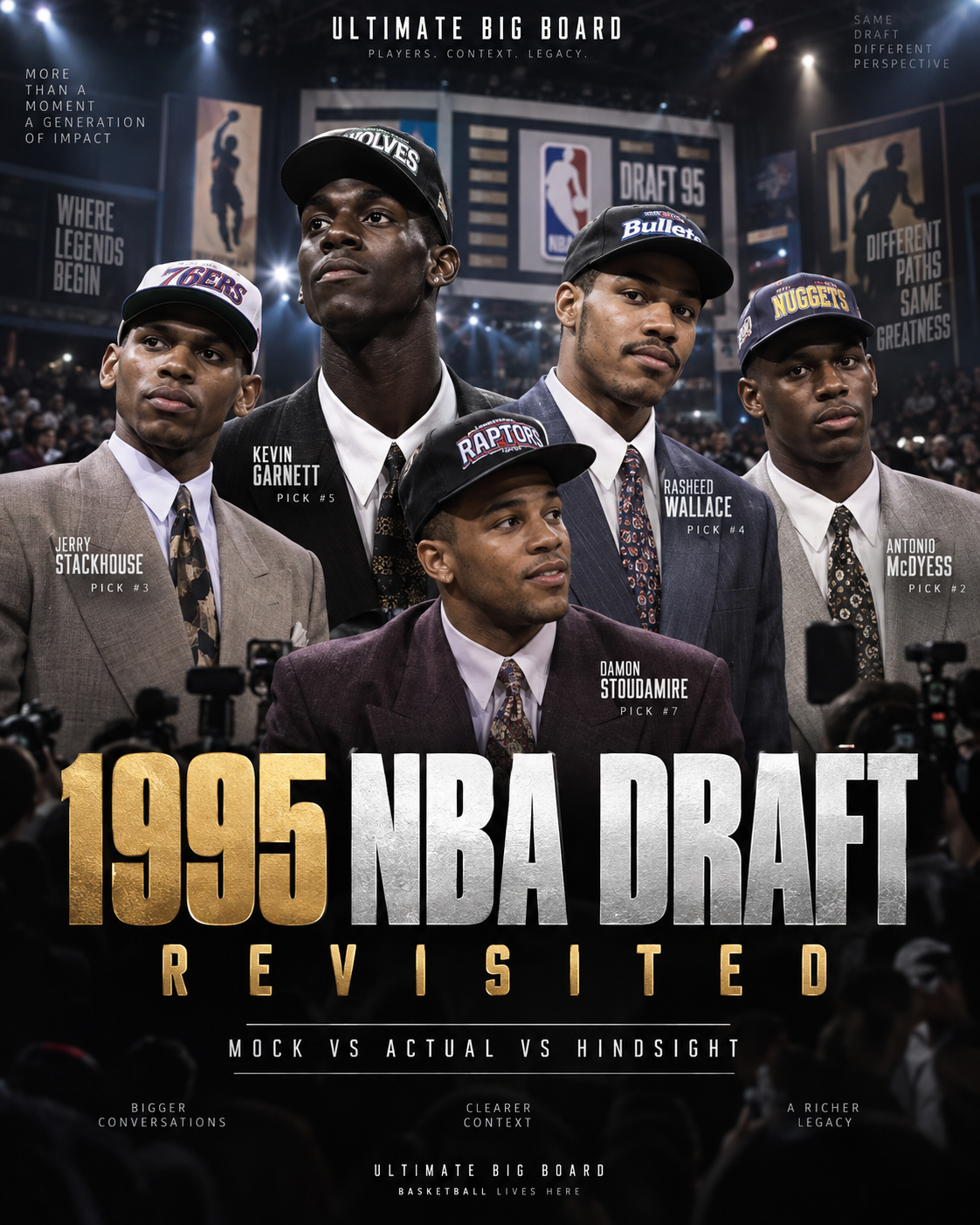
The 1995 draft was held at the SkyDome in Toronto, the first draft for the league's two new Canadian teams, and it's remembered for a decision four teams made before Minnesota's turn. Kevin Garnett was a high school senior from Chicago, trying to become the first player drafted straight out of high school in 20 years. Golden State, the Clippers, Philadelphia and Washington all took college sophomores instead. Minnesota took Garnett fifth, and he became one of the best power forwards in history.
The mock drafts saw it the same way the teams did. The public consensus had Garnett fifth, too. That's the most interesting thing about 1995: the mocks and the teams agreed almost completely at the top, and they were both wrong in the same way. The disagreements came later, in the middle of the first round, where the public badly underrated two future All-Stars, Michael Finley and Theo Ratliff.
This article compares three timelines for every first-round pick. The first is what the public mock market expected, using The Draft Review's 15-mock consensus. The second is who teams actually took. The third is who they should have taken, knowing how every career turned out.
Three-timeline overview
How to read the mock baseline: The Draft Review orders its archive by median projected pick, with average pick as a tiebreaker. Its consensus rank labels, including A/B groups, are separate from projected pick numbers. Each row below shows the actual selection's archive rank, median projected slot, earliest-to-latest projection band and number of mocks listing that player. Medians can be fractional and exclude mocks that omit the player. A missing projection is reported explicitly.
Using actual overall pick equal to median projected slot as the definition of a match, 6 of 29 first-round selections matched; 11 came earlier and 12 later. This is a slot comparison, not a claim that all mocks or a particular team agreed.
| Pick | Team | Actual player's archived mock profile | Actual pick (archive rank) | Hindsight pick |
|---|---|---|---|---|
| 1 | Warriors | Archive rank 1; median slot 1; band 1–3; 15/15 mocks | Joe Smith (1) | Kevin Garnett |
| 2 | Clippers | Archive rank 3; median slot 3; band 3–5; 15/15 mocks | Antonio McDyess (3) | Rasheed Wallace |
| 3 | 76ers | Archive rank 2; median slot 2; band 1–2; 15/15 mocks | Jerry Stackhouse (2) | Michael Finley |
| 4 | Bullets | Archive rank 4; median slot 4; band 2–5; 15/15 mocks | Rasheed Wallace (4) | Jerry Stackhouse |
| 5 | Timberwolves | Archive rank 5; median slot 5; band 4–6; 15/15 mocks | Kevin Garnett (5) | Antonio McDyess |
| 6 | Grizzlies | Archive rank 6; median slot 6; band 6–9; 15/15 mocks | Bryant Reeves (6) | Theo Ratliff |
| 7 | Raptors | Archive rank 10-A; median slot 11; band 8–13; 15/15 mocks | Damon Stoudamire (10) | Kurt Thomas |
| 8 | Trail Blazers | Archive rank 9; median slot 9; band 8–21; 15/15 mocks | Shawn Respert (9) | Damon Stoudamire |
| 9 | Nets | Archive rank 8; median slot 8; band 4–13; 15/15 mocks | Ed O'Bannon (8) | Brent Barry |
| 10 | Heat | Archive rank 10-B; median slot 11; band 10–25; 14/15 mocks | Kurt Thomas (10) | Joe Smith |
| 11 | Bucks | Archive rank 13; median slot 15; band 14–27; 15/15 mocks | Gary Trent (13) | Corliss Williamson |
| 12 | Mavericks | Archive rank 7; median slot 7; band 6–10; 15/15 mocks | Cherokee Parks (7) | Eric Snow |
| 13 | Kings | Archive rank 11-A; median slot 12; band 7–20; 15/15 mocks | Corliss Williamson (11) | Bob Sura |
| 14 | Celtics | Archive rank 24-A; median slot 26; band 15–29; 12/15 mocks | Eric Williams (24) | Greg Ostertag |
| 15 | Nuggets | Archive rank 16-A; median slot 19; band 13–27; 15/15 mocks | Brent Barry (16) | Alan Henderson |
| 16 | Hawks | Archive rank 14; median slot 16; band 14–28; 15/15 mocks | Alan Henderson (14) | Travis Best |
| 17 | Cavaliers | Archive rank 12; median slot 14; band 13–17; 15/15 mocks | Bob Sura (12) | Gary Trent |
| 18 | Pistons | Archive rank 26-A; median slot 27; band 24–29; 4/15 mocks | Theo Ratliff (26) | Fred Hoiberg |
| 19 | Trail Blazers | Archive rank 15; median slot 17.5; band 11–22; 14/15 mocks | Randolph Childress (15) | Bryant Reeves |
| 20 | Bulls | Archive rank 23-A; median slot 25; band 24–29; 3/15 mocks | Jason Caffey (23) | Eric Williams |
| 21 | Suns | Archive rank 20; median slot 22; band 14–28; 15/15 mocks | Michael Finley (20) | Jason Caffey |
| 22 | Hornets | Archive rank 21-B; median slot 23; band 18–28; 8/15 mocks | George Zidek (21) | Cory Alexander |
| 23 | Pacers | Archive rank 21-A; median slot 23; band 18–27; 10/15 mocks | Travis Best (21) | Cherokee Parks |
| 24 | Mavericks | Archive rank 17; median slot 19.5; band 17–24; 10/15 mocks | Loren Meyer (17) | Tyus Edney |
| 25 | Magic | Archive rank 18-A; median slot 20; band 15–25; 15/15 mocks | David Vaughn (18) | Ed O'Bannon |
| 26 | SuperSonics | Archive rank 16-B; median slot 19; band 9–29; 15/15 mocks | Sherell Ford (16) | George Zidek |
| 27 | Suns | Archive rank 11-B; median slot 12; band 10–23; 15/15 mocks | Mario Bennett (11) | Shawn Respert |
| 28 | Jazz | Archive rank 22; median slot 24; band 21–28; 12/15 mocks | Greg Ostertag (22) | Randolph Childress |
| 29 | Spurs | Archive rank 21-C; median slot 23; band 19–27; 2/15 mocks | Cory Alexander (21) | Loren Meyer |
Pick-by-pick: Mock vs Actual vs Hindsight
No. 1: Golden State Warriors — Joe Smith
What the mock market was saying: Joe Smith: Archive rank 1; median slot 1; band 1–3; 15/15 mocks. He was a 6-10 sophomore from Maryland and the 1995 national player of the year, a skilled, fluid forward who could score inside and out. The main concern was his thin frame.
Why the Warriors made the pick: Golden State was in turmoil. The Warriors had traded Chris Webber early in the 1994–95 season after he clashed with coach Don Nelson, and Nelson had resigned in February. Golden State needed a young power forward to replace Webber, and Smith was the best college player in the country.
Actual pick versus mock median: The actual selection at No. 1 matched the median projected slot of 1. 14 of 15 listed mocks placed Joe Smith at that exact pick. This compares overall slots, rather than inferring a team-specific prediction from the archive rank.
What hindsight changes: Smith was a solid player for 16 seasons, but he never became a star and played for 12 teams. His career is also remembered for a secret contract agreement with Minnesota that the league voided in 2000, costing the Timberwolves several first-round picks. He ranks 10th on the hindsight board.
Garnett is the hindsight pick. Golden State needed a franchise player, and Garnett became one of the best of his generation: an MVP, a Defensive Player of the Year, a champion and a Hall of Famer. In 1995, taking a high schooler first overall would have been a huge gamble. No team had drafted one in 20 years.
No. 2: Los Angeles Clippers — Antonio McDyess
What the mock market was saying: Antonio McDyess: Archive rank 3; median slot 3; band 3–5; 15/15 mocks. He was a sophomore from Alabama, an explosive leaper who could rebound and block shots. Scouts wondered about his offense.
Why the Clippers made the pick: The Clippers drafted McDyess to trade him. They sent him and Randy Woods to Denver for Rodney Rogers and the Nuggets' No. 15 pick, Brent Barry. The Clippers wanted to get two players for one pick.
Actual pick versus mock median: The actual selection at No. 2 was 1 place earlier than the median projected slot of 3. 0 of 15 listed mocks placed Antonio McDyess at that exact pick. This compares overall slots, rather than inferring a team-specific prediction from the archive rank.
What hindsight changes: McDyess made the All-NBA Third Team in 1999 and the 2001 All-Star team with Denver before a serious knee injury changed his career. He later became a valuable role player with Detroit. He ranks fifth. Rasheed Wallace is the redraft pick here.
No. 3: Philadelphia 76ers — Jerry Stackhouse
What the mock market was saying: Jerry Stackhouse: Archive rank 2; median slot 2; band 1–2; 15/15 mocks. He was a sophomore from North Carolina, an athletic, powerful scorer often compared to Michael Jordan. Scouts questioned his outside shooting.
Why the 76ers made the pick: Philadelphia was glad to see Stackhouse fall to No. 3. John Lucas, the 76ers' coach and general manager, wanted a star scorer to rebuild around.
Actual pick versus mock median: The actual selection at No. 3 was 1 place later than the median projected slot of 2. 0 of 15 listed mocks placed Jerry Stackhouse at that exact pick. This compares overall slots, rather than inferring a team-specific prediction from the archive rank.
What hindsight changes: Stackhouse was traded to Detroit in 1997, where he averaged nearly 30 points a game in 2000–01 and made two All-Star teams. He played 18 seasons. He ranks fourth.
Finley is the hindsight pick. He was a 6-7 wing from Wisconsin with a strong all-around game, and his median projected slot was 22 (archive rank 20). He became a two-time All-Star in Dallas and won a title with San Antonio in 2007. For a 76ers team that wanted a scorer on the wing, Finley would have given them one for more than a decade.
No. 4: Washington Bullets — Rasheed Wallace
What the mock market was saying: Rasheed Wallace: Archive rank 4; median slot 4; band 2–5; 15/15 mocks. He was Stackhouse's teammate at North Carolina, a 6-10 sophomore with a soft shooting touch and quick feet. Scouts worried about his temper.
Why the Bullets made the pick: Washington had Chris Webber and Juwan Howard and wanted to add a third young big man. Wallace's skill and length fit.
Actual pick versus mock median: The actual selection at No. 4 matched the median projected slot of 4. 10 of 15 listed mocks placed Rasheed Wallace at that exact pick. This compares overall slots, rather than inferring a team-specific prediction from the archive rank.
What hindsight changes: Washington traded Wallace to Portland after one season for Rod Strickland and Harvey Grant. Wallace became a four-time All-Star and won a title with Detroit in 2004. He ranks second on the hindsight board. The Bullets had the right player and gave up on him too early.
No. 5: Minnesota Timberwolves — Kevin Garnett
What the mock market was saying: Kevin Garnett: Archive rank 5; median slot 5; band 4–6; 15/15 mocks. He was a 6-11 senior from Farragut Academy in Chicago with unusual length, quickness and skill. No player had been drafted directly out of high school since 1975, and scouts disagreed about whether he was ready.
Why the Timberwolves made the pick: Kevin McHale had just been hired to run Minnesota's basketball operations, and he and Flip Saunders were convinced by a private workout. The Timberwolves had never had a winning season. They needed a star, and they were willing to wait for Garnett to develop.
Actual pick versus mock median: The actual selection at No. 5 matched the median projected slot of 5. 9 of 15 listed mocks placed Kevin Garnett at that exact pick. This compares overall slots, rather than inferring a team-specific prediction from the archive rank.
What hindsight changes: Garnett made 15 All-Star teams, won the 2004 MVP and the 2008 title, and is No. 1 on the hindsight board. Minnesota made the right pick. The four teams ahead of them didn't. In the sequential redraft, McDyess is the pick here.
No. 6: Vancouver Grizzlies — Bryant Reeves
What the mock market was saying: Bryant Reeves: Archive rank 6; median slot 6; band 6–9; 15/15 mocks. He was a seven-foot, 295-pound center from Oklahoma State, which had just reached the Final Four. Scouts liked his size and touch around the basket and worried about his mobility.
Why the Grizzlies made the pick: Vancouver, drafting for the first time, wanted a center to build around. Reeves was the best one available.
Actual pick versus mock median: The actual selection at No. 6 matched the median projected slot of 6. 9 of 15 listed mocks placed Bryant Reeves at that exact pick. This compares overall slots, rather than inferring a team-specific prediction from the archive rank.
What hindsight changes: Reeves signed a large extension but struggled with back problems and retired after six seasons. He ranks 19th. Theo Ratliff is the redraft pick here. He would have given Vancouver a shot-blocking center who played 16 seasons.
No. 7: Toronto Raptors — Damon Stoudamire
What the mock market was saying: Damon Stoudamire: Archive rank 10-A; median slot 11; band 8–13; 15/15 mocks. He was a 5-10 point guard from Arizona, quick and a good shooter, but his size worried scouts.
Why the Raptors made the pick: Isiah Thomas, who ran Toronto's front office, wanted a point guard to lead the new team. Fans at the SkyDome booed the pick because they wanted Ed O'Bannon.
Actual pick versus mock median: The actual selection at No. 7 was 4 places earlier than the median projected slot of 11. 0 of 15 listed mocks placed Damon Stoudamire at that exact pick. This compares overall slots, rather than inferring a team-specific prediction from the archive rank.
What hindsight changes: Stoudamire won Rookie of the Year in 1996, and the fans who booed him quickly came around. He was traded to Portland in 1998. He ranks eighth. Kurt Thomas is the redraft pick here.
No. 8: Portland Trail Blazers — Shawn Respert
What the mock market was saying: Shawn Respert: Archive rank 9; median slot 9; band 8–21; 15/15 mocks. He was the Big Ten Player of the Year at Michigan State, a scorer who shot well from outside. Scouts questioned whether a 6-1 shooting guard could guard NBA players.
Why the Trail Blazers made the pick: Portland drafted Respert to trade him. The Blazers sent him to Milwaukee for Gary Trent, the No. 11 pick, and a future first-round pick.
Actual pick versus mock median: The actual selection at No. 8 was 1 place earlier than the median projected slot of 9. 2 of 15 listed mocks placed Shawn Respert at that exact pick. This compares overall slots, rather than inferring a team-specific prediction from the archive rank.
What hindsight changes: Respert played four NBA seasons. He later disclosed that he had been treated for stomach cancer early in his career. He ranks 27th. Stoudamire is the redraft pick here.
No. 9: New Jersey Nets — Ed O'Bannon
What the mock market was saying: Ed O'Bannon: Archive rank 8; median slot 8; band 4–13; 15/15 mocks. He had just led UCLA to the 1995 national title and was named the Final Four's Most Outstanding Player. Scouts liked his all-around game but questioned his athleticism and a knee he had injured badly before his freshman season.
Why the Nets made the pick: New Jersey wanted a polished forward who could contribute immediately, and O'Bannon's college success made him the most proven player available.
Actual pick versus mock median: The actual selection at No. 9 was 1 place later than the median projected slot of 8. 1 of 15 listed mocks placed Ed O'Bannon at that exact pick. This compares overall slots, rather than inferring a team-specific prediction from the archive rank.
What hindsight changes: O'Bannon played only two NBA seasons. He's better known now for his lawsuit against the NCAA over the use of players' names and likenesses. He ranks 25th. Brent Barry is the redraft pick here.
No. 10: Miami Heat — Kurt Thomas
What the mock market was saying: Kurt Thomas: Archive rank 10-B; median slot 11; band 10–25; 14/15 mocks. He had led the nation in scoring and rebounding as a senior at TCU.
Why the Heat made the pick: Miami needed a power forward, and Thomas's production made him the best one available.
Actual pick versus mock median: The actual selection at No. 10 was 1 place earlier than the median projected slot of 11. 7 of 14 listed mocks placed Kurt Thomas at that exact pick. This compares overall slots, rather than inferring a team-specific prediction from the archive rank.
What hindsight changes: Thomas was traded to Dallas in 1997 and later became a fixture in New York. He played 18 seasons as a tough, reliable big man and ranks seventh. Joe Smith is the redraft pick here.
No. 11: Milwaukee Bucks — Gary Trent
What the mock market was saying: Gary Trent: Archive rank 13; median slot 15; band 14–27; 15/15 mocks. He was a powerful forward from Ohio University known as "the Shaq of the MAC."
Why the Bucks made the pick: Milwaukee drafted Trent for Portland as part of the Respert trade.
Actual pick versus mock median: The actual selection at No. 11 was 4 places earlier than the median projected slot of 15. 0 of 15 listed mocks placed Gary Trent at that exact pick. This compares overall slots, rather than inferring a team-specific prediction from the archive rank.
What hindsight changes: Trent played nine seasons as a rotation forward and ranks 17th. Corliss Williamson is the redraft pick here.
No. 12: Dallas Mavericks — Cherokee Parks
What the mock market was saying: Cherokee Parks: Archive rank 7; median slot 7; band 6–10; 15/15 mocks. He was a 6-11 senior from Duke who could shoot from outside.
Why the Mavericks made the pick: Dallas had three young scorers in Jason Kidd, Jamal Mashburn and Jim Jackson and needed a big man. Getting a archive top-seven ranked player at No. 12 looked like value.
Actual pick versus mock median: The actual selection at No. 12 was 5 places later than the median projected slot of 7. 0 of 15 listed mocks placed Cherokee Parks at that exact pick. This compares overall slots, rather than inferring a team-specific prediction from the archive rank.
What hindsight changes: Parks had a nine-season journeyman career and ranks 23rd. Eric Snow, a second-round pick who became the starting point guard for Philadelphia's 2001 Finals team, is the redraft pick here.
No. 13: Sacramento Kings — Corliss Williamson
What the mock market was saying: Corliss Williamson: Archive rank 11-A; median slot 12; band 7–20; 15/15 mocks. He was a strong forward known as "Big Nasty" who had led Arkansas to the 1994 national title.
Why the Kings made the pick: Sacramento wanted a physical forward who could score inside.
Actual pick versus mock median: The actual selection at No. 13 was 1 place later than the median projected slot of 12. 1 of 15 listed mocks placed Corliss Williamson at that exact pick. This compares overall slots, rather than inferring a team-specific prediction from the archive rank.
What hindsight changes: Williamson won Sixth Man of the Year in 2002 and a title with Detroit in 2004. He ranks 11th. Bob Sura is the redraft pick here.
No. 14: Boston Celtics — Eric Williams
What the mock market was saying: Eric Williams: Archive rank 24-A; median slot 26; band 15–29; 12/15 mocks. He was an athletic forward from Providence.
Why the Celtics made the pick: Boston saw a strong, athletic wing who could get to the free-throw line.
Actual pick versus mock median: The actual selection at No. 14 was 12 places earlier than the median projected slot of 26. 0 of 12 listed mocks placed Eric Williams at that exact pick. This compares overall slots, rather than inferring a team-specific prediction from the archive rank.
What hindsight changes: Williams played 11 seasons as a solid role player and ranks 20th. Greg Ostertag is the redraft pick here.
No. 15: Denver Nuggets — Brent Barry
What the mock market was saying: Brent Barry: Archive rank 16-A; median slot 19; band 13–27; 15/15 mocks. He was the son of Hall of Famer Rick Barry, a thin, skilled guard from Oregon State.
Why the Nuggets made the pick: Denver drafted Barry for the Clippers as part of the McDyess trade.
Actual pick versus mock median: The actual selection at No. 15 was 4 places earlier than the median projected slot of 19. 1 of 15 listed mocks placed Brent Barry at that exact pick. This compares overall slots, rather than inferring a team-specific prediction from the archive rank.
What hindsight changes: Barry won the 1996 dunk contest and became a valuable shooter, winning two titles with San Antonio. He ranks ninth. Alan Henderson is the redraft pick here.
No. 16: Atlanta Hawks — Alan Henderson
What the mock market was saying: Alan Henderson: Archive rank 14; median slot 16; band 14–28; 15/15 mocks. He was a forward from Indiana.
Why the Hawks made the pick: Atlanta needed front-court depth and took the player most mocks predicted.
Actual pick versus mock median: The actual selection at No. 16 matched the median projected slot of 16. 9 of 15 listed mocks placed Alan Henderson at that exact pick. This compares overall slots, rather than inferring a team-specific prediction from the archive rank.
What hindsight changes: Henderson won Most Improved Player in 1998 and ranks 15th. Travis Best is the redraft pick here.
No. 17: Cleveland Cavaliers — Bob Sura
What the mock market was saying: Bob Sura: Archive rank 12; median slot 14; band 13–17; 15/15 mocks. He was a versatile guard from Florida State.
Why the Cavaliers made the pick: Cleveland wanted a guard who could handle the ball and score.
Actual pick versus mock median: The actual selection at No. 17 was 3 places later than the median projected slot of 14. 1 of 15 listed mocks placed Bob Sura at that exact pick. This compares overall slots, rather than inferring a team-specific prediction from the archive rank.
What hindsight changes: Sura had a long career as a versatile guard and ranks 13th. Gary Trent is the redraft pick here.
No. 18: Detroit Pistons — Theo Ratliff
What the mock market was saying: Theo Ratliff: Archive rank 26-A; median slot 27; band 24–29; 4/15 mocks. He was a thin, long shot-blocker from Wyoming.
Why the Pistons made the pick: Detroit saw a shot-blocker with unusual timing and length.
Actual pick versus mock median: The actual selection at No. 18 was 9 places earlier than the median projected slot of 27. 0 of 4 listed mocks placed Theo Ratliff at that exact pick. This compares overall slots, rather than inferring a team-specific prediction from the archive rank.
What hindsight changes: Ratliff led the league in blocks more than once and made the 2001 All-Star team. He ranks sixth, one of the biggest steals relative to the mocks. Detroit traded him to Philadelphia in the 1997 Stackhouse deal. Fred Hoiberg, a second-round shooter, is the redraft pick here.
No. 19: Portland Trail Blazers — Randolph Childress
What the mock market was saying: Randolph Childress: Archive rank 15; median slot 17.5; band 11–22; 14/15 mocks. He was a scoring guard from Wake Forest who had starred in the 1995 ACC tournament.
Why the Trail Blazers made the pick: Portland wanted a guard who could score.
Actual pick versus mock median: The actual selection at No. 19 was 1.5 places later than the median projected slot of 17.5. 4 of 14 listed mocks placed Randolph Childress at that exact pick. This compares overall slots, rather than inferring a team-specific prediction from the archive rank.
What hindsight changes: Childress played only briefly in the NBA and ranks 28th. Bryant Reeves is the redraft pick here.
No. 20: Chicago Bulls — Jason Caffey
What the mock market was saying: Jason Caffey: Archive rank 23-A; median slot 25; band 24–29; 3/15 mocks. He was a physical forward from Alabama.
Why the Bulls made the pick: Chicago had Michael Jordan back and needed a physical forward off the bench.
Actual pick versus mock median: The actual selection at No. 20 was 5 places earlier than the median projected slot of 25. 0 of 3 listed mocks placed Jason Caffey at that exact pick. This compares overall slots, rather than inferring a team-specific prediction from the archive rank.
What hindsight changes: Caffey won two titles with the Bulls and ranks 21st. Eric Williams is the redraft pick here.
No. 21: Phoenix Suns — Michael Finley
What the mock market was saying: Michael Finley: Archive rank 20; median slot 22; band 14–28; 15/15 mocks. He was a senior from Wisconsin, an athletic wing with a good all-around game.
Why the Suns made the pick: Phoenix was a veteran team and wanted a young wing who could develop behind its stars.
Actual pick versus mock median: The actual selection at No. 21 was 1 place earlier than the median projected slot of 22. 4 of 15 listed mocks placed Michael Finley at that exact pick. This compares overall slots, rather than inferring a team-specific prediction from the archive rank.
What hindsight changes: Finley made the All-Rookie First Team, was traded to Dallas in the 1996 Jason Kidd deal, and became a two-time All-Star. He ranks third, the biggest miss in the draft by both the public and the teams. Caffey is the redraft pick here.
No. 22: Charlotte Hornets — George Zidek
What the mock market was saying: George Zidek: Archive rank 21-B; median slot 23; band 18–28; 8/15 mocks. He was a Czech center from UCLA's championship team.
Why the Hornets made the pick: Charlotte needed size.
Actual pick versus mock median: The actual selection at No. 22 was 1 place earlier than the median projected slot of 23. 3 of 8 listed mocks placed George Zidek at that exact pick. This compares overall slots, rather than inferring a team-specific prediction from the archive rank.
What hindsight changes: Zidek played three NBA seasons and ranks 26th. Cory Alexander is the redraft pick here.
No. 23: Indiana Pacers — Travis Best
What the mock market was saying: Travis Best: Archive rank 21-A; median slot 23; band 18–27; 10/15 mocks. He was a quick point guard from Georgia Tech.
Why the Pacers made the pick: Indiana needed a backup point guard.
Actual pick versus mock median: The actual selection at No. 23 matched the median projected slot of 23. 5 of 10 listed mocks placed Travis Best at that exact pick. This compares overall slots, rather than inferring a team-specific prediction from the archive rank.
What hindsight changes: Best was a reliable backup for 10 seasons, including on the Pacers' 2000 Finals team. He ranks 16th. Cherokee Parks is the redraft pick here.
No. 24: Dallas Mavericks — Loren Meyer
What the mock market was saying: Loren Meyer: Archive rank 17; median slot 19.5; band 17–24; 10/15 mocks. He was a center from Iowa State.
Why the Mavericks made the pick: Dallas used its second pick on another big man.
Actual pick versus mock median: The actual selection at No. 24 was 4.5 places later than the median projected slot of 19.5. 2 of 10 listed mocks placed Loren Meyer at that exact pick. This compares overall slots, rather than inferring a team-specific prediction from the archive rank.
What hindsight changes: Meyer played only a few NBA seasons and ranks 29th. Tyus Edney, a second-round pick who later became a star in Europe, is the redraft pick here.
No. 25: Orlando Magic — David Vaughn
What the mock market was saying: David Vaughn: Archive rank 18-A; median slot 20; band 15–25; 15/15 mocks. He was a forward from Memphis.
Why the Magic made the pick: Orlando had just reached the NBA Finals and needed front-court depth.
Actual pick versus mock median: The actual selection at No. 25 was 5 places later than the median projected slot of 20. 4 of 15 listed mocks placed David Vaughn at that exact pick. This compares overall slots, rather than inferring a team-specific prediction from the archive rank.
What hindsight changes: Vaughn played only a few NBA seasons and falls outside the hindsight board's top 29. Ed O'Bannon is the redraft pick here.
No. 26: Seattle SuperSonics — Sherell Ford
What the mock market was saying: Sherell Ford: Archive rank 16-B; median slot 19; band 9–29; 15/15 mocks. He was a scoring forward from Illinois-Chicago.
Why the SuperSonics made the pick: Seattle wanted a scorer.
Actual pick versus mock median: The actual selection at No. 26 was 7 places later than the median projected slot of 19. 0 of 15 listed mocks placed Sherell Ford at that exact pick. This compares overall slots, rather than inferring a team-specific prediction from the archive rank.
What hindsight changes: Ford played one NBA season and falls outside the hindsight board's top 29. Zidek is the redraft pick here.
No. 27: Phoenix Suns — Mario Bennett
What the mock market was saying: Mario Bennett: Archive rank 11-B; median slot 12; band 10–23; 15/15 mocks. He was a forward from Arizona State.
Why the Suns made the pick: Phoenix got a consensus lottery-level talent at No. 27.
Actual pick versus mock median: The actual selection at No. 27 was 15 places later than the median projected slot of 12. 0 of 15 listed mocks placed Mario Bennett at that exact pick. This compares overall slots, rather than inferring a team-specific prediction from the archive rank.
What hindsight changes: Bennett played only briefly in the NBA and falls outside the hindsight board's top 29. Respert is the redraft pick here.
No. 28: Utah Jazz — Greg Ostertag
What the mock market was saying: Greg Ostertag: Archive rank 22; median slot 24; band 21–28; 12/15 mocks. He was a 7-2 center from Kansas.
Why the Jazz made the pick: Utah was a contender that wanted a big man to protect the rim.
Actual pick versus mock median: The actual selection at No. 28 was 4 places later than the median projected slot of 24. 4 of 12 listed mocks placed Greg Ostertag at that exact pick. This compares overall slots, rather than inferring a team-specific prediction from the archive rank.
What hindsight changes: Ostertag started at center for the Jazz teams that reached the 1997 and 1998 Finals and played 11 seasons. He ranks 14th. Childress is the redraft pick here.
No. 29: San Antonio Spurs — Cory Alexander
What the mock market was saying: Cory Alexander: Archive rank 21-C; median slot 23; band 19–27; 2/15 mocks. He was a point guard from Virginia whose college career had been interrupted by a broken ankle.
Why the Spurs made the pick: San Antonio needed a backup point guard.
Actual pick versus mock median: The actual selection at No. 29 was 6 places later than the median projected slot of 23. 0 of 2 listed mocks placed Cory Alexander at that exact pick. This compares overall slots, rather than inferring a team-specific prediction from the archive rank.
What hindsight changes: Alexander had a journeyman career and ranks 22nd. Meyer is the redraft pick here.
Why the three timelines split
The mocks and the teams agreed on the top of the draft. The consensus top six went in the top six, with only the order of McDyess and Stackhouse reversed by a trade. The public and the front offices were working from the same evaluations.
Both the public and the teams were cautious about Garnett. Four college sophomores went ahead of the best player in the draft. No team had drafted a high schooler in 20 years, and the mocks reflected that caution.
The mocks missed the late bloomers. Finley's median projected slot was 22 (archive rank 20) and Ratliff's was 27 (archive rank 26-A; four mocks). Both became All-Stars. The public, like the teams, was better at evaluating college stars than players who would develop in the NBA.
Teams traded away good players early. Washington gave up on Wallace after one season. Detroit traded Ratliff after two. Phoenix traded Finley in his second season.
What the mock market got right
The consensus was accurate at the top of the draft, and it rated Kurt Thomas, Bob Sura and Corliss Williamson about where their careers eventually placed them.
Where teams beat the mocks
Detroit's reach for Ratliff was the best pick relative to the mocks. Toronto's choice of Stoudamire over the fans' favorite, O'Bannon, also paid off right away.
Hindsight top five
- Kevin Garnett
- Rasheed Wallace
- Michael Finley
- Jerry Stackhouse
- Antonio McDyess
FAQ
Who should go No. 1 in a 1995 NBA redraft?
Kevin Garnett. He was an MVP, a champion and a Defensive Player of the Year.
What did mock drafts predict in the 1995 NBA Draft?
The Draft Review's archive separates rank labels from median projected slots. Using actual overall pick equal to median projected slot as the definition of a match, 6 of 29 first-round selections matched; 11 came earlier and 12 later. This is a slot comparison, not a claim that all mocks or a particular team agreed.
Who was the biggest draft-night slide in 1995?
Among first-round selections with an archived projection, the largest difference below the mock median was 15 places: Mario Bennett (median slot 12, actual No. 27, archive rank 11-B; 15 mocks). This uses median projected slot, not the archive rank number.
What is the biggest lesson from the 1995 NBA Draft?
When the public and the teams agree, they can both be wrong. Garnett, Finley and Ratliff were underrated by both.
Full hindsight board
| Hindsight rank | Player |
|---|---|
| 1 | Kevin Garnett |
| 2 | Rasheed Wallace |
| 3 | Michael Finley |
| 4 | Jerry Stackhouse |
| 5 | Antonio McDyess |
| 6 | Theo Ratliff |
| 7 | Kurt Thomas |
| 8 | Damon Stoudamire |
| 9 | Brent Barry |
| 10 | Joe Smith |
| 11 | Corliss Williamson |
| 12 | Eric Snow |
| 13 | Bob Sura |
| 14 | Greg Ostertag |
| 15 | Alan Henderson |
| 16 | Travis Best |
| 17 | Gary Trent |
| 18 | Fred Hoiberg |
| 19 | Bryant Reeves |
| 20 | Eric Williams |
| 21 | Jason Caffey |
| 22 | Cory Alexander |
| 23 | Cherokee Parks |
| 24 | Tyus Edney |
| 25 | Ed O'Bannon |
| 26 | George Zidek |
| 27 | Shawn Respert |
| 28 | Randolph Childress |
| 29 | Loren Meyer |
Sources and methodology
- Historical mock baseline: The Draft Review's 1995 consensus mock draft, built from 15 mock drafts. https://www.thedraftreview.com/consensus-mock-draft-archive/1995-nba-draft-consensus-mock-draft
- Actual first-round order and transaction context: historical NBA draft records.
- Hindsight rankings are Ultimate Big Board editorial judgments built around peak value, longevity, two-way impact, postseason utility, role portability, and overall career production.
- Alternate-history notes are interpretive and do not assume every downstream roster move remains unchanged.