
1996 NBA Draft Revisited: Mock vs Actual vs Hindsight
Compare the historical mock market, the actual first round, and a full-career hindsight board for the 1996 NBA Draft.
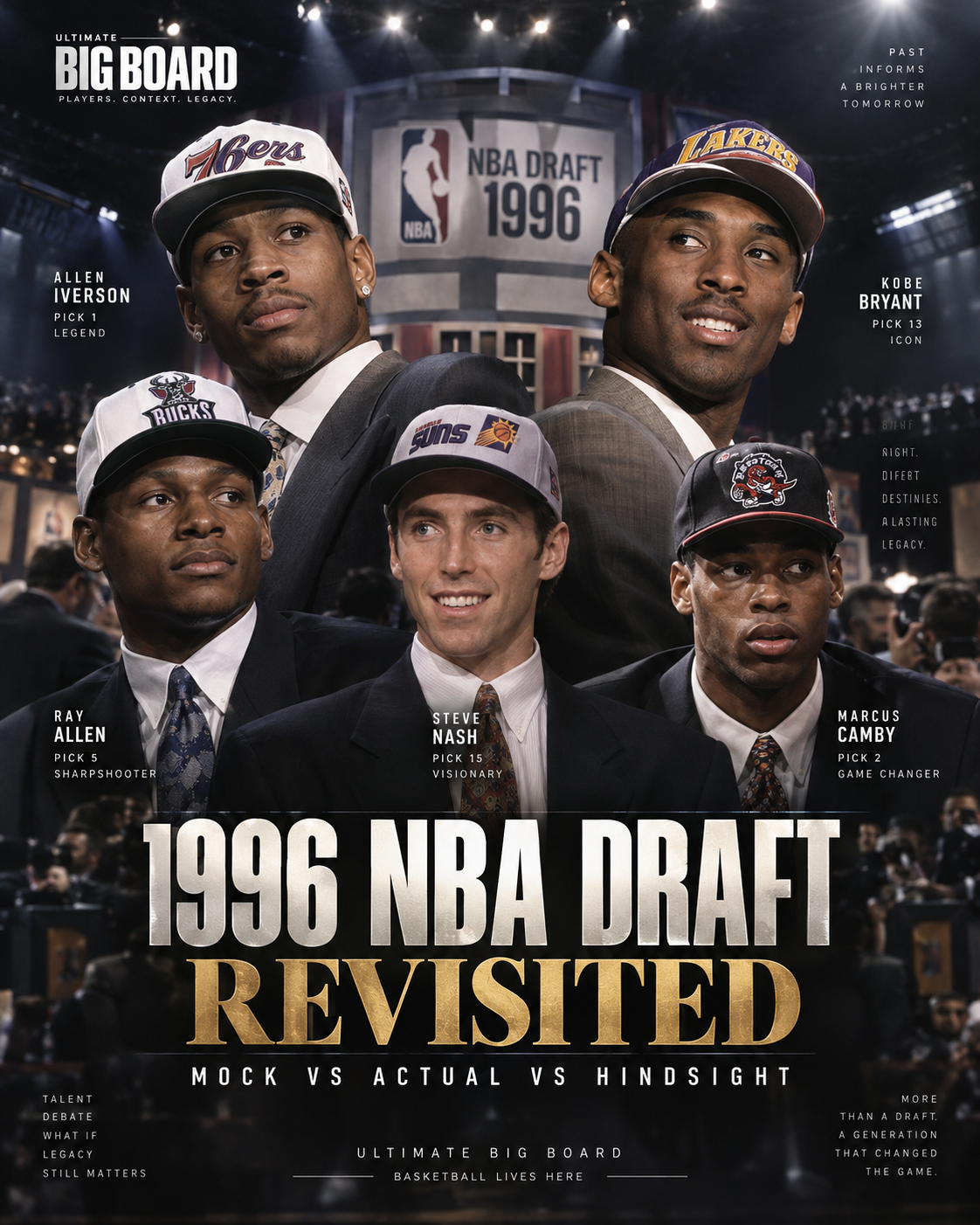
The 1996 draft is usually ranked among the best in NBA history, and the reputation is deserved. It produced Kobe Bryant, Allen Iverson, Steve Nash, Ray Allen, and a long list of All-Stars behind them. What's less remembered is how differently the public saw it at the time. The mock drafts agreed on Iverson at No. 1, and they correctly identified most of the top talent. But they projected Kobe in the middle of the first round, had Nash as a fringe lottery pick, and gave the Greek center Efthimios Rentzias archive rank 9, with a median projected slot of 11.
Several of the class's best players also reached their eventual teams in unusual ways. Kobe told teams he wanted to play for the Lakers and got there through a trade with Charlotte. Ray Allen and Stephon Marbury were swapped on draft night. Nash was booed by Phoenix fans. Jermaine O'Neal spent four years on Portland's bench before becoming a six-time All-Star in Indiana.
This article compares three timelines for every first-round pick. The first is what the public mock market expected, using The Draft Review's 15-mock consensus. The second is who teams actually took. The third is who they should have taken, knowing how every career turned out.
Three-timeline overview
How to read the mock baseline: The Draft Review orders its archive by median projected pick, with average pick as a tiebreaker. Its consensus rank labels, including A/B groups, are separate from projected pick numbers. Each row below shows the actual selection's archive rank, median projected slot, earliest-to-latest projection band and number of mocks listing that player. Medians can be fractional and exclude mocks that omit the player. A missing projection is reported explicitly.
Using actual overall pick equal to median projected slot as the definition of a match, 5 of 29 first-round selections matched; 11 came earlier and 11 later. 2 selections have no archived projection. This is a slot comparison, not a claim that all mocks or a particular team agreed.
| Pick | Team | Actual player's archived mock profile | Actual pick (archive rank) | Hindsight pick |
|---|---|---|---|---|
| 1 | 76ers | Archive rank 1; median slot 1; band 1; 15/15 mocks | Allen Iverson (1) | Kobe Bryant |
| 2 | Raptors | Archive rank 3; median slot 3; band 2–6; 15/15 mocks | Marcus Camby (3) | Allen Iverson |
| 3 | Grizzlies | Archive rank 2; median slot 2; band 2–3; 14/15 mocks | Shareef Abdur-Rahim (2) | Steve Nash |
| 4 | Bucks | Archive rank 4; median slot 4; band 3–5; 15/15 mocks | Stephon Marbury (4) | Ray Allen |
| 5 | Timberwolves | Archive rank 5-A; median slot 5; band 2–7; 15/15 mocks | Ray Allen (5) | Jermaine O'Neal |
| 6 | Celtics | Archive rank 5-B; median slot 5; band 5–9; 15/15 mocks | Antoine Walker (5) | Peja Stojakovic |
| 7 | Clippers | Archive rank 8; median slot 9; band 6–10; 15/15 mocks | Lorenzen Wright (8) | Stephon Marbury |
| 8 | Nets | Archive rank 7-B; median slot 8; band 7–14; 14/15 mocks | Kerry Kittles (7) | Marcus Camby |
| 9 | Mavericks | Archive rank 11; median slot 13; band 12–17; 15/15 mocks | Samaki Walker (11) | Antoine Walker |
| 10 | Pacers | Archive rank 6; median slot 7; band 6–10; 15/15 mocks | Erick Dampier (6) | Shareef Abdur-Rahim |
| 11 | Warriors | Archive rank 10; median slot 12; band 11–22; 15/15 mocks | Todd Fuller (10) | Zydrunas Ilgauskas |
| 12 | Cavaliers | Archive rank 12; median slot 14; band 10–26; 15/15 mocks | Vitaly Potapenko (12) | Derek Fisher |
| 13 | Hornets | Archive rank 15-A; median slot 18; band 12–19; 15/15 mocks | Kobe Bryant (15) | Erick Dampier |
| 14 | Kings | Archive rank 14-B; median slot 17; band 10–28; 11/15 mocks | Peja Stojakovic (14) | Kerry Kittles |
| 15 | Suns | Archive rank 13; median slot 15; band 10–22; 15/15 mocks | Steve Nash (13) | Jerome Williams |
| 16 | Hornets | Archive rank 19; median slot 21.5; band 16–29; 14/15 mocks | Tony Delk (19) | Malik Rose |
| 17 | Trail Blazers | Archive rank 23-A; median slot 25; band 15–29; 14/15 mocks | Jermaine O'Neal (23) | Shandon Anderson |
| 18 | Knicks | Archive rank 7-A; median slot 8; band 5–20; 15/15 mocks | John Wallace (7) | Lorenzen Wright |
| 19 | Knicks | Archive rank 15-B; median slot 18; band 15–28; 14/15 mocks | Walter McCarty (15) | Tony Delk |
| 20 | Cavaliers | Archive rank 16; median slot 19; band 12–28; 13/15 mocks | Zydrunas Ilgauskas (16) | Walter McCarty |
| 21 | Knicks | Archive rank 20-A; median slot 22; band 14–28; 14/15 mocks | Dontae' Jones (20) | Vitaly Potapenko |
| 22 | Grizzlies | Archive rank 17; median slot 20; band 10–29; 15/15 mocks | Roy Rogers (17) | Samaki Walker |
| 23 | Nuggets | Archive rank 9; median slot 11; band 11–27; 15/15 mocks | Efthimios Rentzias (9) | John Wallace |
| 24 | Lakers | Archive rank 27-A; median slot 29; band 29; 1/15 mocks | Derek Fisher (27) | Othella Harrington |
| 25 | Jazz | No projection in the archived 15 mocks | Martin Muursepp (not mocked) | Moochie Norris |
| 26 | Pistons | Archive rank 14-A; median slot 17; band 13–22; 14/15 mocks | Jerome Williams (14) | Jeff McInnis |
| 27 | Magic | Archive rank 23-B; median slot 25; band 22–29; 14/15 mocks | Brian Evans (23) | Todd Fuller |
| 28 | Hawks | Archive rank 23-C; median slot 25; band 18–26; 11/15 mocks | Priest Lauderdale (23) | Roy Rogers |
| 29 | Bulls | No projection in the archived 15 mocks | Travis Knight (not mocked) | Travis Knight |
Pick-by-pick: Mock vs Actual vs Hindsight
No. 1: Philadelphia 76ers — Allen Iverson
What the mock market was saying: Allen Iverson: Archive rank 1; median slot 1; band 1; 15/15 mocks. He was a 6-0 sophomore from Georgetown, perhaps the quickest player in college basketball, and a scorer who could get to the rim against anyone. The concerns were his size, his shot selection, and whether a player that small could carry an NBA team.
Why the 76ers made the pick: Philadelphia had just finished 18–64 and was under new ownership. The 76ers wanted a star who could fill the building again, and Iverson's talent and personality made him that player.
Actual pick versus mock median: The actual selection at No. 1 matched the median projected slot of 1. 15 of 15 listed mocks placed Allen Iverson at that exact pick. This compares overall slots, rather than inferring a team-specific prediction from the archive rank.
What hindsight changes: Iverson won Rookie of the Year, four scoring titles and the 2001 MVP, and carried Philadelphia to the 2001 Finals. He ranks second on the hindsight board.
Kobe is the hindsight pick, and the reason is his whole career, not his first few seasons. Iverson peaked higher and faster, but Kobe won five titles, made 18 All-Star teams and played 20 seasons. In 1996, taking a high schooler first overall would have been unthinkable. It took Kobe several years to become the better player.
No. 2: Toronto Raptors — Marcus Camby
What the mock market was saying: Marcus Camby: Archive rank 3; median slot 3; band 2–6; 15/15 mocks. He had just been named national player of the year at Massachusetts. He was a long, thin shot-blocker who could run the floor, and scouts worried mainly about his weight. Two mocks had him going second to Toronto.
Why the Raptors made the pick: Toronto, heading into its second season, already had a point guard in Damon Stoudamire. Isiah Thomas, who ran the front office, wanted a big man who could defend and block shots, and Camby was the best one in the draft.
Actual pick versus mock median: The actual selection at No. 2 was 1 place earlier than the median projected slot of 3. 2 of 15 listed mocks placed Marcus Camby at that exact pick. This compares overall slots, rather than inferring a team-specific prediction from the archive rank.
What hindsight changes: Camby was traded to the Knicks after two seasons and played a key role on their 1999 Finals team. He later won Defensive Player of the Year with Denver in 2007 and led the league in blocks several times, though injuries cost him many games. He ranks eighth on the hindsight board. Iverson is the redraft pick here.
No. 3: Vancouver Grizzlies — Shareef Abdur-Rahim
What the mock market was saying: Shareef Abdur-Rahim: Archive rank 2; median slot 2; band 2–3; 14/15 mocks. He was a 6-9 freshman from California, a skilled scorer who could play inside and out. Scouts saw one of the most polished young forwards in years and questioned only his defense.
Why the Grizzlies made the pick: Vancouver was glad to see Abdur-Rahim fall to No. 3. The Grizzlies needed a scorer to build around, and he was the best one available.
Actual pick versus mock median: The actual selection at No. 3 was 1 place later than the median projected slot of 2. 2 of 14 listed mocks placed Shareef Abdur-Rahim at that exact pick. This compares overall slots, rather than inferring a team-specific prediction from the archive rank.
What hindsight changes: Abdur-Rahim averaged more than 20 points a game for five straight seasons and made the 2002 All-Star team with Atlanta, but he played on losing teams for most of his career. He ranks 10th. The redraft puts Nash here, a player who would have given the young Grizzlies an organizer for a young roster.
No. 4: Milwaukee Bucks — Stephon Marbury
What the mock market was saying: Stephon Marbury: Archive rank 4; median slot 4; band 3–5; 15/15 mocks. He was a freshman point guard from Georgia Tech, a famous player since his high school days in Brooklyn, and one of the most talented scorers in the country. Scouts questioned his passing and his willingness to share the ball.
Why the Bucks made the pick: Milwaukee drafted Marbury to trade him. The Bucks sent him to Minnesota for Ray Allen, the No. 5 pick, and a future first-round pick. Minnesota wanted Marbury to pair with his friend Kevin Garnett. Milwaukee got a shooting guard it liked and an extra pick for moving down one spot.
Actual pick versus mock median: The actual selection at No. 4 matched the median projected slot of 4. 8 of 15 listed mocks placed Stephon Marbury at that exact pick. This compares overall slots, rather than inferring a team-specific prediction from the archive rank.
What hindsight changes: Marbury made two All-Star teams and averaged more than 20 points a game for much of his career, but he forced his way out of Minnesota in 1999 and never led a team to sustained success. He ranks seventh.
Ray Allen is the hindsight pick. The trade worked well for Milwaukee: Allen made three All-Star teams as a Buck and later won titles with Boston and Miami. He held the NBA record for career three-pointers for a decade.
No. 5: Minnesota Timberwolves — Ray Allen
What the mock market was saying: Ray Allen: Archive rank 5-A; median slot 5; band 2–7; 15/15 mocks. He was a junior from Connecticut with a pure jump shot and more athleticism than his reputation suggested. His range in the mocks ran from No. 2 to No. 7.
Why the Timberwolves made the pick: Minnesota took Allen only to trade him for Marbury. Kevin McHale wanted a point guard to play with Garnett, and Marbury was that player.
Actual pick versus mock median: The actual selection at No. 5 matched the median projected slot of 5. 4 of 15 listed mocks placed Ray Allen at that exact pick. This compares overall slots, rather than inferring a team-specific prediction from the archive rank.
What hindsight changes: Minnesota's trade looked good for three years, then fell apart when Marbury asked out. Allen had a Hall of Fame career. He ranks fourth. At No. 5, the sequential redraft takes Jermaine O'Neal, who would have given Minnesota a big man to play next to Garnett.
No. 6: Boston Celtics — Antoine Walker
What the mock market was saying: Antoine Walker: Archive rank 5-B; median slot 5; band 5–9; 15/15 mocks. He was a sophomore from Kentucky's 1996 national champions, a 6-8 forward who could handle the ball, pass and shoot. Scouts worried about his shot selection and conditioning.
Why the Celtics made the pick: Boston was one of the worst teams in the league and needed talent. Walker was the most versatile forward available, and his skill made him a natural building block.
Actual pick versus mock median: The actual selection at No. 6 was 1 place later than the median projected slot of 5. 4 of 15 listed mocks placed Antoine Walker at that exact pick. This compares overall slots, rather than inferring a team-specific prediction from the archive rank.
What hindsight changes: Walker made three All-Star teams and helped Boston reach the 2002 Eastern Conference Finals, and he won a title with Miami in 2006. He ranks ninth. Peja Stojakovic is the redraft pick here.
No. 7: Los Angeles Clippers — Lorenzen Wright
What the mock market was saying: Lorenzen Wright: Archive rank 8; median slot 9; band 6–10; 15/15 mocks. He was a 6-11 sophomore from Memphis, a strong rebounder with a promising face-up game.
Why the Clippers made the pick: The Clippers needed a big man, and Wright was the best one available. They took him a spot or two before most mocks expected.
Actual pick versus mock median: The actual selection at No. 7 was 2 places earlier than the median projected slot of 9. 0 of 15 listed mocks placed Lorenzen Wright at that exact pick. This compares overall slots, rather than inferring a team-specific prediction from the archive rank.
What hindsight changes: Wright played 13 seasons as a solid rebounder but never became a star. He ranks 18th. Marbury is the redraft pick here.
No. 8: New Jersey Nets — Kerry Kittles
What the mock market was saying: Kerry Kittles: Archive rank 7-B; median slot 8; band 7–14; 14/15 mocks. He was a senior from Villanova, a smooth scorer and good defender who had been one of the Big East's best players.
Why the Nets made the pick: John Calipari, New Jersey's new coach and executive, reportedly considered taking Kobe here. Kobe's camp made it clear he wanted to play for the Lakers and might go to Italy instead of New Jersey. The Nets took Kittles, the player the mocks expected.
Actual pick versus mock median: The actual selection at No. 8 matched the median projected slot of 8. 10 of 14 listed mocks placed Kerry Kittles at that exact pick. This compares overall slots, rather than inferring a team-specific prediction from the archive rank.
What hindsight changes: Kittles was a solid starter for the Nets' 2002 and 2003 Finals teams, but knee injuries shortened his career. He ranks 14th. The redraft puts Camby here.
No. 9: Dallas Mavericks — Samaki Walker
What the mock market was saying: Samaki Walker: Archive rank 11; median slot 13; band 12–17; 15/15 mocks. He was a sophomore from Louisville, an athletic power forward and shot-blocker.
Why the Mavericks made the pick: Dallas was coming off a losing season and needed size in the frontcourt.
Actual pick versus mock median: The actual selection at No. 9 was 4 places earlier than the median projected slot of 13. 0 of 15 listed mocks placed Samaki Walker at that exact pick. This compares overall slots, rather than inferring a team-specific prediction from the archive rank.
What hindsight changes: Walker became a journeyman big man and won a title with the Lakers in 2002. He ranks 22nd. Antoine Walker is the redraft pick here.
No. 10: Indiana Pacers — Erick Dampier
What the mock market was saying: Erick Dampier: Archive rank 6; median slot 7; band 6–10; 15/15 mocks. He was a 6-11 center who had just led Mississippi State to the Final Four.
Why the Pacers made the pick: Indiana was a veteran team with Rik Smits at center and wanted a young big man to develop. Getting a archive top-six ranked player at No. 10 looked like value.
Actual pick versus mock median: The actual selection at No. 10 was 3 places later than the median projected slot of 7. 3 of 15 listed mocks placed Erick Dampier at that exact pick. This compares overall slots, rather than inferring a team-specific prediction from the archive rank.
What hindsight changes: Indiana traded Dampier to Golden State a year later for Chris Mullin. Dampier played 16 seasons and ranks 13th. The redraft puts Abdur-Rahim here.
No. 11: Golden State Warriors — Todd Fuller
What the mock market was saying: Todd Fuller: Archive rank 10; median slot 12; band 11–22; 15/15 mocks. He was a seven-foot senior from North Carolina State, a solid scorer and rebounder who was also an academic All-American. Scouts saw a player who could contribute right away but would probably never be a star. Most mocks had Golden State taking Efthimios Rentzias here instead.
Why the Warriors made the pick: Golden State wanted a center who could play immediately. Fuller was ready now. Rentzias would have stayed in Greece for a few years.
Actual pick versus mock median: The actual selection at No. 11 was 1 place earlier than the median projected slot of 12. 2 of 15 listed mocks placed Todd Fuller at that exact pick. This compares overall slots, rather than inferring a team-specific prediction from the archive rank.
What hindsight changes: Fuller played only a few NBA seasons. He ranks 27th. The redraft takes Zydrunas Ilgauskas, who would have been an international gamble that paid off.
No. 12: Cleveland Cavaliers — Vitaly Potapenko
What the mock market was saying: Vitaly Potapenko: Archive rank 12; median slot 14; band 10–26; 15/15 mocks. He was a strong Ukrainian power forward who had played at Wright State.
Why the Cavaliers made the pick: Mike Fratello's Cavaliers played a slow, physical style and wanted a big man who could rebound and defend. Potapenko fit.
Actual pick versus mock median: The actual selection at No. 12 was 2 places earlier than the median projected slot of 14. 3 of 15 listed mocks placed Vitaly Potapenko at that exact pick. This compares overall slots, rather than inferring a team-specific prediction from the archive rank.
What hindsight changes: Potapenko played 11 seasons as a backup and ranks 21st. The redraft takes Derek Fisher here.
No. 13: Charlotte Hornets — Kobe Bryant
What the mock market was saying: Kobe Bryant: Archive rank 15-A; median slot 18; band 12–19; 15/15 mocks. He was a 17-year-old from Lower Merion High School outside Philadelphia, the son of former NBA player Joe Bryant. He was talented, confident and skilled, but no guard had ever gone straight from high school to the NBA, and scouts disagreed about how long he would need to develop.
Why the Hornets made the pick: Charlotte drafted Kobe for the Lakers. The Lakers traded center Vlade Divac to the Hornets for the pick, a deal that also cleared cap space for the Lakers to sign Shaquille O'Neal in July. Jerry West, the Lakers' general manager, had watched Kobe work out and believed he could be a star. Kobe's camp had told other teams he wanted to play in Los Angeles.
Actual pick versus mock median: The actual selection at No. 13 was 5 places earlier than the median projected slot of 18. 1 of 15 listed mocks placed Kobe Bryant at that exact pick. This compares overall slots, rather than inferring a team-specific prediction from the archive rank.
What hindsight changes: Kobe won five titles, made 18 All-Star teams and was the 2008 MVP. He is No. 1 on the hindsight board. Charlotte got Divac, a good center, for two seasons. The Lakers got one of the best players ever.
The sequential redraft has Dampier here. By No. 13, the best players from this draft are already gone in the redraft, which shows how strong the top of this class was.
No. 14: Sacramento Kings — Peja Stojakovic
What the mock market was saying: Peja Stojakovic: Archive rank 14-B; median slot 17; band 10–28; 11/15 mocks. He was a 6-9 forward playing for PAOK in Greece, a smooth shooter whose contract made it unclear when he could join an NBA team.
Why the Kings made the pick: Geoff Petrie, Sacramento's general manager, was willing to wait. The Kings let Stojakovic stay in Greece for two more seasons.
Actual pick versus mock median: The actual selection at No. 14 was 3 places earlier than the median projected slot of 17. 2 of 11 listed mocks placed Peja Stojakovic at that exact pick. This compares overall slots, rather than inferring a team-specific prediction from the archive rank.
What hindsight changes: Stojakovic arrived in 1998, became a three-time All-Star and one of the league's best shooters, and won a title with Dallas in 2011. He ranks sixth. Kittles is the redraft pick here.
No. 15: Phoenix Suns — Steve Nash
What the mock market was saying: Steve Nash: Archive rank 13; median slot 15; band 10–22; 15/15 mocks. He was a Canadian point guard from Santa Clara, a small school. He was a smart passer and good shooter, but scouts worried about his athleticism and defense.
Why the Suns made the pick: Phoenix took Nash despite already having Kevin Johnson at point guard. Suns fans at the draft party booed the pick. Phoenix saw a player who could develop behind a veteran.
Actual pick versus mock median: The actual selection at No. 15 matched the median projected slot of 15. 3 of 15 listed mocks placed Steve Nash at that exact pick. This compares overall slots, rather than inferring a team-specific prediction from the archive rank.
What hindsight changes: Nash backed up in Phoenix for two seasons, was traded to Dallas in 1998, and became an All-Star there. He returned to Phoenix in 2004 and won two MVPs. He ranks third. Jerome Williams is the redraft pick here.
No. 16: Charlotte Hornets — Tony Delk
What the mock market was saying: Tony Delk: Archive rank 19; median slot 21.5; band 16–29; 14/15 mocks. He was the Final Four's Most Outstanding Player for Kentucky's 1996 champions, a guard who could score.
Why the Hornets made the pick: After trading its first pick for Divac, Charlotte wanted a guard who could score, and Delk's championship experience made him an attractive choice.
Actual pick versus mock median: The actual selection at No. 16 was 5.5 places earlier than the median projected slot of 21.5. 5 of 14 listed mocks placed Tony Delk at that exact pick. This compares overall slots, rather than inferring a team-specific prediction from the archive rank.
What hindsight changes: Delk played 10 seasons and once scored 53 points in a game for Phoenix. He ranks 19th. The redraft takes Malik Rose, a second-rounder who won two titles with San Antonio.
No. 17: Portland Trail Blazers — Jermaine O'Neal
What the mock market was saying: Jermaine O'Neal: Archive rank 23-A; median slot 25; band 15–29; 14/15 mocks. He was a 6-11 high schooler from South Carolina, long and athletic but very raw.
Why the Trail Blazers made the pick: Portland was a deep playoff team and could afford to wait years for a teenager to develop.
Actual pick versus mock median: The actual selection at No. 17 was 8 places earlier than the median projected slot of 25. 1 of 14 listed mocks placed Jermaine O'Neal at that exact pick. This compares overall slots, rather than inferring a team-specific prediction from the archive rank.
What hindsight changes: O'Neal barely played in four seasons behind Portland's veteran big men. He was traded to Indiana in 2000, where he became a six-time All-Star and won Most Improved Player in 2002. He ranks fifth. Portland made the right pick but didn't keep him. Shandon Anderson, who went 54th, is the redraft pick here.
No. 18: New York Knicks — John Wallace
What the mock market was saying: John Wallace: Archive rank 7-A; median slot 8; band 5–20; 15/15 mocks. He was a senior from Syracuse who had led the Orange to the 1996 title game after withdrawing from the 1995 draft. Scouts questioned whether he was a small forward or a power forward.
Why the Knicks made the pick: New York had three first-round picks and got a lottery-level talent at No. 18.
Actual pick versus mock median: The actual selection at No. 18 was 10 places later than the median projected slot of 8. 0 of 15 listed mocks placed John Wallace at that exact pick. This compares overall slots, rather than inferring a team-specific prediction from the archive rank.
What hindsight changes: Wallace had a journeyman career and ranks 23rd. Lorenzen Wright is the redraft pick here.
No. 19: New York Knicks — Walter McCarty
What the mock market was saying: Walter McCarty: Archive rank 15-B; median slot 18; band 15–28; 14/15 mocks. He was a 6-10 forward from Kentucky's championship team.
Why the Knicks made the pick: New York took a versatile forward with its second pick.
Actual pick versus mock median: The actual selection at No. 19 was 1 place later than the median projected slot of 18. 1 of 14 listed mocks placed Walter McCarty at that exact pick. This compares overall slots, rather than inferring a team-specific prediction from the archive rank.
What hindsight changes: McCarty was traded to Boston in 1997 and became a long-time bench player there. He ranks 20th. Delk is the redraft pick here.
No. 20: Cleveland Cavaliers — Zydrunas Ilgauskas
What the mock market was saying: Zydrunas Ilgauskas: Archive rank 16; median slot 19; band 12–28; 13/15 mocks. He was a 7-3 Lithuanian center. Scouts liked his size and skill, but foot problems were already a concern.
Why the Cavaliers made the pick: Cleveland had already taken Potapenko at No. 12 and used its second pick on a riskier, more talented big man.
Actual pick versus mock median: The actual selection at No. 20 was 1 place later than the median projected slot of 19. 2 of 13 listed mocks placed Zydrunas Ilgauskas at that exact pick. This compares overall slots, rather than inferring a team-specific prediction from the archive rank.
What hindsight changes: Ilgauskas missed his entire first season and much of three later seasons with foot injuries. When healthy, he became a two-time All-Star and played 12 seasons with Cleveland. He ranks 11th. McCarty is the redraft pick here.
No. 21: New York Knicks — Dontae' Jones
What the mock market was saying: Dontae' Jones: Archive rank 20-A; median slot 22; band 14–28; 14/15 mocks. He was a forward from Mississippi State's Final Four team.
Why the Knicks made the pick: New York took another talented forward with its third pick.
Actual pick versus mock median: The actual selection at No. 21 was 1 place earlier than the median projected slot of 22. 0 of 14 listed mocks placed Dontae' Jones at that exact pick. This compares overall slots, rather than inferring a team-specific prediction from the archive rank.
What hindsight changes: Jones was hurt as a rookie and played very little in the NBA. He falls outside the hindsight board's top 29. Potapenko is the redraft pick here.
No. 22: Vancouver Grizzlies — Roy Rogers
What the mock market was saying: Roy Rogers: Archive rank 17; median slot 20; band 10–29; 15/15 mocks. He was a shot-blocker from Alabama.
Why the Grizzlies made the pick: Vancouver took a defensive big man to go with Abdur-Rahim and Bryant Reeves.
Actual pick versus mock median: The actual selection at No. 22 was 2 places later than the median projected slot of 20. 2 of 15 listed mocks placed Roy Rogers at that exact pick. This compares overall slots, rather than inferring a team-specific prediction from the archive rank.
What hindsight changes: Rogers played only a few NBA seasons and ranks 28th. Samaki Walker is the redraft pick here.
No. 23: Denver Nuggets — Efthimios Rentzias
What the mock market was saying: Efthimios Rentzias: Archive rank 9; median slot 11; band 11–27; 15/15 mocks. He was a 6-11 Greek center, still a teenager, whom scouts considered one of the best young big men in Europe.
Why the Nuggets made the pick: Denver took a chance on a player it could leave in Europe to develop.
Actual pick versus mock median: The actual selection at No. 23 was 12 places later than the median projected slot of 11. 0 of 15 listed mocks placed Efthimios Rentzias at that exact pick. This compares overall slots, rather than inferring a team-specific prediction from the archive rank.
What hindsight changes: Rentzias played one NBA season and spent most of his career in Europe. He falls outside the hindsight board's top 29. Wallace is the redraft pick here.
No. 24: Los Angeles Lakers — Derek Fisher
What the mock market was saying: Derek Fisher: Archive rank 27-A; median slot 29; band 29; 1/15 mocks. He was a point guard from Arkansas-Little Rock, a small school.
Why the Lakers made the pick: Jerry West liked Fisher's toughness and defense, and the Lakers needed a backup point guard.
Actual pick versus mock median: The actual selection at No. 24 was 5 places earlier than the median projected slot of 29. 0 of 1 listed mock placed Derek Fisher at that exact pick. This compares overall slots, rather than inferring a team-specific prediction from the archive rank.
What hindsight changes: Fisher won five titles with the Lakers and played 18 seasons, including the famous 0.4-second shot against San Antonio in 2004. He ranks 12th. The sequential redraft puts Othella Harrington here.
No. 25: Utah Jazz — Martin Muursepp
What the mock market was saying: Martin Muursepp: No projection in the archived 15 mocks. He was an Estonian forward.
Why the Jazz made the pick: Utah drafted Muursepp and traded his rights to Miami.
Actual pick versus mock median: The archive does not list a projection for Martin Muursepp, so no median-slot comparison is available for the actual selection at No. 25.
What hindsight changes: Muursepp played briefly for Miami and Dallas, and he was part of the 1998 trade that sent Steve Nash to Dallas. He falls outside the hindsight board's top 29. Moochie Norris is the redraft pick here.
No. 26: Detroit Pistons — Jerome Williams
What the mock market was saying: Jerome Williams: Archive rank 14-A; median slot 17; band 13–22; 14/15 mocks. He was a senior from Georgetown, Iverson's college teammate, and an energetic rebounder and defender.
Why the Pistons made the pick: Detroit got a consensus lottery-level player at No. 26 and a hard worker who fit its style.
Actual pick versus mock median: The actual selection at No. 26 was 9 places later than the median projected slot of 17. 0 of 14 listed mocks placed Jerome Williams at that exact pick. This compares overall slots, rather than inferring a team-specific prediction from the archive rank.
What hindsight changes: Williams, known as "Junkyard Dog," had a long career as a rebounder and energy player. He ranks 15th. Jeff McInnis is the redraft pick here.
No. 27: Orlando Magic — Brian Evans
What the mock market was saying: Brian Evans: Archive rank 23-B; median slot 25; band 22–29; 14/15 mocks. He was a forward from Indiana.
Why the Magic made the pick: Orlando, which was weeks away from losing Shaquille O'Neal to the Lakers in free agency, took a forward who could shoot.
Actual pick versus mock median: The actual selection at No. 27 was 2 places later than the median projected slot of 25. 0 of 14 listed mocks placed Brian Evans at that exact pick. This compares overall slots, rather than inferring a team-specific prediction from the archive rank.
What hindsight changes: Evans played only a few NBA seasons. He falls outside the hindsight board's top 29. Todd Fuller is the redraft pick here.
No. 28: Atlanta Hawks — Priest Lauderdale
What the mock market was saying: Priest Lauderdale: Archive rank 23-C; median slot 25; band 18–26; 11/15 mocks. He was a 7-4 center playing in Greece.
Why the Hawks made the pick: Atlanta took a chance on size.
Actual pick versus mock median: The actual selection at No. 28 was 3 places later than the median projected slot of 25. 0 of 11 listed mocks placed Priest Lauderdale at that exact pick. This compares overall slots, rather than inferring a team-specific prediction from the archive rank.
What hindsight changes: Lauderdale played two NBA seasons and falls outside the hindsight board's top 29. Roy Rogers is the redraft pick here.
No. 29: Chicago Bulls — Travis Knight
What the mock market was saying: Travis Knight: No projection in the archived 15 mocks. He was a center from Connecticut.
Why the Bulls made the pick: Chicago had just won 72 games and a title. The Bulls took Knight and later renounced his rights, and he signed with the Lakers.
Actual pick versus mock median: The archive does not list a projection for Travis Knight, so no median-slot comparison is available for the actual selection at No. 29.
What hindsight changes: Knight played several seasons as a backup center. He ranks 29th, and the sequential redraft keeps him here.
Why the three timelines split
The mocks correctly identified the top of the class. Iverson, Abdur-Rahim, Camby, Marbury, Allen and Antoine Walker all made the top six players in the archive order, and all went in the top six. The public read the top of this draft very well.
Where the mocks missed was high school and international talent. The median projected slots were 18 for Kobe, 25 for O'Neal, 17 for Stojakovic and 19 for Ilgauskas. Those four players became the first, fifth, sixth and eleventh best in the class. The public had no reliable way to evaluate players it had rarely seen.
Private deals shaped the draft. The Lakers arranged the pick that became Kobe. Milwaukee and Minnesota agreed to swap Marbury and Allen. The mocks couldn't account for either deal.
Teams chose college centers they could count on. Golden State took Fuller instead of Rentzias, Kobe or Nash. The Clippers took Wright a spot early. In both cases, the team wanted a big man ready to play.
Several teams drafted well but didn't keep their players. Portland had O'Neal, Phoenix had Nash, and Boston had Walker. O'Neal and Nash became stars elsewhere.
What the mock market got right
The archive ranked Iverson, Allen and Marbury in its top five rank groups; their median projected slots were 1, 5 and 4. It also rated Jerome Williams and John Wallace much higher than the teams did, though neither became more than a role player.
Where teams beat the mocks
The Lakers had the best draft of any team, getting Kobe at No. 13 and Fisher at No. 24. Jerry West's judgment beat the public's on both players. Sacramento's patience with Stojakovic and Cleveland's gamble on Ilgauskas also paid off.
Hindsight top five
- Kobe Bryant
- Allen Iverson
- Steve Nash
- Ray Allen
- Jermaine O'Neal
FAQ
Who should go No. 1 in a 1996 NBA redraft?
Kobe Bryant. Iverson peaked faster, but Kobe's five titles and 20-year career give him the edge.
What did mock drafts predict in the 1996 NBA Draft?
The Draft Review's archive separates rank labels from median projected slots. Using actual overall pick equal to median projected slot as the definition of a match, 5 of 29 first-round selections matched; 11 came earlier and 11 later. 2 selections have no archived projection. This is a slot comparison, not a claim that all mocks or a particular team agreed.
Who was the biggest draft-night slide in 1996?
Among first-round selections with an archived projection, the largest difference below the mock median was 12 places: Efthimios Rentzias (median slot 11, actual No. 23, archive rank 9; 15 mocks). This uses median projected slot, not the archive rank number.
What is the biggest lesson from the 1996 NBA Draft?
The public was good at evaluating college players and bad at evaluating high schoolers and international players. The best teams trusted their own scouting of the players the public couldn't see.
Full hindsight board
| Hindsight rank | Player |
|---|---|
| 1 | Kobe Bryant |
| 2 | Allen Iverson |
| 3 | Steve Nash |
| 4 | Ray Allen |
| 5 | Jermaine O'Neal |
| 6 | Peja Stojakovic |
| 7 | Stephon Marbury |
| 8 | Marcus Camby |
| 9 | Antoine Walker |
| 10 | Shareef Abdur-Rahim |
| 11 | Zydrunas Ilgauskas |
| 12 | Derek Fisher |
| 13 | Erick Dampier |
| 14 | Kerry Kittles |
| 15 | Jerome Williams |
| 16 | Malik Rose |
| 17 | Shandon Anderson |
| 18 | Lorenzen Wright |
| 19 | Tony Delk |
| 20 | Walter McCarty |
| 21 | Vitaly Potapenko |
| 22 | Samaki Walker |
| 23 | John Wallace |
| 24 | Othella Harrington |
| 25 | Moochie Norris |
| 26 | Jeff McInnis |
| 27 | Todd Fuller |
| 28 | Roy Rogers |
| 29 | Travis Knight |
The board includes drafted players only. Ben Wallace, who went undrafted in 1996 and became a four-time Defensive Player of the Year and a Hall of Famer, would rank near the top if undrafted players were included.
Sources and methodology
- Historical mock baseline: The Draft Review's 1996 consensus mock draft, built from 15 mock drafts. https://www.thedraftreview.com/consensus-mock-draft-archive/1996-nba-draft-consensus-mock-draft
- Actual first-round order and transaction context: historical NBA draft records.
- Hindsight rankings are Ultimate Big Board editorial judgments built around peak value, longevity, two-way impact, postseason utility, role portability, and overall career production.
- Alternate-history notes are interpretive and do not assume every downstream roster move remains unchanged.