
1997 NBA Draft Revisited: Mock vs Actual vs Hindsight
Compare the historical mock market, the actual first round, and a full-career hindsight board for the 1997 NBA Draft.
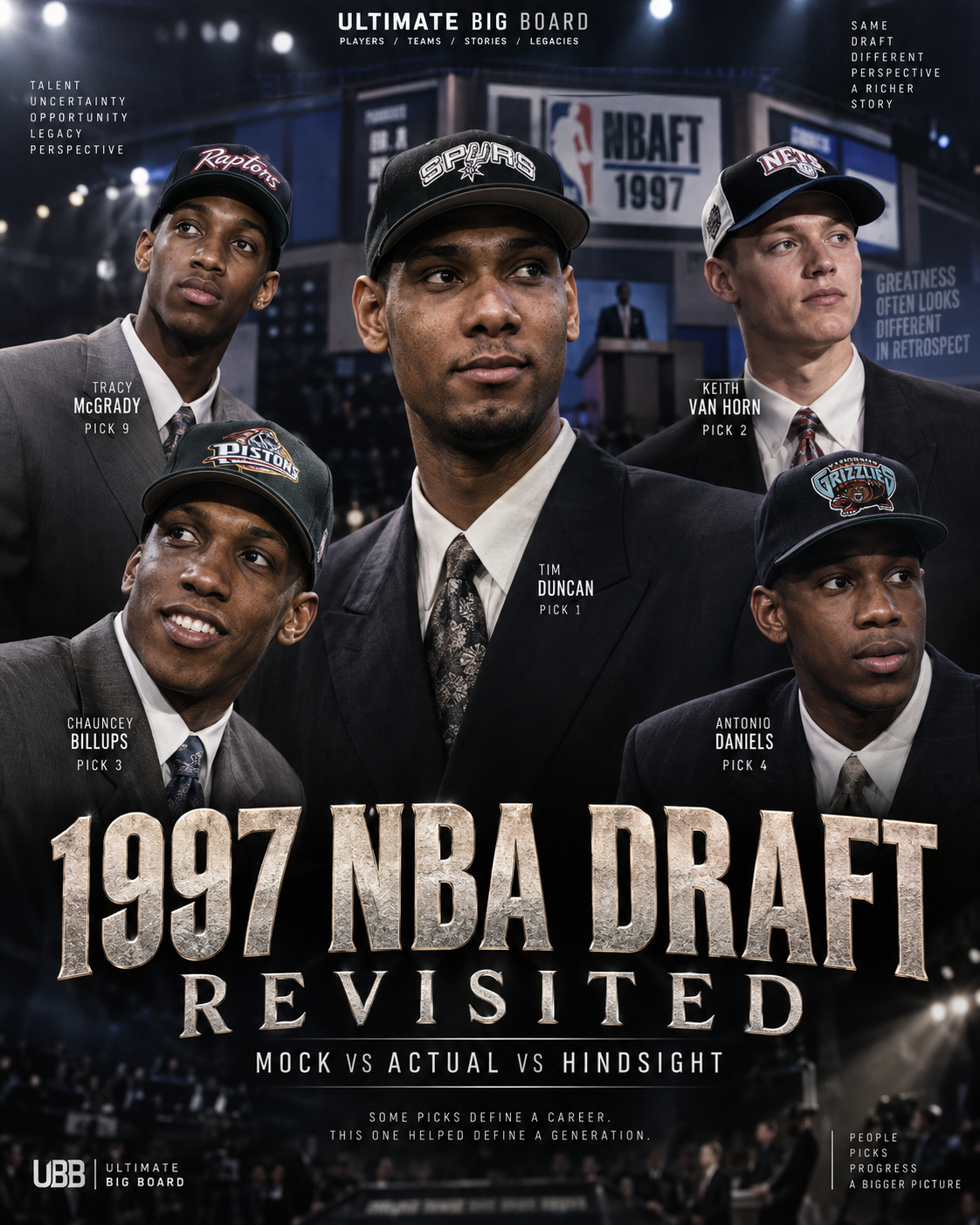
Everyone knew how the 1997 draft would start. Tim Duncan was the only sure thing, and the lottery decided which team would get him. The Boston Celtics had the best odds, having finished 15–67 in a season many people believed they had played to lose. The San Antonio Spurs, who had lost David Robinson to injury for almost the entire year, won instead.
After Duncan, the class was viewed with suspicion, and hindsight confirms that most of the suspicion was deserved. But the two best players after Duncan were drafted in ways that tell you how the league thought in 1997. Chauncey Billups was taken third, traded halfway through his rookie season, and didn't become a star until his sixth year and fifth team. Tracy McGrady, a high schooler from a prep academy in North Carolina, went ninth after teams took a string of college big men ahead of him.
This article compares three timelines for every first-round pick. The first is what the public mock market expected, using The Draft Review's 15-mock consensus. The second is who teams actually took. The third is who they should have taken, knowing how every career turned out. Washington forfeited its first-round pick as a penalty for its 1996 signing of Juwan Howard, so the first round had 28 picks.
Three-timeline overview
How to read the mock baseline: The Draft Review orders its archive by median projected pick, with average pick as a tiebreaker. Its consensus rank labels, including A/B groups, are separate from projected pick numbers. Each row below shows the actual selection's archive rank, median projected slot, earliest-to-latest projection band and number of mocks listing that player. Medians can be fractional and exclude mocks that omit the player. A missing projection is reported explicitly.
Using actual overall pick equal to median projected slot as the definition of a match, 10 of 28 first-round selections matched; 10 came earlier and 6 later. 2 selections have no archived projection. This is a slot comparison, not a claim that all mocks or a particular team agreed.
| Pick | Team | Actual player's archived mock profile | Actual pick (archive rank) | Hindsight pick |
|---|---|---|---|---|
| 1 | Spurs | Archive rank 1; median slot 1; band 1; 15/15 mocks | Tim Duncan (1) | Tim Duncan |
| 2 | 76ers | Archive rank 2-B; median slot 3; band 2–5; 15/15 mocks | Keith Van Horn (2) | Tracy McGrady |
| 3 | Celtics | Archive rank 2-A; median slot 3; band 2–5; 15/15 mocks | Chauncey Billups (2) | Chauncey Billups |
| 4 | Grizzlies | Archive rank 3; median slot 4; band 4; 15/15 mocks | Antonio Daniels (3) | Stephen Jackson |
| 5 | Nuggets | Archive rank 4; median slot 5; band 2–10; 15/15 mocks | Tony Battie (4) | Keith Van Horn |
| 6 | Celtics | Archive rank 8; median slot 9; band 2–11; 15/15 mocks | Ron Mercer (8) | Tim Thomas |
| 7 | Nets | Archive rank 6; median slot 7; band 6–9; 15/15 mocks | Tim Thomas (6) | Derek Anderson |
| 8 | Warriors | Archive rank 7; median slot 8; band 7–10; 15/15 mocks | Adonal Foyle (7) | Bobby Jackson |
| 9 | Raptors | Archive rank 5; median slot 6; band 6–9; 15/15 mocks | Tracy McGrady (5) | Antonio Daniels |
| 10 | Bucks | Archive rank 11-C; median slot 13; band 7–24; 14/15 mocks | Danny Fortson (11) | Anthony Parker |
| 11 | Kings | Archive rank 11-A; median slot 13; band 9–16; 15/15 mocks | Olivier Saint-Jean (11) | Maurice Taylor |
| 12 | Pacers | Archive rank 10-A; median slot 12; band 11–18; 15/15 mocks | Austin Croshere (10) | Ron Mercer |
| 13 | Cavaliers | Archive rank 11-B; median slot 13; band 13–16; 15/15 mocks | Derek Anderson (11) | Austin Croshere |
| 14 | Clippers | Archive rank 12; median slot 15; band 8–27; 15/15 mocks | Maurice Taylor (12) | Tony Battie |
| 15 | Mavericks | Archive rank 9; median slot 11; band 10–19; 14/15 mocks | Kelvin Cato (9) | Brevin Knight |
| 16 | Cavaliers | Archive rank 13; median slot 16; band 8–21; 15/15 mocks | Brevin Knight (13) | Anthony Johnson |
| 17 | Magic | Archive rank 14-B; median slot 17; band 12–23; 12/15 mocks | Johnny Taylor (14) | Alvin Williams |
| 18 | Trail Blazers | Archive rank 16-A; median slot 19.5; band 14–27; 14/15 mocks | Chris Anstey (16) | Scot Pollard |
| 19 | Pistons | Archive rank 26-A; median slot 28; band 25–28; 5/15 mocks | Scot Pollard (26) | Jacque Vaughn |
| 20 | Timberwolves | Archive rank 16-B; median slot 19.5; band 18–28; 12/15 mocks | Paul Grant (16) | Danny Fortson |
| 21 | Nets | Archive rank 21-A; median slot 23; band 14–28; 15/15 mocks | Anthony Parker (21) | Kelvin Cato |
| 22 | Hawks | Archive rank 21-B; median slot 23; band 20–27; 11/15 mocks | Ed Gray (21) | Adonal Foyle |
| 23 | SuperSonics | Archive rank 22-A; median slot 24; band 19–26; 10/15 mocks | Bobby Jackson (22) | Marc Jackson |
| 24 | Rockets | No projection in the archived 15 mocks | Rodrick Rhodes (not mocked) | Olivier Saint-Jean |
| 25 | Knicks | Archive rank 18-A; median slot 21; band 18–27; 9/15 mocks | John Thomas (18) | Charles Smith |
| 26 | Heat | No projection in the archived 15 mocks | Charles Smith (not mocked) | Ed Gray |
| 27 | Jazz | Archive rank 14-A; median slot 17; band 10–22; 13/15 mocks | Jacque Vaughn (14) | John Thomas |
| 28 | Bulls | Archive rank 25; median slot 26.5; band 26–27; 2/15 mocks | Keith Booth (25) | Johnny Taylor |
Pick-by-pick: Mock vs Actual vs Hindsight
No. 1: San Antonio Spurs — Tim Duncan
What the mock market was saying: Tim Duncan: Archive rank 1; median slot 1; band 1; 15/15 mocks. He was the national player of the year at Wake Forest, a senior who had turned down the NBA twice, and a seven-footer who could score, rebound, pass and defend. The only criticisms scouts could find were his free-throw shooting and a calm demeanor that some read as a lack of fire.
Why the Spurs made the pick: There was nothing to decide. San Antonio had gone 20–62 while Robinson missed all but six games, and the lottery gave them the one player who could turn that season into a dynasty. Pairing Duncan with a healthy Robinson gave the Spurs two of the best big men in the league.
Actual pick versus mock median: The actual selection at No. 1 matched the median projected slot of 1. 15 of 15 listed mocks placed Tim Duncan at that exact pick. This compares overall slots, rather than inferring a team-specific prediction from the archive rank.
What hindsight changes: Nothing. Duncan won five titles, two MVPs and three Finals MVPs, all with the Spurs. He's the easy No. 1 on the hindsight board.
No. 2: Philadelphia 76ers — Keith Van Horn
What the mock market was saying: Keith Van Horn: Archive rank 2-B; median slot 3; band 2–5; 15/15 mocks. He was a 6-10 forward from Utah who could shoot from outside, a four-year player who had been a star in the WAC. Scouts saw a polished scorer who would contribute immediately. The concerns were his strength and whether he could defend either forward position.
Why the 76ers made the pick: Philadelphia drafted Van Horn to trade him. Larry Brown had just taken over the team, and the 76ers sent Van Horn and three veterans to New Jersey for Jim Jackson, Eric Montross, and two players the Nets had just drafted: Tim Thomas at No. 7 and Anthony Parker at No. 21. Brown wanted to reshape the roster around Allen Iverson, and New Jersey wanted a young scorer.
Actual pick versus mock median: The actual selection at No. 2 was 1 place earlier than the median projected slot of 3. 6 of 15 listed mocks placed Keith Van Horn at that exact pick. This compares overall slots, rather than inferring a team-specific prediction from the archive rank.
What hindsight changes: Van Horn averaged around 20 points a game in his first two seasons and helped the Nets reach the 2002 Finals, but injuries and defense limited him, and his career faded early. He ranks fifth on the hindsight board.
McGrady is the hindsight pick. His median projected slot was 6 (archive rank 5), so he wasn't an obscure choice. Philadelphia's problem is that Brown wanted veterans and a roster that could win soon. A high schooler who would need three years to develop didn't fit that plan, even though he became the second-best player in the draft.
No. 3: Boston Celtics — Chauncey Billups
What the mock market was saying: Chauncey Billups: Archive rank 2-A; median slot 3; band 2–5; 15/15 mocks. He was a strong, physical guard from Colorado who could score and had the size to play either backcourt position. The question was which position he really played. Some scouts saw a shooting guard in a point guard's body.
Why the Celtics made the pick: Rick Pitino had just been hired from Kentucky to run the team as president and coach. Boston had lost the Duncan lottery but held two top-six picks. Billups was the best guard available and fit Pitino's pressing, up-tempo style.
Actual pick versus mock median: The actual selection at No. 3 matched the median projected slot of 3. 10 of 15 listed mocks placed Chauncey Billups at that exact pick. This compares overall slots, rather than inferring a team-specific prediction from the archive rank.
What hindsight changes: The pick was right, but Boston didn't wait for it to pay off. Pitino traded Billups to Toronto after just 51 games. Billups then played for Denver and Minnesota before landing in Detroit in 2002, where he became an All-Star, a Finals MVP in 2004, and eventually a Hall of Famer. He ranks third on the hindsight board, and that's where the sequential redraft places him.
The lesson here isn't about the draft. It's about patience. Billups needed time to learn to play point guard, and the team that drafted him didn't give it to him.
No. 4: Vancouver Grizzlies — Antonio Daniels
What the mock market was saying: Antonio Daniels: Archive rank 3; median slot 4; band 4; 15/15 mocks. He was a long, quick point guard from Bowling Green who had played in the Mid-American Conference, and scouts saw him as a smart, steady player.
Why the Grizzlies made the pick: Vancouver, in its third season, needed a point guard to run its offense around Shareef Abdur-Rahim and Bryant Reeves. Daniels was the best one available, and the Grizzlies made little secret of their interest.
Actual pick versus mock median: The actual selection at No. 4 matched the median projected slot of 4. 15 of 15 listed mocks placed Antonio Daniels at that exact pick. This compares overall slots, rather than inferring a team-specific prediction from the archive rank.
What hindsight changes: Daniels lasted one season in Vancouver. The Grizzlies took Mike Bibby in the 1998 draft and traded Daniels to San Antonio, where he became a useful backup on the Spurs' 1999 title team. He played 13 seasons and ranks ninth on the hindsight board.
The hindsight pick is Stephen Jackson, who went 42nd to Phoenix after one season at a junior college. He was cut, played in the CBA and overseas, and didn't stick in the NBA until 2000. He then became a starter for the 2003 champion Spurs and a leader of the 2007 "We Believe" Warriors. Nobody could have projected that path in 1997, and it's why he fell so far.
No. 5: Denver Nuggets — Tony Battie
What the mock market was saying: Tony Battie: Archive rank 4; median slot 5; band 2–10; 15/15 mocks. He was a 6-11 junior from Texas Tech, athletic and long, with a good face-up game. Five mocks had him going second, which shows how highly some scouts rated him.
Why the Nuggets made the pick: Denver had just traded Antonio McDyess and needed a big man. Battie was the most athletic big available and fit the Nuggets' need for frontcourt size.
Actual pick versus mock median: The actual selection at No. 5 matched the median projected slot of 5. 8 of 15 listed mocks placed Tony Battie at that exact pick. This compares overall slots, rather than inferring a team-specific prediction from the archive rank.
What hindsight changes: The Nuggets won just 11 games in 1997–98, and Battie was traded to the Lakers a year later. He played 15 seasons as a backup big and ranks 14th on the hindsight board.
The redraft puts Van Horn here. McGrady was still available in the actual draft, and his median projected slot was 6 (archive rank 5). Denver was one of several teams that picked a big man over McGrady, and that shared preference for size is the main theme of the 1997 lottery.
No. 6: Boston Celtics — Ron Mercer
What the mock market was saying: Ron Mercer: Archive rank 8; median slot 9; band 2–11; 15/15 mocks. He was a smooth, athletic scorer from Kentucky, a sophomore who had played for Pitino. Some scouts worried he was more of a scorer than a complete player.
Why the Celtics made the pick: Pitino took the player he knew best. Mercer had been part of his 1996 national title team at Kentucky, and Pitino trusted him to run his system. With Billups at No. 3, Boston left the first round with two young guards who fit the coach's style.
Actual pick versus mock median: The actual selection at No. 6 was 3 places earlier than the median projected slot of 9. 4 of 15 listed mocks placed Ron Mercer at that exact pick. This compares overall slots, rather than inferring a team-specific prediction from the archive rank.
What hindsight changes: Mercer was named to the All-Rookie First Team but never developed further, and Boston traded him after two seasons. He ranks 12th. The sequential redraft puts Tim Thomas here. Boston's larger lesson is that it drafted two players Pitino liked and gave up on the better one after half a season.
No. 7: New Jersey Nets — Tim Thomas
What the mock market was saying: Tim Thomas: Archive rank 6; median slot 7; band 6–9; 15/15 mocks. He was a 6-10 freshman from Villanova with guard skills, and scouts saw him as one of the most talented players in the class. The concern was his motivation. Scouts questioned whether he played as hard as his talent demanded.
Why the Nets made the pick: New Jersey drafted Thomas for Philadelphia as part of the Van Horn trade. The mocks had predicted Thomas would go to the 76ers, and he did. They just didn't know he would get there by way of the Nets.
Actual pick versus mock median: The actual selection at No. 7 matched the median projected slot of 7. 11 of 15 listed mocks placed Tim Thomas at that exact pick. This compares overall slots, rather than inferring a team-specific prediction from the archive rank.
What hindsight changes: Thomas had a long career, mostly in Milwaukee, as a talented forward who never became a star. He ranks sixth. The hindsight pick is Derek Anderson, a Kentucky guard whose smooth scoring made him a long-time starter.
No. 8: Golden State Warriors — Adonal Foyle
What the mock market was saying: Adonal Foyle: Archive rank 7; median slot 8; band 7–10; 15/15 mocks. He had dominated the Patriot League at Colgate and left as the NCAA's career leader in blocked shots. Scouts liked his strength, instincts and defense, but worried about his offense.
Why the Warriors made the pick: Golden State was a franchise in turmoil. P.J. Carlesimo had just been hired as coach, and the Warriors needed a defensive center. Foyle's shot-blocking and work ethic fit what the team wanted to build.
Actual pick versus mock median: The actual selection at No. 8 matched the median projected slot of 8. 10 of 15 listed mocks placed Adonal Foyle at that exact pick. This compares overall slots, rather than inferring a team-specific prediction from the archive rank.
What hindsight changes: Foyle spent 10 seasons with the Warriors as a backup center and defensive specialist, but never developed offensively. He ranks 22nd on the hindsight board. McGrady was still available, and the Warriors passed on him for Foyle. At No. 8, the sequential redraft takes Bobby Jackson, the 2003 Sixth Man of the Year.
No. 9: Toronto Raptors — Tracy McGrady
What the mock market was saying: Tracy McGrady: Archive rank 5; median slot 6; band 6–9; 15/15 mocks. He had been a little-known high school player a year earlier, then became a star on the summer camp circuit and spent his senior year at Mount Zion Christian Academy. He was 6-8 with a guard's skills and a big wingspan. Only three high schoolers had been drafted in the previous two years, Kevin Garnett in 1995 and Kobe Bryant and Jermaine O'Neal in 1996, and teams didn't yet know how to value them.
Why the Raptors made the pick: Toronto was a new franchise that needed a star, and Isiah Thomas, who ran the front office, was willing to wait for a teenager to develop. The Raptors had traded their first star, Damon Stoudamire, and wanted a young player who could become the face of the team.
Actual pick versus mock median: The actual selection at No. 9 was 3 places later than the median projected slot of 6. 3 of 15 listed mocks placed Tracy McGrady at that exact pick. This compares overall slots, rather than inferring a team-specific prediction from the archive rank.
What hindsight changes: McGrady spent three seasons in Toronto, mostly as a backup, then signed with Orlando in 2000. There he won two scoring titles and made seven All-Star teams on his way to the Hall of Fame. He ranks second on the hindsight board. For Toronto, the pick was right, but the Raptors couldn't keep him. In the sequential redraft, Antonio Daniels is the pick here.
No. 10: Milwaukee Bucks — Danny Fortson
What the mock market was saying: Danny Fortson: Archive rank 11-C; median slot 13; band 7–24; 14/15 mocks. He was a bruising 6-7 power forward from Cincinnati who scored and rebounded in the post. Scouts worried that he was undersized for his position.
Why the Bucks made the pick: Milwaukee drafted Fortson to trade him. The Bucks sent his rights, along with Johnny Newman and Joe Wolf, to Denver for center Ervin Johnson. Milwaukee wanted a proven center more than a rookie.
Actual pick versus mock median: The actual selection at No. 10 was 3 places earlier than the median projected slot of 13. 2 of 14 listed mocks placed Danny Fortson at that exact pick. This compares overall slots, rather than inferring a team-specific prediction from the archive rank.
What hindsight changes: Fortson became a relentless rebounder whose career was shaped by injuries and foul trouble. He ranks 20th. The redraft takes Anthony Parker, who went 21st and later became a Euroleague star and a starter in Toronto.
No. 11: Sacramento Kings — Olivier Saint-Jean
What the mock market was saying: Olivier Saint-Jean: Archive rank 11-A; median slot 13; band 9–16; 15/15 mocks. He was a French wing who had played at Michigan and San Jose State, and scouts liked his athleticism and defense. The question was whether he could shoot well enough to play in the NBA.
Why the Kings made the pick: Sacramento was looking for athletic wings to play next to Mitch Richmond, and Saint-Jean's defense and athleticism fit that need.
Actual pick versus mock median: The actual selection at No. 11 was 2 places earlier than the median projected slot of 13. 4 of 15 listed mocks placed Olivier Saint-Jean at that exact pick. This compares overall slots, rather than inferring a team-specific prediction from the archive rank.
What hindsight changes: Saint-Jean played eight seasons but became better known for a large contract than for his production. He ranks 24th. Maurice Taylor, who went three picks later, is the redraft choice here.
No. 12: Indiana Pacers — Austin Croshere
What the mock market was saying: Austin Croshere: Archive rank 10-A; median slot 12; band 11–18; 15/15 mocks. He was a 6-9 forward from Providence who could shoot from outside. Scouts saw a player who would stretch the floor but might struggle defensively.
Why the Pacers made the pick: Larry Bird had just been hired as Indiana's coach, and the Pacers were a veteran team that could let Croshere develop slowly behind Reggie Miller, Rik Smits and Dale Davis.
Actual pick versus mock median: The actual selection at No. 12 matched the median projected slot of 12. 11 of 15 listed mocks placed Austin Croshere at that exact pick. This compares overall slots, rather than inferring a team-specific prediction from the archive rank.
What hindsight changes: Croshere was a useful role player on the Pacers' 2000 Finals team and then signed a large contract. He ranks 13th. The redraft puts Ron Mercer here.
No. 13: Cleveland Cavaliers — Derek Anderson
What the mock market was saying: Derek Anderson: Archive rank 11-B; median slot 13; band 13–16; 15/15 mocks. He was a smooth-scoring guard from Kentucky, where he had played for Pitino. He had torn his ACL during his senior season, which kept him out of Kentucky's run to the 1997 title game and likely lowered his stock.
Why the Cavaliers made the pick: Mike Fratello's Cavaliers needed guards, and Anderson was a talented scorer who might have gone higher without the knee injury. Cleveland took him at No. 13 and Brevin Knight at No. 16. With help from those rookies and Zydrunas Ilgauskas, the Cavaliers made the 1998 playoffs.
Actual pick versus mock median: The actual selection at No. 13 matched the median projected slot of 13. 10 of 15 listed mocks placed Derek Anderson at that exact pick. This compares overall slots, rather than inferring a team-specific prediction from the archive rank.
What hindsight changes: Anderson recovered fully and played 11 seasons, averaging more than 16 points a game at his best and winning a title with Miami in 2006. He ranks seventh on the hindsight board. At No. 13, the sequential redraft takes Croshere.
No. 14: Los Angeles Clippers — Maurice Taylor
What the mock market was saying: Maurice Taylor: Archive rank 12; median slot 15; band 8–27; 15/15 mocks. He was a strong forward from Michigan who could score inside and out, but scouts questioned his consistency.
Why the Clippers made the pick: The Clippers were rebuilding and needed talent everywhere. Taylor was one of the best scorers left, and his skill set fit a team looking for offense.
Actual pick versus mock median: The actual selection at No. 14 was 1 place earlier than the median projected slot of 15. 0 of 15 listed mocks placed Maurice Taylor at that exact pick. This compares overall slots, rather than inferring a team-specific prediction from the archive rank.
What hindsight changes: Taylor averaged more than 16 points a game in his third season, then signed a large contract with Houston. He ranks 11th. Tony Battie is the redraft pick here.
No. 15: Dallas Mavericks — Kelvin Cato
What the mock market was saying: Kelvin Cato: Archive rank 9; median slot 11; band 10–19; 14/15 mocks. He was a 6-11 shot-blocker from Iowa State who had started his college career at South Alabama. Scouts saw a raw but athletic center with a great deal of defensive potential.
Why the Mavericks made the pick: Dallas took Cato and immediately traded him to Portland for Chris Anstey, the No. 18 pick, and cash. Don Nelson had just taken over the Mavericks' front office and was making deals from the start.
Actual pick versus mock median: The actual selection at No. 15 was 4 places later than the median projected slot of 11. 0 of 14 listed mocks placed Kelvin Cato at that exact pick. This compares overall slots, rather than inferring a team-specific prediction from the archive rank.
What hindsight changes: Cato had a long career as a backup center, much of it in Houston after he was included in the 1999 Scottie Pippen trade. He ranks 21st. Brevin Knight is the redraft pick at No. 15.
No. 16: Cleveland Cavaliers — Brevin Knight
What the mock market was saying: Brevin Knight: Archive rank 13; median slot 16; band 8–21; 15/15 mocks. He was a quick, smart point guard from Stanford who was only 5-10. Scouts loved his passing and defense but wondered whether his size would limit him.
Why the Cavaliers made the pick: With Anderson already taken at No. 13, Cleveland used its second pick on a point guard. Knight's defense and ball-handling fit Fratello's slow, disciplined style.
Actual pick versus mock median: The actual selection at No. 16 matched the median projected slot of 16. 2 of 15 listed mocks placed Brevin Knight at that exact pick. This compares overall slots, rather than inferring a team-specific prediction from the archive rank.
What hindsight changes: Knight had a 12-season career as a starting-caliber point guard and made the All-Rookie First Team. He ranks 15th. Anthony Johnson, a second-round pick who became a long-time backup point guard, is the redraft pick here.
No. 17: Orlando Magic — Johnny Taylor
What the mock market was saying: Johnny Taylor: Archive rank 14-B; median slot 17; band 12–23; 12/15 mocks. He was a 6-9 forward from Tennessee-Chattanooga who scored well at a small school.
Why the Magic made the pick: Orlando needed forward depth and took an athletic scorer who could contribute off the bench.
Actual pick versus mock median: The actual selection at No. 17 matched the median projected slot of 17. 3 of 12 listed mocks placed Johnny Taylor at that exact pick. This compares overall slots, rather than inferring a team-specific prediction from the archive rank.
What hindsight changes: Taylor played only a few NBA seasons and ranks 28th. Alvin Williams, a second-round pick who became Toronto's starting point guard, is the redraft pick here.
No. 18: Portland Trail Blazers — Chris Anstey
What the mock market was saying: Chris Anstey: Archive rank 16-A; median slot 19.5; band 14–27; 14/15 mocks. He was a seven-foot Australian playing for the South East Melbourne Magic, a mobile big man who needed to get stronger.
Why the Trail Blazers made the pick: Portland drafted Anstey for Dallas as part of the Cato trade.
Actual pick versus mock median: The actual selection at No. 18 was 1.5 places earlier than the median projected slot of 19.5. 1 of 14 listed mocks placed Chris Anstey at that exact pick. This compares overall slots, rather than inferring a team-specific prediction from the archive rank.
What hindsight changes: Anstey played three NBA seasons before returning to Australia. He falls outside the hindsight board's top 28. Scot Pollard is the redraft pick here.
No. 19: Detroit Pistons — Scot Pollard
What the mock market was saying: Scot Pollard: Archive rank 26-A; median slot 28; band 25–28; 5/15 mocks. He was a 6-11 senior from Kansas, a tough, physical big man with limited skill.
Why the Pistons made the pick: Doug Collins's Pistons needed a big man to play behind their veterans, and Pollard's toughness fit.
Actual pick versus mock median: The actual selection at No. 19 was 9 places earlier than the median projected slot of 28. 0 of 5 listed mocks placed Scot Pollard at that exact pick. This compares overall slots, rather than inferring a team-specific prediction from the archive rank.
What hindsight changes: Pollard became a valuable backup center, especially on Sacramento's contending teams in the early 2000s, and won a title with Boston in 2008. He ranks 18th. Jacque Vaughn is the redraft pick here.
No. 20: Minnesota Timberwolves — Paul Grant
What the mock market was saying: Paul Grant: Archive rank 16-B; median slot 19.5; band 18–28; 12/15 mocks. He was a seven-foot center from Wisconsin.
Why the Timberwolves made the pick: Minnesota had Kevin Garnett and needed a center. Grant's size fit that need.
Actual pick versus mock median: The actual selection at No. 20 was 0.5 places later than the median projected slot of 19.5. 1 of 12 listed mocks placed Paul Grant at that exact pick. This compares overall slots, rather than inferring a team-specific prediction from the archive rank.
What hindsight changes: Grant played only a handful of NBA games and falls outside the hindsight board's top 28. Danny Fortson is the redraft pick here.
No. 21: New Jersey Nets — Anthony Parker
What the mock market was saying: Anthony Parker: Archive rank 21-A; median slot 23; band 14–28; 15/15 mocks. He was a skilled, versatile wing from Bradley.
Why the Nets made the pick: New Jersey drafted Parker for Philadelphia as part of the Van Horn trade.
Actual pick versus mock median: The actual selection at No. 21 was 2 places earlier than the median projected slot of 23. 0 of 15 listed mocks placed Anthony Parker at that exact pick. This compares overall slots, rather than inferring a team-specific prediction from the archive rank.
What hindsight changes: Parker's first NBA stint was short and unproductive. He went to Israel, where he became one of the best players in Europe with Maccabi Tel Aviv, then returned to the NBA in 2006 as a starting wing in Toronto. He ranks tenth. The sequential redraft puts Kelvin Cato here.
No. 22: Atlanta Hawks — Ed Gray
What the mock market was saying: Ed Gray: Archive rank 21-B; median slot 23; band 20–27; 11/15 mocks. He was a scoring guard from California.
Why the Hawks made the pick: Atlanta was a solid playoff team that needed guard depth. Gray's scoring fit.
Actual pick versus mock median: The actual selection at No. 22 was 1 place earlier than the median projected slot of 23. 1 of 11 listed mocks placed Ed Gray at that exact pick. This compares overall slots, rather than inferring a team-specific prediction from the archive rank.
What hindsight changes: Gray's NBA career was short, and he ranks 26th. Adonal Foyle is the redraft pick here.
No. 23: Seattle SuperSonics — Bobby Jackson
What the mock market was saying: Bobby Jackson: Archive rank 22-A; median slot 24; band 19–26; 10/15 mocks. He was a tough, quick guard who had led Minnesota to the 1997 Final Four. Scouts worried he was a combo guard without a clear position.
Why the SuperSonics made the pick: Seattle drafted Jackson and traded his rights to Denver.
Actual pick versus mock median: The actual selection at No. 23 was 1 place earlier than the median projected slot of 24. 1 of 10 listed mocks placed Bobby Jackson at that exact pick. This compares overall slots, rather than inferring a team-specific prediction from the archive rank.
What hindsight changes: Jackson had a long career and won Sixth Man of the Year with Sacramento in 2003. He ranks eighth on the hindsight board, one of the best values in the draft. Marc Jackson, who went 37th and became a productive big man after a stint in Europe, is the redraft pick here.
No. 24: Houston Rockets — Rodrick Rhodes
What the mock market was saying: Rodrick Rhodes: No projection in the archived 15 mocks. He had been a top recruit at Kentucky before transferring to USC.
Why the Rockets made the pick: Houston's roster was built around Olajuwon, Barkley and Drexler, and the Rockets took a player whose athleticism they believed in.
Actual pick versus mock median: The archive does not list a projection for Rodrick Rhodes, so no median-slot comparison is available for the actual selection at No. 24.
What hindsight changes: Rhodes played two NBA seasons and falls outside the hindsight board's top 28. Olivier Saint-Jean is the redraft pick here.
No. 25: New York Knicks — John Thomas
What the mock market was saying: John Thomas: Archive rank 18-A; median slot 21; band 18–27; 9/15 mocks. He was a strong power forward from Minnesota.
Why the Knicks made the pick: New York was a physical playoff team that needed front-court depth, and Thomas fit its style.
Actual pick versus mock median: The actual selection at No. 25 was 4 places later than the median projected slot of 21. 0 of 9 listed mocks placed John Thomas at that exact pick. This compares overall slots, rather than inferring a team-specific prediction from the archive rank.
What hindsight changes: Thomas played a few NBA seasons and was part of the Billups trade to Toronto. He ranks 27th. Charles Smith is the redraft pick here.
No. 26: Miami Heat — Charles Smith
What the mock market was saying: Charles Smith: No projection in the archived 15 mocks. He was a scoring guard from New Mexico.
Why the Heat made the pick: Pat Riley's Heat were a contender and had no need for a rookie to play. Smith's scoring was worth a late first-round pick.
Actual pick versus mock median: The archive does not list a projection for Charles Smith, so no median-slot comparison is available for the actual selection at No. 26.
What hindsight changes: Smith spent time in Europe and had brief NBA stints. He ranks 25th. Ed Gray is the redraft pick here.
No. 27: Utah Jazz — Jacque Vaughn
What the mock market was saying: Jacque Vaughn: Archive rank 14-A; median slot 17; band 10–22; 13/15 mocks. He was a four-year point guard at Kansas, known for his defense and leadership. Scouts questioned his outside shooting.
Why the Jazz made the pick: Utah had just reached the NBA Finals with John Stockton at point guard, and Vaughn gave them a future backup.
Actual pick versus mock median: The actual selection at No. 27 was 10 places later than the median projected slot of 17. 0 of 13 listed mocks placed Jacque Vaughn at that exact pick. This compares overall slots, rather than inferring a team-specific prediction from the archive rank.
What hindsight changes: Vaughn played 12 seasons as a backup, won a title with San Antonio in 2007, and later became an NBA head coach. He ranks 19th. The sequential redraft puts John Thomas here.
No. 28: Chicago Bulls — Keith Booth
What the mock market was saying: Keith Booth: Archive rank 25; median slot 26.5; band 26–27; 2/15 mocks. He was a tough forward from Maryland.
Why the Bulls made the pick: Chicago was heading toward its sixth title and needed only a player to fill out its roster.
Actual pick versus mock median: The actual selection at No. 28 was 1.5 places later than the median projected slot of 26.5. 0 of 2 listed mocks placed Keith Booth at that exact pick. This compares overall slots, rather than inferring a team-specific prediction from the archive rank.
What hindsight changes: Booth played two NBA seasons and falls outside the hindsight board's top 28. Johnny Taylor is the redraft pick here.
Why the three timelines split
The mocks were more accurate in 1997 than in most years. The first five actual selections were within one place of their median projected slots, and it correctly identified Daniels, Foyle and Anderson at their exact slots. Most of the differences came from teams valuing the same players slightly differently.
Teams chose college big men over a high school wing. McGrady's three-place difference from his median projected slot of 6 happened because Denver, Boston and Golden State each chose a college player they could count on. Denver took Battie, Boston took Mercer, and Golden State took Foyle. In 1997, only three high schoolers had been drafted in the previous two years, and teams didn't yet trust the projection.
Personal connections shaped the picks. Mercer went at No. 6, three places earlier than his median projected slot of 9. Pitino's time at Kentucky shaped the choice. Several mocks had anticipated the connection.
Teams traded away the best players too early. Billups, McGrady and Parker all became stars or valuable starters, but none of them did it with the team that drafted them. Boston gave up on Billups after half a season. Toronto couldn't keep McGrady. Parker needed a detour through Europe.
The best value came late. Stephen Jackson went 42nd. Bobby Jackson went 23rd. Anthony Johnson went 39th and Alvin Williams 47th. In a thin draft, the gap between a late first-rounder and a good second-rounder was small, and several teams would have done better by waiting.
What the mock market got right
The archive ranked McGrady fifth, with a median projected slot of 6, higher than the four teams that passed on him before Toronto. It also correctly identified Billups as the best guard in the draft, and it placed Duncan, Van Horn, Daniels and Battie within a spot or two of where they went.
Where teams beat the mocks
San Antonio got Duncan, which required only luck. Detroit's reach for Pollard gave them a player who lasted more than a decade. Cleveland's patience with Anderson's knee injury paid off with a long-time starter.
Hindsight top five
- Tim Duncan
- Tracy McGrady
- Chauncey Billups
- Stephen Jackson
- Keith Van Horn
FAQ
Who should go No. 1 in a 1997 NBA redraft?
Tim Duncan. It's the easiest redraft decision of the decade.
What did mock drafts predict in the 1997 NBA Draft?
The Draft Review's archive separates rank labels from median projected slots. Using actual overall pick equal to median projected slot as the definition of a match, 10 of 28 first-round selections matched; 10 came earlier and 6 later. 2 selections have no archived projection. This is a slot comparison, not a claim that all mocks or a particular team agreed.
Who was the biggest draft-night slide in 1997?
Among first-round selections with an archived projection, the largest difference below the mock median was 10 places: Jacque Vaughn (median slot 17, actual No. 27, archive rank 14-A; 13 mocks). This uses median projected slot, not the archive rank number.
What is the biggest lesson from the 1997 NBA Draft?
Drafting the right player isn't enough if the team won't wait for him. Billups and McGrady both became stars for someone other than the team that drafted them.
Full hindsight board
| Hindsight rank | Player |
|---|---|
| 1 | Tim Duncan |
| 2 | Tracy McGrady |
| 3 | Chauncey Billups |
| 4 | Stephen Jackson |
| 5 | Keith Van Horn |
| 6 | Tim Thomas |
| 7 | Derek Anderson |
| 8 | Bobby Jackson |
| 9 | Antonio Daniels |
| 10 | Anthony Parker |
| 11 | Maurice Taylor |
| 12 | Ron Mercer |
| 13 | Austin Croshere |
| 14 | Tony Battie |
| 15 | Brevin Knight |
| 16 | Anthony Johnson |
| 17 | Alvin Williams |
| 18 | Scot Pollard |
| 19 | Jacque Vaughn |
| 20 | Danny Fortson |
| 21 | Kelvin Cato |
| 22 | Adonal Foyle |
| 23 | Marc Jackson |
| 24 | Olivier Saint-Jean |
| 25 | Charles Smith |
| 26 | Ed Gray |
| 27 | John Thomas |
| 28 | Johnny Taylor |
Sources and methodology
- Historical mock baseline: The Draft Review's 1997 consensus mock draft, built from 15 mock drafts. https://www.thedraftreview.com/consensus-mock-draft-archive/1997-nba-draft-consensus-mock-draft
- Actual first-round order and transaction context: historical NBA draft records.
- Hindsight rankings are Ultimate Big Board editorial judgments built around peak value, longevity, two-way impact, postseason utility, role portability, and overall career production.
- Alternate-history notes are interpretive and do not assume every downstream roster move remains unchanged.