
1998 NBA Draft Revisited: Mock vs Actual vs Hindsight
Compare the historical mock market, the actual first round, and a full-career hindsight board for the 1998 NBA Draft.
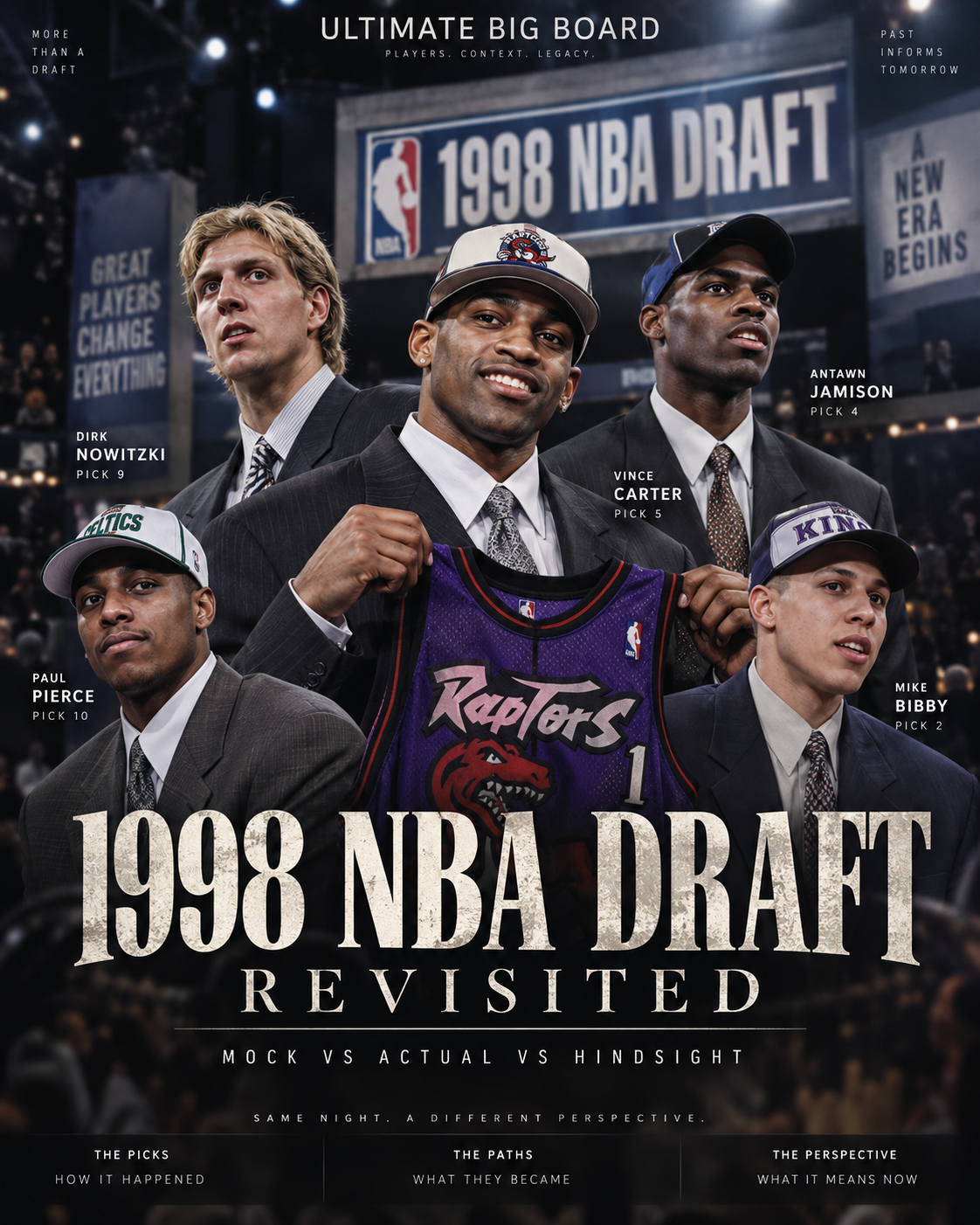
The 1998 draft is remembered for one sentence: the Clippers took Michael Olowokandi first and Dirk Nowitzki went ninth. That's true, but it undersells how strange the night was. The public consensus had its own No. 1, Mike Bibby, and the Clippers ignored it. The best wing in the class, Paul Pierce, was mocked third and fell to tenth. Two of the three best players were traded on draft night. The Houston Rockets held three first-round picks, passed on a Houston high schooler every mock sent their way, and watched him become a two-time All-Star in Seattle.
It was also a draft with no future to plan around. The lockout began a week later, and nobody knew whether there would be a 1998–99 season.
This article compares three timelines for every first-round pick. The first is what the public mock market expected, using The Draft Review's 15-mock consensus. The second is who teams actually took. The third is who they should have taken, knowing how every career turned out.
Three-timeline overview
How to read the mock baseline: The Draft Review orders its archive by median projected pick, with average pick as a tiebreaker. Its consensus rank labels, including A/B groups, are separate from projected pick numbers. Each row below shows the actual selection's archive rank, median projected slot, earliest-to-latest projection band and number of mocks listing that player. Medians can be fractional and exclude mocks that omit the player. A missing projection is reported explicitly.
Using actual overall pick equal to median projected slot as the definition of a match, 3 of 29 first-round selections matched; 14 came earlier and 12 later. This is a slot comparison, not a claim that all mocks or a particular team agreed.
| Pick | Team | Actual player's archived mock profile | Actual pick (archive rank) | Hindsight pick |
|---|---|---|---|---|
| 1 | Clippers | Archive rank 2; median slot 2; band 1–3; 15/15 mocks | Michael Olowokandi (2) | Dirk Nowitzki |
| 2 | Grizzlies | Archive rank 1; median slot 1; band 1–3; 15/15 mocks | Mike Bibby (1) | Paul Pierce |
| 3 | Nuggets | Archive rank 4; median slot 4; band 3–9; 15/15 mocks | Raef LaFrentz (4) | Vince Carter |
| 4 | Raptors | Archive rank 5; median slot 5; band 4–9; 15/15 mocks | Antawn Jamison (5) | Rashard Lewis |
| 5 | Warriors | Archive rank 7; median slot 7; band 3–8; 14/15 mocks | Vince Carter (7) | Mike Bibby |
| 6 | Mavericks | Archive rank 8; median slot 8; band 4–9; 15/15 mocks | Robert Traylor (8) | Antawn Jamison |
| 7 | Kings | Archive rank 12; median slot 13; band 11–28; 15/15 mocks | Jason Williams (12) | Cuttino Mobley |
| 8 | 76ers | Archive rank 6; median slot 6; band 4–11; 15/15 mocks | Larry Hughes (6) | Al Harrington |
| 9 | Bucks | Archive rank 9-B; median slot 9; band 6–27; 14/15 mocks | Dirk Nowitzki (9) | Jason Williams |
| 10 | Celtics | Archive rank 3; median slot 3; band 2–4; 15/15 mocks | Paul Pierce (3) | Larry Hughes |
| 11 | Pistons | Archive rank 13-B; median slot 15; band 11–25; 13/15 mocks | Bonzi Wells (13) | Ricky Davis |
| 12 | Magic | Archive rank 9-A; median slot 9; band 7–19; 15/15 mocks | Michael Doleac (9) | Bonzi Wells |
| 13 | Magic | Archive rank 11; median slot 12; band 10–22; 15/15 mocks | Keon Clark (11) | Raef LaFrentz |
| 14 | Rockets | Archive rank 15-B; median slot 16; band 11–24; 15/15 mocks | Michael Dickerson (15) | Matt Harpring |
| 15 | Magic | Archive rank 18-A; median slot 20; band 19–28; 15/15 mocks | Matt Harpring (18) | Tyronn Lue |
| 16 | Rockets | Archive rank 17; median slot 19; band 13–26; 15/15 mocks | Bryce Drew (17) | Michael Dickerson |
| 17 | Timberwolves | Archive rank 16; median slot 17; band 14–28; 12/15 mocks | Radoslav Nesterovic (16) | Nazr Mohammed |
| 18 | Rockets | Archive rank 28-A; median slot 28; band 25–29; 7/15 mocks | Mirsad Turkcan (28) | Pat Garrity |
| 19 | Bucks | Archive rank 13-A; median slot 15; band 10–21; 15/15 mocks | Pat Garrity (13) | Radoslav Nesterovic |
| 20 | Hawks | Archive rank 27-B; median slot 27; band 27–29; 3/15 mocks | Roshown McLeod (27) | Brian Skinner |
| 21 | Hornets | Archive rank 26-B; median slot 26.5; band 21–27; 4/15 mocks | Ricky Davis (26) | Bryce Drew |
| 22 | Clippers | Archive rank 19; median slot 21; band 16–27; 15/15 mocks | Brian Skinner (19) | Keon Clark |
| 23 | Nuggets | Archive rank 21-A; median slot 23; band 16–26; 12/15 mocks | Tyronn Lue (21) | Mirsad Turkcan |
| 24 | Spurs | Archive rank 23-A; median slot 25; band 22–28; 8/15 mocks | Felipe Lopez (23) | Felipe Lopez |
| 25 | Pacers | Archive rank 14; median slot 15.5; band 10–28; 12/15 mocks | Al Harrington (14) | Michael Doleac |
| 26 | Lakers | Archive rank 23-C; median slot 25; band 25; 1/15 mocks | Sam Jacobson (23*) | Vladimir Stepania |
| 27 | SuperSonics | Archive rank 20-B; median slot 22; band 15–28; 11/15 mocks | Vladimir Stepania (20) | Corey Benjamin |
| 28 | Bulls | Archive rank 20-A; median slot 22; band 18–27; 15/15 mocks | Corey Benjamin (20) | Sam Jacobson |
| 29 | Jazz | Archive rank 10; median slot 10; band 10–17; 15/15 mocks | Nazr Mohammed (10) | Roshown McLeod |
*Jacobson appeared in only one of the 15 mocks. Past about pick 20, the consensus rests on thin samples.
Pick-by-pick: Mock vs Actual vs Hindsight
No. 1: Los Angeles Clippers — Michael Olowokandi
What the mock market was saying: Michael Olowokandi: Archive rank 2; median slot 2; band 1–3; 15/15 mocks. He was a true seven-footer with a strong frame and quick feet, and he had dominated the Big West at Pacific. The case against him was experience. He had come to organized basketball late, and his feel for the game lagged far behind his body. Scouts described him as someone who looked like a franchise center and hadn't yet learned to play like one.
Why the Clippers made the pick: The Clippers had just finished 17–65 and had spent most of their history near the bottom of the league. They had the No. 1 pick and wanted a player who could change the franchise. In 1998, most people in the NBA believed that meant a center. Shaquille O'Neal, Hakeem Olajuwon, David Robinson, Patrick Ewing and Alonzo Mourning dominated the league, and San Antonio had taken Tim Duncan first the year before. A point guard, even one as polished as Bibby, didn't seem like a franchise-changing pick. Olowokandi's short time in the game was also part of his appeal: if he was this good after a few years of basketball, the Clippers reasoned, he might be much better after a few more.
Actual pick versus mock median: The actual selection at No. 1 was 1 place earlier than the median projected slot of 2. 4 of 15 listed mocks placed Michael Olowokandi at that exact pick. This compares overall slots, rather than inferring a team-specific prediction from the archive rank.
What hindsight changes: Olowokandi never became more than an average starting center. His best season came in 2002–03, in the last year of his rookie contract, which led to questions about his motivation. He falls outside the hindsight top 29. The scouting lesson is that inexperience was more of a risk than the Clippers believed. A player who is behind at 22 doesn't usually catch up.
Nowitzki is the hindsight pick, and he was the kind of big-man gamble the Clippers were already making, just with a very different skill set. They bet on a raw seven-footer with an NBA body. Nowitzki was a raw seven-footer with an NBA shooting stroke, and the shooting turned out to matter more. It's hard to imagine the 1998 Clippers developing him the way Dallas did, under Don Nelson and with a patient front office. But in terms of talent, the Clippers took the wrong seven-footer from a draft that had one of the best in history.
No. 2: Vancouver Grizzlies — Mike Bibby
What the mock market was saying: Mike Bibby: Archive rank 1; median slot 1; band 1–3; 15/15 mocks. He had started at point guard for Arizona's 1997 national champions as a freshman, which almost never happened in that era. He had a scorer's instincts, a steady handle and the calm of a coach's son; his father, Henry Bibby, had played in the NBA and coached at USC. The only real knock was size: he was about 6-1 and not a great athlete. Nobody questioned whether he could play in the NBA.
Why the Grizzlies made the pick: Vancouver had finished 19–63 and had just drafted a point guard. Antonio Daniels, the No. 4 pick in 1997, hadn't worked out. The Grizzlies took Bibby and that same night traded Daniels to San Antonio for Carl Herrera and the draft rights to Felipe Lopez, the No. 24 pick. Vancouver's core was Shareef Abdur-Rahim at forward and Bryant Reeves at center, and the Grizzlies wanted a point guard to tie it together. Bibby was the best one in the draft.
Actual pick versus mock median: The actual selection at No. 2 was 1 place later than the median projected slot of 1. 3 of 15 listed mocks placed Mike Bibby at that exact pick. This compares overall slots, rather than inferring a team-specific prediction from the archive rank.
What hindsight changes: Bibby was as good as expected. After three seasons, Vancouver traded him to Sacramento for Jason Williams, the No. 7 pick in the same draft. With the Kings he played his best basketball, including the 2002 Western Conference Finals, in which he hit several of the biggest shots of the series against the Lakers. He ranks fifth on the hindsight board.
The hindsight pick is Pierce, and the reason is how Vancouver's history played out. The Grizzlies never won more than 23 games in Vancouver and moved to Memphis in 2001. Bibby was a good piece to add to a team that already had stars. Pierce could have been the star. Next to Abdur-Rahim, he would have given the Grizzlies two young scorers at forward, and Pierce was the more durable and more complete of the two.
No. 3: Denver Nuggets — Raef LaFrentz
What the mock market was saying: Raef LaFrentz: Archive rank 4; median slot 4; band 3–9; 15/15 mocks. He had a lot going for him: seven feet tall, a good rebounder and shot-blocker, and able to hit shots from the perimeter at a time when few big men could. The concerns were about toughness and strength. Some scouts worried he was more of a finesse big than a true center.
Why the Nuggets made the pick: Denver was coming off an 11–71 season, one of the worst in league history, and had no frontcourt anchor after trading Antonio McDyess the year before. The Nuggets needed a big man, and LaFrentz was the most proven one in the class. Four years of results made him look like the safe choice for a team that couldn't afford another miss.
Actual pick versus mock median: The actual selection at No. 3 was 1 place earlier than the median projected slot of 4. 2 of 15 listed mocks placed Raef LaFrentz at that exact pick. This compares overall slots, rather than inferring a team-specific prediction from the archive rank.
What hindsight changes: LaFrentz tore his ACL early in his rookie season, and he was never quite the same player. He was still a useful stretch big for about a decade, but his reputation suffered after Boston took on his large contract in 2003. He ranks 13th.
Carter is the hindsight pick, and Pierce would also have worked. Either one would have given Denver the kind of star it didn't have again until Carmelo Anthony arrived in 2003. The Nuggets went looking for size when what they really needed was talent. In a draft this strong at the top, the third pick should have gone to the best wing available, not the best big man.
No. 4: Toronto Raptors — Antawn Jamison
What the mock market was saying: Antawn Jamison: Archive rank 5; median slot 5; band 4–9; 15/15 mocks. He had just been named national player of the year at North Carolina. He was a relentless scorer near the basket with a quick release and an unusual ability to score in traffic. The questions were about his position. At about 6-8, was he a small forward or a power forward? He did most of his scoring close to the basket and wasn't yet a strong outside shooter.
Why the Raptors made the pick: Toronto took Jamison in order to trade him. The Raptors and Warriors had agreed to swap him for Vince Carter, his college teammate, whom Golden State took one pick later. Toronto was a four-year-old expansion team in a market that was new to basketball. It had traded away its first star, Damon Stoudamire, a few months earlier, and it had drafted high schooler Tracy McGrady the year before. The Raptors wanted an athletic, exciting wing who could help sell the team. Carter was that player.
Actual pick versus mock median: The actual selection at No. 4 was 1 place earlier than the median projected slot of 5. 1 of 15 listed mocks placed Antawn Jamison at that exact pick. This compares overall slots, rather than inferring a team-specific prediction from the archive rank.
What hindsight changes: Toronto's bet on Carter paid off. He won Rookie of the Year, won the 2000 dunk contest, and led the Raptors to their first playoff series win in 2001. Jamison was also good. He twice scored 51 points in back-to-back games in December 2000, and he became a two-time All-Star and a Sixth Man of the Year. He ranks sixth.
Because the sequential redraft has already placed Carter at No. 3, the hindsight pick here is Rashard Lewis. He fits Toronto well for the same reason McGrady did: the Raptors were willing to take a long, skilled teenager and wait for him to develop. Lewis became a 6-10 small forward who could shoot from deep, a player type the league would soon value very highly. He ranks fourth on the hindsight board.
No. 5: Golden State Warriors — Vince Carter
What the mock market was saying: Vince Carter: Archive rank 7; median slot 7; band 3–8; 14/15 mocks. He was one of the best athletes anyone had seen at North Carolina, but in three college seasons he had never been the team's main option, and his numbers never matched his reputation. Some scouts worried that he was a great dunker without a star's skill set.
Why the Warriors made the pick: Golden State took Carter only to trade him to Toronto for Jamison. The Warriors were a franchise in crisis. Latrell Sprewell had choked coach P.J. Carlesimo the previous December, and the team wanted stability. Jamison had a clear, proven way of scoring. Carter was more of a projection. Golden State chose the player whose production was already known.
Actual pick versus mock median: The actual selection at No. 5 was 2 places earlier than the median projected slot of 7. 4 of 14 listed mocks placed Vince Carter at that exact pick. This compares overall slots, rather than inferring a team-specific prediction from the archive rank.
What hindsight changes: Carter was the better choice by a wide margin. He made eight All-Star teams, played a record 22 seasons, and entered the Hall of Fame in 2024. He ranks third. Golden State didn't make the playoffs again until 2007.
In the sequential redraft, the Warriors get Bibby here. That would have given them a point guard to build around, something they didn't have. The broader lesson is that Golden State had the chance to take a player the mocks were unsure about and trade instead for the one they were confident in. In this draft, the players the mocks were unsure about were usually the ones worth taking.
No. 6: Dallas Mavericks — Robert Traylor
What the mock market was saying: Robert Traylor: Archive rank 8; median slot 8; band 4–9; 15/15 mocks. He was a 6-8, nearly 300-pound power forward from Michigan, known as "Tractor." He was strong in the post, had soft hands and moved his feet better than his size suggested. The main question was his weight, and whether a player that heavy could handle an NBA schedule.
Why the Mavericks made the pick: Dallas drafted Traylor for Milwaukee. The Mavericks had decided on Dirk Nowitzki after watching him score 33 points and grab 14 rebounds against the best American high school players at the Nike Hoop Summit that March. Don Nelson, who was both coach and general manager, and his son Donnie believed Nowitzki could be a star. The Bucks wanted Traylor and were willing to pay to move up from No. 9 to get him. So Dallas took Traylor at No. 6 and sent him to Milwaukee for Nowitzki and the Bucks' No. 19 pick, Pat Garrity. That same day, Dallas traded Garrity and others to Phoenix for Steve Nash.
Actual pick versus mock median: The actual selection at No. 6 was 2 places earlier than the median projected slot of 8. 0 of 15 listed mocks placed Robert Traylor at that exact pick. This compares overall slots, rather than inferring a team-specific prediction from the archive rank.
What hindsight changes: Traylor struggled with his weight and never became more than a backup; he falls outside the hindsight top 29. The Mavericks don't need a correction. They got the best player in the draft and, through the Garrity trade, an MVP point guard. On the board itself, the hindsight pick at No. 6 is Jamison.
No. 7: Sacramento Kings — Jason Williams
What the mock market was saying: Jason Williams: Archive rank 12; median slot 13; band 11–28; 15/15 mocks. He was a flashy passer with unusual range, and his highlight reels were famous. The risk was just as obvious. He had followed coach Billy Donovan from Marshall to Florida, then was dismissed from the Florida team during his junior season. Scouts also wondered whether his playground style would work in an NBA offense.
Why the Kings made the pick: Sacramento was remaking itself that summer. Geoff Petrie, the general manager, had traded for Chris Webber in May, and Rick Adelman would be hired as coach before the season. Vlade Divac and Peja Stojakovic joined after the lockout. The Kings wanted to play fast and move the ball, and they needed a point guard who could run that kind of team. Williams fit.
Actual pick versus mock median: The actual selection at No. 7 was 6 places earlier than the median projected slot of 13. 0 of 15 listed mocks placed Jason Williams at that exact pick. This compares overall slots, rather than inferring a team-specific prediction from the archive rank.
What hindsight changes: In the short term, the pick worked. The 1999 Kings were among the league's most exciting teams, and Williams was a big reason. Three years later, Sacramento traded him to Vancouver for Bibby, whose steadier game fit a team that was by then a contender. Williams later won a title with Miami in 2006. He ranks ninth.
Cuttino Mobley is the hindsight pick at No. 7. He wasn't in any of the 15 mocks and went 41st to Houston after helping Rhode Island reach the Elite Eight. His scoring would have fit Sacramento's fast-paced offense, and he averaged over 16 points a game over his career. The Kings were right to take a risk on a player the mocks underrated. They just chose the wrong one.
No. 8: Philadelphia 76ers — Larry Hughes
What the mock market was saying: Larry Hughes: Archive rank 6; median slot 6; band 4–11; 15/15 mocks. He was a freshman at Saint Louis with long arms, quick hands and a natural feel for scoring. Scouts saw a player who was still thin and needed to improve as a shooter, but who had a lot of upside as a defender and scorer.
Why the 76ers made the pick: Larry Brown had taken over Philadelphia the year before, and the team revolved around Allen Iverson. Brown wanted long, athletic defenders around Iverson, and Hughes looked like that kind of guard. Getting a archive top-six ranked player at No. 8 also looked like good value.
Actual pick versus mock median: The actual selection at No. 8 was 2 places later than the median projected slot of 6. 0 of 15 listed mocks placed Larry Hughes at that exact pick. This compares overall slots, rather than inferring a team-specific prediction from the archive rank.
What hindsight changes: Hughes and Iverson both needed the ball, and the fit never worked. Philadelphia traded Hughes to Golden State midway through his second season. His best year came much later, in Washington in 2004–05, when he led the league in steals and made the All-Defensive First Team. He ranks tenth.
Al Harrington is the hindsight pick, and the reasoning is about fit. Philadelphia needed a forward to go with Iverson more than it needed another guard, and Harrington was a local prospect from St. Patrick High School in New Jersey. He would have given the 76ers a scoring forward who didn't need the ball in his hands. Philadelphia was right to want an athletic player next to Iverson. It chose one who played the same position.
No. 9: Milwaukee Bucks — Dirk Nowitzki
What the mock market was saying: Dirk Nowitzki: Archive rank 9-B; median slot 9; band 6–27; 14/15 mocks. He was a 6-11 German teenager who shot like a guard, and he had played mostly in Germany's second division. Most American scouts had seen him only at the Hoop Summit. Skeptics worried that he couldn't defend, was too thin, and hadn't faced real competition.
Why the Bucks made the pick: Milwaukee took Nowitzki on Dallas's behalf as part of the trade for Traylor. George Karl had just been hired as coach, and the Bucks wanted players who could help immediately. A German teenager who might need years to develop didn't fit that plan. Traylor did.
Actual pick versus mock median: The actual selection at No. 9 matched the median projected slot of 9. 4 of 14 listed mocks placed Dirk Nowitzki at that exact pick. This compares overall slots, rather than inferring a team-specific prediction from the archive rank.
What hindsight changes: Nowitzki struggled as a rookie in the lockout season, then became one of the best players of his generation. He won the 2007 MVP and the 2011 title and Finals MVP, and he is No. 1 on the hindsight board. Milwaukee's mistake wasn't drafting him. It was choosing a player who fit the coach's timeline over one who would have fit the franchise's for 20 years. In the sequential redraft, Jason Williams is the pick here.
No. 10: Boston Celtics — Paul Pierce
What the mock market was saying: Paul Pierce: Archive rank 3; median slot 3; band 2–4; 15/15 mocks. He was a Kansas junior with a strong body, a mature scoring game and the ability to create his own shot. The only knocks were that he wasn't especially explosive and might struggle to guard quicker wings. Those were the kind of small concerns scouts raise about players they otherwise like.
Why the Celtics made the pick: Boston didn't have to reason its way to Pierce. He fell to them. Rick Pitino, who ran the team as both president and coach, had spent a year collecting young talent: Antoine Walker and Ron Mercer were already on the roster. Most mocks expected Boston to take a big man, often Nazr Mohammed, whom Pitino had recruited to Kentucky. When Pierce was still available at No. 10, the Celtics took him without hesitation.
Actual pick versus mock median: The actual selection at No. 10 was 7 places later than the median projected slot of 3. 0 of 15 listed mocks placed Paul Pierce at that exact pick. This compares overall slots, rather than inferring a team-specific prediction from the archive rank.
What hindsight changes: Pierce played 15 seasons in Boston, made 10 All-Star teams, and was Finals MVP in 2008. He ranks second on the hindsight board. For Boston, no correction is needed. In the sequential redraft, Hughes is the best player left at No. 10.
No. 11: Detroit Pistons — Bonzi Wells
What the mock market was saying: Bonzi Wells: Archive rank 13-B; median slot 15; band 11–25; 13/15 mocks. He was Ball State's career scoring leader, a strong, physical guard who could post up smaller defenders and score from the midrange. The questions were about his level of competition, since he'd played in the Mid-American Conference, and his temperament.
Why the Pistons made the pick: Detroit already had Grant Hill and Jerry Stackhouse on the wings, so Wells wasn't going to get much playing time there. The Pistons took the best available scorer and then traded his rights to Portland before he played for them. For Detroit, he was a trade asset more than a roster decision.
Actual pick versus mock median: The actual selection at No. 11 was 4 places earlier than the median projected slot of 15. 1 of 13 listed mocks placed Bonzi Wells at that exact pick. This compares overall slots, rather than inferring a team-specific prediction from the archive rank.
What hindsight changes: Wells became a good player in Portland, a tough, physical wing. His 2006 playoff series for Sacramento against the Spurs was one of the best individual performances of that postseason. He ranks 12th. Ricky Davis, who scored more points over a longer career, is the hindsight pick here.
No. 12: Orlando Magic — Michael Doleac
What the mock market was saying: Michael Doleac: Archive rank 9-A; median slot 9; band 7–19; 15/15 mocks. He was a skilled center from Utah who could shoot from 15 feet and pass well for his size. He had just helped the Utes reach the national championship game, where they lost to Kentucky. Scouts saw a player who was ready to contribute but not a future star.
Why the Magic made the pick: Orlando had three picks in the next four (12, 13 and 15) and could spread its bets. Chuck Daly was the coach, and the Magic were trying to stay competitive after losing Shaquille O'Neal in 1996. Doleac was a player who could contribute right away, and taking a consensus rank No. 9 pick at No. 12 looked like value.
Actual pick versus mock median: The actual selection at No. 12 was 3 places later than the median projected slot of 9. 1 of 15 listed mocks placed Michael Doleac at that exact pick. This compares overall slots, rather than inferring a team-specific prediction from the archive rank.
What hindsight changes: Doleac became almost exactly what scouts expected, a reliable backup big man. He ranks 25th. Wells is the hindsight pick here. With three picks, Orlando made three safe choices. The team would have been better served using one of them on a player with more upside.
No. 13: Orlando Magic — Keon Clark
What the mock market was saying: Keon Clark: Archive rank 11; median slot 12; band 10–22; 15/15 mocks. He was a long, springy shot-blocker from UNLV with a thin frame and a limited offensive game. Scouts liked his length and athleticism and wondered how much more skill he could add.
Why the Magic made the pick: With its second of three picks, Orlando took the best big man left on physical tools, then traded his rights to Denver.
Actual pick versus mock median: The actual selection at No. 13 was 1 place later than the median projected slot of 12. 2 of 15 listed mocks placed Keon Clark at that exact pick. This compares overall slots, rather than inferring a team-specific prediction from the archive rank.
What hindsight changes: Clark had several productive seasons as a shot-blocking, high-energy big man, but his career was shorter than his talent suggested. He ranks 22nd. The sequential redraft brings LaFrentz here. That's a reminder that LaFrentz was a good player who went much too high, not a bust. Taken at No. 13, he would have been a strong pick.
No. 14: Houston Rockets — Michael Dickerson
What the mock market was saying: Michael Dickerson: Archive rank 15-B; median slot 16; band 11–24; 15/15 mocks. He had been Bibby's backcourt partner on Arizona's 1997 title team, and he was a smooth shooter who projected as a scoring guard. Many mocks had Houston taking Lewis here instead.
Why the Rockets made the pick: Houston had three first-round picks (14, 16 and 18) and a veteran core built around Hakeem Olajuwon, then 35. Charles Barkley was still on the roster, and Scottie Pippen would arrive after the lockout. The Rockets were trying to win right away, and they wanted players who could help immediately. A four-year college shooter from a championship program fit that plan better than a high schooler.
Actual pick versus mock median: The actual selection at No. 14 was 2 places earlier than the median projected slot of 16. 3 of 15 listed mocks placed Michael Dickerson at that exact pick. This compares overall slots, rather than inferring a team-specific prediction from the archive rank.
What hindsight changes: Dickerson scored well, averaging nearly 19 points a game for Vancouver after Houston traded him there in the 1999 deal that brought Steve Francis to the Rockets. So the pick eventually helped Houston land a star, just indirectly. Groin injuries ended Dickerson's career early. He ranks 16th. Matt Harpring is the hindsight pick at No. 14.
No. 15: Orlando Magic — Matt Harpring
What the mock market was saying: Matt Harpring: Archive rank 18-A; median slot 20; band 19–28; 15/15 mocks. He was a tough, physical forward from Georgia Tech who played hard every minute. Scouts saw a player who would work his way into a rotation but lacked the athleticism to become a star.
Why the Magic made the pick: With its third pick, Orlando again went with a player who could contribute right away. Harpring's toughness also fit Chuck Daly's preference for players who competed.
Actual pick versus mock median: The actual selection at No. 15 was 5 places earlier than the median projected slot of 20. 0 of 15 listed mocks placed Matt Harpring at that exact pick. This compares overall slots, rather than inferring a team-specific prediction from the archive rank.
What hindsight changes: Harpring turned out better than projected. After stops in Cleveland and Philadelphia, he found his best years in Utah, where he became a tough 16-points-a-game scorer. He ranks 14th. The redraft puts Tyronn Lue here. None of Orlando's three picks became core players, but Harpring came closest.
No. 16: Houston Rockets — Bryce Drew
What the mock market was saying: Bryce Drew: Archive rank 17; median slot 19; band 13–26; 15/15 mocks. His buzzer-beater for Valparaiso against Ole Miss in the 1998 NCAA tournament, known as "The Shot," had made him the most famous mid-major player in the country. Scouts liked his shooting and decision-making but doubted he had the size or quickness to play point guard in the NBA.
Why the Rockets made the pick: Houston needed guards who could shoot to play alongside its veteran stars, and Drew's shooting and poise fit that need.
Actual pick versus mock median: The actual selection at No. 16 was 3 places earlier than the median projected slot of 19. 0 of 15 listed mocks placed Bryce Drew at that exact pick. This compares overall slots, rather than inferring a team-specific prediction from the archive rank.
What hindsight changes: Drew played six seasons as a backup and later became a successful college coach. He ranks 21st. Dickerson is the hindsight pick here, and Lewis was still available.
No. 17: Minnesota Timberwolves — Radoslav Nesterovic
What the mock market was saying: Radoslav Nesterovic: Archive rank 16; median slot 17; band 14–28; 12/15 mocks. He was a seven-foot Slovenian playing for Kinder Bologna in Italy, a mobile big man with good fundamentals who needed to get stronger.
Why the Timberwolves made the pick: Minnesota had signed Kevin Garnett to a record extension the year before and needed a big man to play next to him. The Timberwolves were about to lose Tom Gugliotta in free agency, making the need more urgent. Nesterovic was a center who could run, defend and play without the ball, which fit well next to Garnett.
Actual pick versus mock median: The actual selection at No. 17 matched the median projected slot of 17. 5 of 12 listed mocks placed Radoslav Nesterovic at that exact pick. This compares overall slots, rather than inferring a team-specific prediction from the archive rank.
What hindsight changes: Nesterovic became a starting center for Minnesota, then signed with San Antonio in 2003 and won a title with the Spurs in 2005. He ranks 19th. The redraft puts Nazr Mohammed here, another big man with a long career.
No. 18: Houston Rockets — Mirsad Turkcan
What the mock market was saying: Mirsad Turkcan: Archive rank 28-A; median slot 28; band 25–29; 7/15 mocks. He was a Turkish forward from Efes Pilsen who could rebound and shoot from outside. This was the biggest reach in the draft relative to the consensus.
Why the Rockets made the pick: Houston was most likely drafting Turkcan to leave him in Europe for a while. The Rockets traded his rights to the Knicks soon after the draft.
Actual pick versus mock median: The actual selection at No. 18 was 10 places earlier than the median projected slot of 28. 0 of 7 listed mocks placed Mirsad Turkcan at that exact pick. This compares overall slots, rather than inferring a team-specific prediction from the archive rank.
What hindsight changes: Turkcan played only a handful of NBA games, though he had a long career in Europe. He ranks 23rd. Meanwhile, Lewis kept falling. He sat in the green room, visibly upset, until Seattle took him at No. 32. He became a two-time All-Star and won a title with Miami in 2013. Houston did partly make up for its night by taking Mobley at No. 41. Pat Garrity is the hindsight pick at No. 18.
No. 19: Milwaukee Bucks — Pat Garrity
What the mock market was saying: Pat Garrity: Archive rank 13-A; median slot 15; band 10–21; 15/15 mocks. He was a 6-9 forward from Notre Dame who could shoot from outside, and several mocks had him going in the lottery.
Why the Bucks made the pick: Milwaukee drafted Garrity in order to trade him. He was the price the Bucks paid to move up from No. 9 to No. 6 for Traylor. He went to Dallas with Nowitzki, and Dallas then sent him to Phoenix in the trade for Steve Nash. Garrity may be the only player in history involved in two trades for future MVPs on the night he was drafted.
Actual pick versus mock median: The actual selection at No. 19 was 4 places later than the median projected slot of 15. 1 of 15 listed mocks placed Pat Garrity at that exact pick. This compares overall slots, rather than inferring a team-specific prediction from the archive rank.
What hindsight changes: Garrity became a useful floor-spacing forward in Orlando, a type of player the NBA undervalued until later. He ranks 18th. The redraft puts Nesterovic at No. 19.
No. 20: Atlanta Hawks — Roshown McLeod
What the mock market was saying: Roshown McLeod: Archive rank 27-B; median slot 27; band 27–29; 3/15 mocks. He was a senior forward at Duke who had transferred from St. John's, a polished scorer who wasn't especially athletic.
Why the Hawks made the pick: Atlanta was a playoff team built around Dikembe Mutombo, Steve Smith and Mookie Blaylock, and it wanted a college-ready forward who could play right away. McLeod's polish and Duke background fit that need.
Actual pick versus mock median: The actual selection at No. 20 was 7 places earlier than the median projected slot of 27. 0 of 3 listed mocks placed Roshown McLeod at that exact pick. This compares overall slots, rather than inferring a team-specific prediction from the archive rank.
What hindsight changes: Knee injuries ended McLeod's career after three seasons. He ranks last on the featured hindsight board. Brian Skinner, a durable big man who played 13 seasons, is the hindsight pick here.
No. 21: Charlotte Hornets — Ricky Davis
What the mock market was saying: Ricky Davis: Archive rank 26-B; median slot 26.5; band 21–27; 4/15 mocks. He was an explosive athlete who had played one season at Iowa, and scouts saw his talent as well ahead of his feel for the game.
Why the Hornets made the pick: Charlotte was a deep playoff team that didn't need a rookie to contribute right away, so the Hornets could take a chance on the most athletic player left.
Actual pick versus mock median: The actual selection at No. 21 was 5.5 places earlier than the median projected slot of 26.5. 1 of 4 listed mocks placed Ricky Davis at that exact pick. This compares overall slots, rather than inferring a team-specific prediction from the archive rank.
What hindsight changes: Davis's upside was real. He averaged around 20 points a game at his peak and scored more career points than almost anyone drafted outside the lottery. He ranks 11th. His reputation for being a selfish player was also real, which is why he played for seven teams. Bryce Drew is the redraft pick here.
No. 22: Los Angeles Clippers — Brian Skinner
What the mock market was saying: Brian Skinner: Archive rank 19; median slot 21; band 16–27; 15/15 mocks. He was a strong rebounder and shot-blocker from Baylor who projected as a dependable backup big man.
Why the Clippers made the pick: After betting on Olowokandi at No. 1, the Clippers used their second pick on a reliable big man who could back him up.
Actual pick versus mock median: The actual selection at No. 22 was 1 place later than the median projected slot of 21. 0 of 15 listed mocks placed Brian Skinner at that exact pick. This compares overall slots, rather than inferring a team-specific prediction from the archive rank.
What hindsight changes: Skinner played 13 seasons as a backup big and ranks 20th. Keon Clark is the hindsight pick here.
No. 23: Denver Nuggets — Tyronn Lue
What the mock market was saying: Tyronn Lue: Archive rank 21-A; median slot 23; band 16–26; 12/15 mocks. He was a quick, confident point guard from Nebraska who was small for the NBA.
Why the Nuggets made the pick: Denver drafted Lue for the Lakers. The Nuggets sent Lue and Tony Battie to Los Angeles for Nick Van Exel, whom the Lakers had soured on. For Denver, No. 23 was a way to get an established point guard.
Actual pick versus mock median: The actual selection at No. 23 matched the median projected slot of 23. 6 of 12 listed mocks placed Tyronn Lue at that exact pick. This compares overall slots, rather than inferring a team-specific prediction from the archive rank.
What hindsight changes: Lue won two titles with the Lakers as a backup, including the 2001 Finals, where Allen Iverson famously stepped over him. He later coached Cleveland to the 2016 title. As a player he ranks 15th. The redraft slides Turkcan here.
No. 24: San Antonio Spurs — Felipe Lopez
What the mock market was saying: Felipe Lopez: Archive rank 23-A; median slot 25; band 22–28; 8/15 mocks. He had been one of the most hyped high school players in New York in years, but his career at St. John's was good rather than great. Scouts saw a talented athlete who had never quite lived up to his early reputation.
Why the Spurs made the pick: San Antonio drafted Lopez as part of a trade with Vancouver. The Spurs sent him and Carl Herrera to the Grizzlies for Antonio Daniels, Vancouver's No. 4 pick from 1997. San Antonio wanted a backup point guard to play behind Avery Johnson, and Daniels filled that role on the Spurs' 1999 title team.
Actual pick versus mock median: The actual selection at No. 24 was 1 place earlier than the median projected slot of 25. 0 of 8 listed mocks placed Felipe Lopez at that exact pick. This compares overall slots, rather than inferring a team-specific prediction from the archive rank.
What hindsight changes: This is the one pick where the redraft lands on the same player. That says less about how good the pick was and more about how few good players were left by No. 24. Lopez played a few seasons as a backup and ranks 24th.
No. 25: Indiana Pacers — Al Harrington
What the mock market was saying: Al Harrington: Archive rank 14; median slot 15.5; band 10–28; 12/15 mocks. He was coming straight from St. Patrick High School in New Jersey. He was 6-8 with a well-built body and a smooth game. In 1998, few players had gone directly from high school to the NBA, and teams disagreed sharply about how to value them.
Why the Pacers made the pick: Indiana had just taken Chicago to seven games in the Eastern Conference Finals and didn't need any rookie to play. Larry Bird was the coach and Donnie Walsh ran the front office. The Pacers were a stable, veteran team that could afford to take a teenager and let him develop slowly.
Actual pick versus mock median: The actual selection at No. 25 was 9.5 places later than the median projected slot of 15.5. 0 of 12 listed mocks placed Al Harrington at that exact pick. This compares overall slots, rather than inferring a team-specific prediction from the archive rank.
What hindsight changes: Harrington played 16 seasons as a scoring forward and ranks eighth on the hindsight board. Measured by where he was picked versus how his career turned out, he was the best value in the first round. Indiana's willingness to wait on him was exactly the right approach. The redraft moves him up to No. 8 and brings Doleac to this slot.
No. 26: Los Angeles Lakers — Sam Jacobson
What the mock market was saying: Sam Jacobson: Archive rank 23-C; median slot 25; band 25; 1/15 mocks. He was an athletic wing from the University of Minnesota.
Why the Lakers made the pick: The Lakers had Shaquille O'Neal, Kobe Bryant and Eddie Jones, and they needed athletic wings to fill out the bench. Jerry West ran the front office, and he trusted his own scouting.
Actual pick versus mock median: The actual selection at No. 26 was 1 place later than the median projected slot of 25. 0 of 1 listed mock placed Sam Jacobson at that exact pick. This compares overall slots, rather than inferring a team-specific prediction from the archive rank.
What hindsight changes: Jacobson played three NBA seasons and ranks 28th. Even West, one of the best evaluators of his era, missed on this one. Vladimir Stepania is the redraft pick here.
No. 27: Seattle SuperSonics — Vladimir Stepania
What the mock market was saying: Vladimir Stepania: Archive rank 20-B; median slot 22; band 15–28; 11/15 mocks. He was a seven-foot center from Georgia playing for Olimpija Ljubljana in Slovenia, mobile but raw.
Why the SuperSonics made the pick: Seattle needed size and took a consensus top-20 center at No. 27, which looked like good value.
Actual pick versus mock median: The actual selection at No. 27 was 5 places later than the median projected slot of 22. 2 of 11 listed mocks placed Vladimir Stepania at that exact pick. This compares overall slots, rather than inferring a team-specific prediction from the archive rank.
What hindsight changes: Stepania played for several teams as a backup center and ranks 26th. Seattle's better move that night came five picks later, when Lewis was still available at No. 32. Corey Benjamin is the redraft pick here.
No. 28: Chicago Bulls — Corey Benjamin
What the mock market was saying: Corey Benjamin: Archive rank 20-A; median slot 22; band 18–27; 15/15 mocks. He was an athletic sophomore from Oregon State who could score but was still raw.
Why the Bulls made the pick: Chicago had just won its sixth title in eight years, and it was widely expected that the dynasty was about to end. Jerry Krause, the general manager, took a young, athletic wing with upside as a start on the rebuild.
Actual pick versus mock median: The actual selection at No. 28 was 6 places later than the median projected slot of 22. 0 of 15 listed mocks placed Corey Benjamin at that exact pick. This compares overall slots, rather than inferring a team-specific prediction from the archive rank.
What hindsight changes: Benjamin never found a lasting NBA role and ranks 27th. Sam Jacobson is the redraft pick here.
No. 29: Utah Jazz — Nazr Mohammed
What the mock market was saying: Nazr Mohammed: Archive rank 10; median slot 10; band 10–17; 15/15 mocks. He had been the starting center on Kentucky's 1998 national championship team. He'd been recruited to Kentucky by Rick Pitino, now running the Celtics, which is likely why so many mocks paired them. Scouts liked his size and how much he had improved.
Why the Jazz made the pick: Utah had just lost the NBA Finals to Chicago and had no roster spot to give a rookie. The Jazz took the best player available, a projected lottery pick at the last pick of the round, and traded his rights to Philadelphia.
Actual pick versus mock median: The actual selection at No. 29 was 19 places later than the median projected slot of 10. 0 of 15 listed mocks placed Nazr Mohammed at that exact pick. This compares overall slots, rather than inferring a team-specific prediction from the archive rank.
What hindsight changes: Mohammed played 18 seasons and won a title with San Antonio in 2005. The mocks were right about him. He ranks 17th. The redraft puts McLeod at No. 29, which shows how few good players were left by the end of the round.
Why the three timelines split
The pick-by-pick breakdown shows a few patterns that explain most of the gaps between the mocks, the actual picks and hindsight.
Many picks weren't really about the teams making them. At least nine first-round picks were made for another team: Jamison, Carter, Traylor, Nowitzki, Wells, Clark, Garrity, Lue and Lopez, with Mohammed and Turkcan traded soon after. The mocks could only reflect public information about each team's needs, and those trades were planned in private. Many of the gaps between the consensus and the actual order come from deals nobody outside the front offices knew about.
Teams drafted for need, and the best player fell. Paul Pierce is the clearest example. Every team between No. 3 and No. 9 had a reason to take someone else, whether a need for a big man, a pre-arranged trade or a style of play. No team rated Pierce poorly, but every team had a reason to pass on him.
Contending teams wanted players who could help right away. Houston, Atlanta and Orlando used their picks on players who could contribute immediately. That's a reasonable approach for a contender, but it meant passing on Lewis and Harrington, the two high schoolers who became the best players available after the top of the draft.
Teams overvalued centers. Olowokandi, LaFrentz and Traylor all went at or above where the mocks projected them. In the late 1990s, the NBA believed a team needed a dominant center to win. The draft's best big man, Nowitzki, was a shooter, and the league didn't know yet how valuable that would be.
Players who were hard to evaluate turned out to be the best. Nowitzki, Carter, Lewis, Harrington and Mobley were all harder to project than the players taken ahead of them: an international teenager, a star athlete without star numbers, two high schoolers and a guard nobody had mocked. The players who seemed safest, like Olowokandi, LaFrentz and Traylor, carried more risk than teams realized, while the uncertain prospects had more room to grow. The teams that did best, especially Dallas and Indiana, were the ones willing to take on that uncertainty.
What the mock market got right
The public consensus correctly identified the top talents. Bibby, Pierce, LaFrentz, Jamison, Hughes and Carter all made the consensus top seven, and all went early. Where the mocks went wrong was in ranking those players against each other. They had Pierce ahead of Carter, and Bibby ahead of everyone. They also had Olowokandi at No. 2, which was high enough that the Clippers' choice wasn't a surprise. The mocks treated him as a reasonable top pick too.
The mocks also rated Mohammed, Harrington and Garrity higher than the teams did, and they were right each time. Those three had long NBA careers even though teams let them fall.
Where teams beat the mocks
The Dallas Mavericks had the best night of any team. They correctly judged Nowitzki as a star while the mocks had him anywhere from No. 6 to No. 27, then turned their pick into Nowitzki and, a few moves later, Steve Nash. Indiana got a lottery talent at No. 25 in Harrington. Sacramento's reach for Jason Williams gave the Kings an identity, and three years later he was traded for Bibby.
Hindsight top five
- Dirk Nowitzki
- Paul Pierce
- Vince Carter
- Rashard Lewis
- Mike Bibby
FAQ
Who should go No. 1 in a 1998 NBA redraft?
Dirk Nowitzki. He was an MVP, a champion and Finals MVP, and a 14-time All-Star, and he's among the most influential big men ever.
What did mock drafts predict in the 1998 NBA Draft?
The Draft Review's archive separates rank labels from median projected slots. Using actual overall pick equal to median projected slot as the definition of a match, 3 of 29 first-round selections matched; 14 came earlier and 12 later. This is a slot comparison, not a claim that all mocks or a particular team agreed.
Who was the biggest draft-night slide in 1998?
Among first-round selections with an archived projection, the largest difference below the mock median was 19 places: Nazr Mohammed (median slot 10, actual No. 29, archive rank 10; 15 mocks). This uses median projected slot, not the archive rank number.
What is the biggest lesson from the 1998 NBA Draft?
The mock market was good at identifying which players were talented and bad at ranking them. The teams that did best trusted their own scouting of hard-to-project players.
Full hindsight board
| Hindsight rank | Player |
|---|---|
| 1 | Dirk Nowitzki |
| 2 | Paul Pierce |
| 3 | Vince Carter |
| 4 | Rashard Lewis |
| 5 | Mike Bibby |
| 6 | Antawn Jamison |
| 7 | Cuttino Mobley |
| 8 | Al Harrington |
| 9 | Jason Williams |
| 10 | Larry Hughes |
| 11 | Ricky Davis |
| 12 | Bonzi Wells |
| 13 | Raef LaFrentz |
| 14 | Matt Harpring |
| 15 | Tyronn Lue |
| 16 | Michael Dickerson |
| 17 | Nazr Mohammed |
| 18 | Pat Garrity |
| 19 | Radoslav Nesterovic |
| 20 | Brian Skinner |
| 21 | Bryce Drew |
| 22 | Keon Clark |
| 23 | Mirsad Turkcan |
| 24 | Felipe Lopez |
| 25 | Michael Doleac |
| 26 | Vladimir Stepania |
| 27 | Corey Benjamin |
| 28 | Sam Jacobson |
| 29 | Roshown McLeod |
Sources and methodology
- Historical mock baseline: The Draft Review's 1998 consensus mock draft, built from 15 mock drafts. https://www.thedraftreview.com/consensus-mock-draft-archive/1998-nba-draft-consensus-mock-draft
- Actual first-round order and transaction context: historical NBA draft records.
- Hindsight rankings are Ultimate Big Board editorial judgments built around peak value, longevity, two-way impact, postseason utility, role portability, and overall career production.
- Alternate-history notes are interpretive and do not assume every downstream roster move remains unchanged.