
2000 NBA Draft Revisited: Mock vs Actual vs Hindsight
Compare a preserved 2000 NBA mock draft with the actual first round and a full-career hindsight redraft, including every pick and the Michael Redd value story.
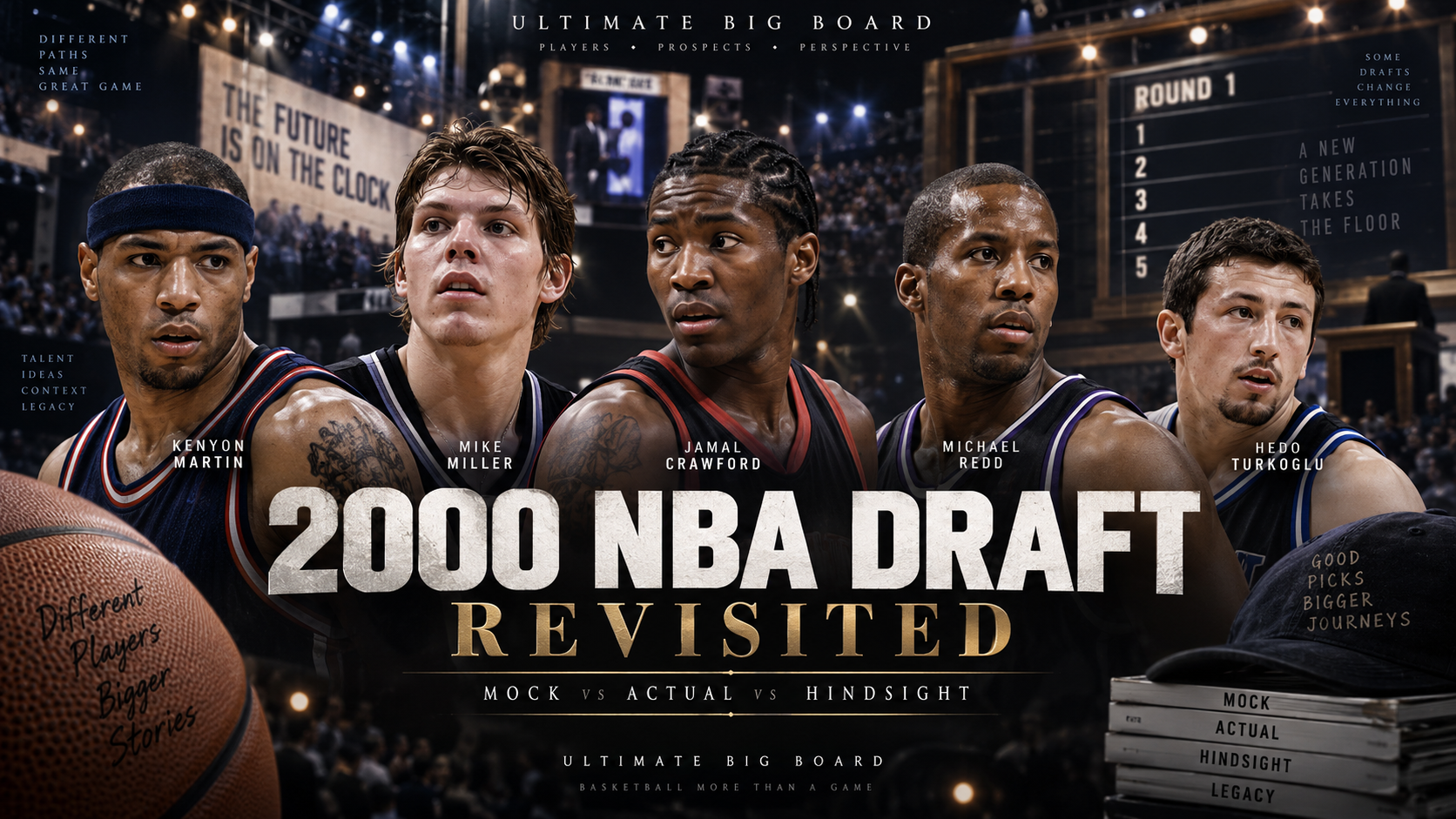
The 2000 draft is usually described as one of the weakest of its era, and the top of the first round supports that reputation. Kenyon Martin went first, exactly as 14 of 15 mocks in The Draft Review's consensus predicted, and he became the only All-Star among the first 10 picks. The public and the teams agreed on almost everything at the top. They were both wrong in the same way.
The best careers came from players the draft undervalued. Jamal Crawford went eighth and won three Sixth Man of the Year awards. Hedo Turkoglu went 16th and became a starter on a Finals team. Michael Redd didn't appear in any of the 15 mocks, went 43rd to Milwaukee, and became an All-Star scorer and an Olympic gold medalist. He is No. 1 on the hindsight board.
This article compares three timelines for every first-round pick. The first is what the public mock market expected, using The Draft Review's 15-mock consensus. The second is who teams actually took. The third is who they should have taken, knowing how every career turned out. With 29 teams in the league, the 2000 first round had 29 picks.
Three-timeline overview
How to read the mock baseline: The Draft Review orders its archive by median projected pick, with average pick as a tiebreaker. Its consensus rank labels, including A/B groups, are separate from projected pick numbers. Each row below shows the actual selection's archive rank, median projected slot, earliest-to-latest projection band and number of mocks listing that player. Medians can be fractional and exclude mocks that omit the player. A missing projection is reported explicitly.
Using actual overall pick equal to median projected slot as the definition of a match, 5 of 29 first-round selections matched; 13 came earlier and 10 later. 1 selection has no archived projection. This is a slot comparison, not a claim that all mocks or a particular team agreed.
| Pick | Team | Actual player's archived mock profile | Actual pick (archive rank) | Hindsight pick |
|---|---|---|---|---|
| 1 | Nets | Archive rank 1; median slot 1; band 1–2; 15/15 mocks | Kenyon Martin (1) | Michael Redd |
| 2 | Grizzlies | Archive rank 2; median slot 2; band 1–3; 15/15 mocks | Stromile Swift (2) | Jamal Crawford |
| 3 | Clippers | Archive rank 4; median slot 4; band 3–10; 15/15 mocks | Darius Miles (4) | Mike Miller |
| 4 | Bulls | Archive rank 3; median slot 3; band 3–6; 15/15 mocks | Marcus Fizer (3) | Hedo Turkoglu |
| 5 | Magic | Archive rank 6; median slot 6; band 5–10; 15/15 mocks | Mike Miller (6) | Kenyon Martin |
| 6 | Hawks | Archive rank 8; median slot 9; band 6–12; 15/15 mocks | DerMarr Johnson (8) | Jamaal Magloire |
| 7 | Bulls | Archive rank 5; median slot 5; band 2–7; 15/15 mocks | Chris Mihm (5) | Quentin Richardson |
| 8 | Cavaliers | Archive rank 12-A; median slot 13; band 10–17; 15/15 mocks | Jamal Crawford (12) | Morris Peterson |
| 9 | Rockets | Archive rank 7-A; median slot 8; band 4–12; 15/15 mocks | Joel Przybilla (7) | Desmond Mason |
| 10 | Magic | Archive rank 11; median slot 12; band 10–21; 14/15 mocks | Keyon Dooling (11) | Speedy Claxton |
| 11 | Celtics | Archive rank 9; median slot 10; band 9–15; 15/15 mocks | Jerome Moiso (9) | DeShawn Stevenson |
| 12 | Mavericks | Archive rank 14; median slot 15; band 11–27; 15/15 mocks | Etan Thomas (14) | Keyon Dooling |
| 13 | Magic | Archive rank 7-B; median slot 8; band 6–10; 15/15 mocks | Courtney Alexander (7) | Marko Jaric |
| 14 | Pistons | Archive rank 13; median slot 14; band 14–24; 15/15 mocks | Mateen Cleaves (13) | Eddie House |
| 15 | Bucks | Archive rank 25-A; median slot 26; band 20–29; 13/15 mocks | Jason Collier (25) | Eduardo Najera |
| 16 | Kings | Archive rank 18-B; median slot 20; band 20–29; 6/15 mocks | Hedo Turkoglu (18) | Primoz Brezec |
| 17 | SuperSonics | Archive rank 18-A; median slot 20; band 15–25; 13/15 mocks | Desmond Mason (18) | Etan Thomas |
| 18 | Clippers | Archive rank 15-B; median slot 16; band 13–23; 15/15 mocks | Quentin Richardson (15) | Joel Przybilla |
| 19 | Hornets | Archive rank 20; median slot 22; band 17–28; 12/15 mocks | Jamaal Magloire (20) | Iakovos Tsakalidis |
| 20 | 76ers | Archive rank 19; median slot 21; band 16–24; 12/15 mocks | Speedy Claxton (19) | Chris Mihm |
| 21 | Raptors | Archive rank 15-A; median slot 16; band 11–23; 15/15 mocks | Morris Peterson (15) | Darius Miles |
| 22 | Knicks | Archive rank 21-A; median slot 23; band 11–28; 13/15 mocks | Donnell Harvey (21) | Stromile Swift |
| 23 | Jazz | Archive rank 21-B; median slot 23; band 13–29; 12/15 mocks | DeShawn Stevenson (21) | Courtney Alexander |
| 24 | Bulls | Archive rank 27; median slot 28; band 26–28; 8/15 mocks | Dalibor Bagaric (27) | Marcus Fizer |
| 25 | Suns | Archive rank 10; median slot 11.5; band 8–28; 14/15 mocks | Iakovos Tsakalidis (10) | Mateen Cleaves |
| 26 | Nuggets | Archive rank 22-A; median slot 24; band 12–27; 15/15 mocks | Mamadou N'Diaye (22) | Jason Collier |
| 27 | Pacers | No projection in the archived 15 mocks | Primoz Brezec (not mocked) | Mark Madsen |
| 28 | Trail Blazers | Archive rank 16; median slot 18; band 13–27; 15/15 mocks | Erick Barkley (16) | Dalibor Bagaric |
| 29 | Lakers | Archive rank 28-A; median slot 29; band 28–29; 7/15 mocks | Mark Madsen (28) | Donnell Harvey |
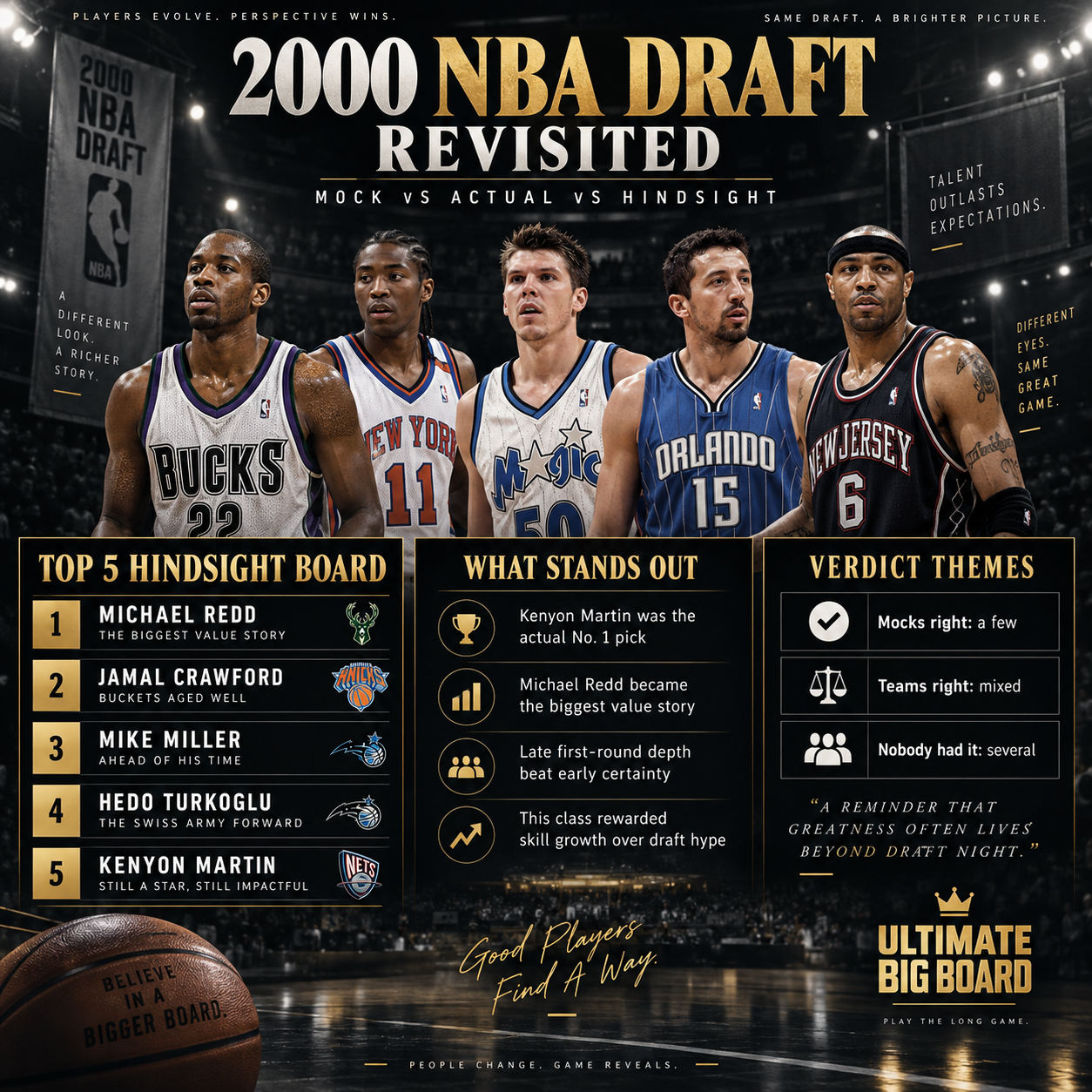
Ultimate Big Board infographic summarizing the 2000 NBA Draft hindsight board, mock-draft themes and major value stories.
Pick-by-pick: Mock vs Actual vs Hindsight
No. 1: New Jersey Nets — Kenyon Martin
What the mock market was saying: Kenyon Martin: Archive rank 1; median slot 1; band 1–2; 15/15 mocks. He had been the national player of the year at Cincinnati, a ferocious shot-blocker and athlete, before breaking his leg in the Conference USA tournament that March. Scouts questioned his offense and his health, but nobody else in the class was considered a better bet.
Why the Nets made the pick: Rod Thorn had just taken over New Jersey's front office and wanted a tough, athletic big man to change the team's identity. Martin's defense and competitiveness made him the obvious choice, and his leg had healed by the draft.
Actual pick versus mock median: The actual selection at No. 1 matched the median projected slot of 1. 14 of 15 listed mocks placed Kenyon Martin at that exact pick. This compares overall slots, rather than inferring a team-specific prediction from the archive rank.
What hindsight changes: Martin was the defensive heart of the Nets teams that reached the 2002 and 2003 Finals, made the 2004 All-Star team, and played 15 seasons. He ranks fifth on the hindsight board.
Michael Redd is the hindsight pick. He was an Ohio State junior who wasn't in any of the 15 mocks and went 43rd to Milwaukee. He became one of the best shooters of his generation, made the 2004 All-Star team, averaged more than 26 points a game at his peak, and won Olympic gold in 2008. Knee injuries shortened his prime, but at his best he was the most valuable scorer in the class.
No. 2: Vancouver Grizzlies — Stromile Swift
What the mock market was saying: Stromile Swift: Archive rank 2; median slot 2; band 1–3; 15/15 mocks. He was an athletic 6-9 sophomore from LSU with exceptional leaping ability and a raw offensive game.
Why the Grizzlies made the pick: Vancouver wanted an athletic big man to play with Shareef Abdur-Rahim, and Swift was the most explosive one available.
Actual pick versus mock median: The actual selection at No. 2 matched the median projected slot of 2. 13 of 15 listed mocks placed Stromile Swift at that exact pick. This compares overall slots, rather than inferring a team-specific prediction from the archive rank.
What hindsight changes: Swift had a nine-season career as an athletic backup but never developed the skills scouts hoped for. He ranks 22nd. Jamal Crawford is the hindsight pick. The Grizzlies, who moved to Memphis a year later, needed a scorer, and Crawford played 20 seasons and won three Sixth Man of the Year awards.
No. 3: Los Angeles Clippers — Darius Miles
What the mock market was saying: Darius Miles: Archive rank 4; median slot 4; band 3–10; 15/15 mocks. He was a 6-9 forward from East St. Louis High School, long and athletic, with passing skills rare for his size.
Why the Clippers made the pick: The Clippers were building a young, athletic team and took the highest-upside player available. Miles became the highest-drafted high school player to that point.
Actual pick versus mock median: The actual selection at No. 3 was 1 place earlier than the median projected slot of 4. 3 of 15 listed mocks placed Darius Miles at that exact pick. This compares overall slots, rather than inferring a team-specific prediction from the archive rank.
What hindsight changes: Miles made the All-Rookie First Team and was an exciting young player, but knee problems derailed his career. He ranks 21st. Mike Miller, the 2001 Rookie of the Year, is the hindsight pick here.
No. 4: Chicago Bulls — Marcus Fizer
What the mock market was saying: Marcus Fizer: Archive rank 3; median slot 3; band 3–6; 15/15 mocks. He was a powerful junior forward from Iowa State who had been one of the best scorers in the country.
Why the Bulls made the pick: Chicago was rebuilding after the Jordan era and wanted a productive college player who could score right away.
Actual pick versus mock median: The actual selection at No. 4 was 1 place later than the median projected slot of 3. 0 of 15 listed mocks placed Marcus Fizer at that exact pick. This compares overall slots, rather than inferring a team-specific prediction from the archive rank.
What hindsight changes: Fizer was an undersized power forward who tore his ACL in 2002 and never established himself. He ranks 24th. Hedo Turkoglu is the hindsight pick here.
No. 5: Orlando Magic — Mike Miller
What the mock market was saying: Mike Miller: Archive rank 6; median slot 6; band 5–10; 15/15 mocks. He was a 6-8 sophomore shooter from Florida, which had just reached the national title game.
Why the Magic made the pick: Orlando had three first-round picks and was clearing salary cap space to sign Grant Hill and Tracy McGrady that summer. The Magic needed shooting around those stars, and Miller was the best shooter in the draft.
Actual pick versus mock median: The actual selection at No. 5 was 1 place earlier than the median projected slot of 6. 1 of 15 listed mocks placed Mike Miller at that exact pick. This compares overall slots, rather than inferring a team-specific prediction from the archive rank.
What hindsight changes: Miller won Rookie of the Year and Sixth Man of the Year in 2006, and he won two titles with Miami. He ranks third. Kenyon Martin is the hindsight pick here.
No. 6: Atlanta Hawks — DerMarr Johnson
What the mock market was saying: DerMarr Johnson: Archive rank 8; median slot 9; band 6–12; 15/15 mocks. He was a 6-9 freshman wing from Cincinnati, Martin's teammate, with a thin frame and good shooting touch.
Why the Hawks made the pick: Atlanta wanted a young wing with upside.
Actual pick versus mock median: The actual selection at No. 6 was 3 places earlier than the median projected slot of 9. 3 of 15 listed mocks placed DerMarr Johnson at that exact pick. This compares overall slots, rather than inferring a team-specific prediction from the archive rank.
What hindsight changes: Johnson broke vertebrae in his neck in a car accident after his rookie season. He returned to play several more seasons but never regained his early promise. He falls outside the hindsight board's top 29. Jamaal Magloire, a 2004 All-Star, is the hindsight pick here.
No. 7: Chicago Bulls — Chris Mihm
What the mock market was saying: Chris Mihm: Archive rank 5; median slot 5; band 2–7; 15/15 mocks. He was a seven-foot center from Texas who could score in the post.
Why the Bulls made the pick: Chicago drafted Mihm to trade him. The Bulls sent his rights to Cleveland for Jamal Crawford, the No. 8 pick.
Actual pick versus mock median: The actual selection at No. 7 was 2 places later than the median projected slot of 5. 1 of 15 listed mocks placed Chris Mihm at that exact pick. This compares overall slots, rather than inferring a team-specific prediction from the archive rank.
What hindsight changes: Mihm had a nine-season career as a backup center. He ranks 20th. Quentin Richardson is the hindsight pick here.
No. 8: Cleveland Cavaliers — Jamal Crawford
What the mock market was saying: Jamal Crawford: Archive rank 12-A; median slot 13; band 10–17; 15/15 mocks. He had played just 17 games as a freshman at Michigan before an eligibility dispute ended his season. Scouts saw a gifted ball-handler and scorer with a thin frame and little college experience.
Why the Cavaliers made the pick: Cleveland drafted Crawford for Chicago as part of the Mihm swap. The Bulls wanted his scoring and creativity.
Actual pick versus mock median: The actual selection at No. 8 was 5 places earlier than the median projected slot of 13. 0 of 15 listed mocks placed Jamal Crawford at that exact pick. This compares overall slots, rather than inferring a team-specific prediction from the archive rank.
What hindsight changes: Crawford played 20 seasons and became one of the best bench scorers in NBA history, winning Sixth Man of the Year three times. He ranks second. Morris Peterson is the hindsight pick here.
No. 9: Houston Rockets — Joel Przybilla
What the mock market was saying: Joel Przybilla: Archive rank 7-A; median slot 8; band 4–12; 15/15 mocks. He was a seven-foot center from Minnesota who had left the team midway through his sophomore season.
Why the Rockets made the pick: Houston drafted Przybilla and traded his rights to Milwaukee for Jason Collier, the No. 15 pick, and a future first-round pick.
Actual pick versus mock median: The actual selection at No. 9 was 1 place later than the median projected slot of 8. 1 of 15 listed mocks placed Joel Przybilla at that exact pick. This compares overall slots, rather than inferring a team-specific prediction from the archive rank.
What hindsight changes: Przybilla became a valuable rebounder and shot-blocker, especially in Portland. He ranks 18th. Desmond Mason is the hindsight pick here.
No. 10: Orlando Magic — Keyon Dooling
What the mock market was saying: Keyon Dooling: Archive rank 11; median slot 12; band 10–21; 14/15 mocks. He was a quick sophomore guard from Missouri.
Why the Magic made the pick: Orlando drafted Dooling and traded his rights to the Clippers, part of the moves that cleared room for Hill and McGrady.
Actual pick versus mock median: The actual selection at No. 10 was 2 places earlier than the median projected slot of 12. 1 of 14 listed mocks placed Keyon Dooling at that exact pick. This compares overall slots, rather than inferring a team-specific prediction from the archive rank.
What hindsight changes: Dooling played 13 seasons as a backup guard. He ranks 12th. Speedy Claxton is the hindsight pick here.
No. 11: Boston Celtics — Jerome Moiso
What the mock market was saying: Jerome Moiso: Archive rank 9; median slot 10; band 9–15; 15/15 mocks. He was a 6-10 French forward from UCLA with length and athleticism.
Why the Celtics made the pick: Rick Pitino's Celtics wanted an athletic big man.
Actual pick versus mock median: The actual selection at No. 11 was 1 place later than the median projected slot of 10. 3 of 15 listed mocks placed Jerome Moiso at that exact pick. This compares overall slots, rather than inferring a team-specific prediction from the archive rank.
What hindsight changes: Moiso played only a few NBA seasons. He falls outside the hindsight board's top 29. DeShawn Stevenson is the hindsight pick here.
No. 12: Dallas Mavericks — Etan Thomas
What the mock market was saying: Etan Thomas: Archive rank 14; median slot 15; band 11–27; 15/15 mocks. He was a strong senior center from Syracuse and one of the best shot-blockers in college.
Why the Mavericks made the pick: Dallas needed a defensive big man to play next to Dirk Nowitzki.
Actual pick versus mock median: The actual selection at No. 12 was 3 places earlier than the median projected slot of 15. 1 of 15 listed mocks placed Etan Thomas at that exact pick. This compares overall slots, rather than inferring a team-specific prediction from the archive rank.
What hindsight changes: Thomas was traded to Washington before playing for Dallas and had a long career as a backup center. He ranks 17th. Keyon Dooling is the hindsight pick here.
No. 13: Orlando Magic — Courtney Alexander
What the mock market was saying: Courtney Alexander: Archive rank 7-B; median slot 8; band 6–10; 15/15 mocks. He was a senior scorer from Fresno State who had led the country in scoring.
Why the Magic made the pick: Orlando drafted Alexander and traded his rights to Dallas.
Actual pick versus mock median: The actual selection at No. 13 was 5 places later than the median projected slot of 8. 0 of 15 listed mocks placed Courtney Alexander at that exact pick. This compares overall slots, rather than inferring a team-specific prediction from the archive rank.
What hindsight changes: Alexander played only a few NBA seasons. He ranks 23rd. Marko Jaric is the hindsight pick here.
No. 14: Detroit Pistons — Mateen Cleaves
What the mock market was saying: Mateen Cleaves: Archive rank 13; median slot 14; band 14–24; 15/15 mocks. He had led Michigan State to the 2000 national title and was named the Final Four's Most Outstanding Player.
Why the Pistons made the pick: Detroit wanted a point guard, and Cleaves was a proven winner from Michigan.
Actual pick versus mock median: The actual selection at No. 14 matched the median projected slot of 14. 9 of 15 listed mocks placed Mateen Cleaves at that exact pick. This compares overall slots, rather than inferring a team-specific prediction from the archive rank.
What hindsight changes: Cleaves played only a few NBA seasons. He ranks 25th. Eddie House, a second-round pick who won a title with Boston in 2008, is the hindsight pick here.
No. 15: Milwaukee Bucks — Jason Collier
What the mock market was saying: Jason Collier: Archive rank 25-A; median slot 26; band 20–29; 13/15 mocks. He was a seven-foot center from Georgia Tech.
Why the Bucks made the pick: Milwaukee drafted Collier for Houston as part of the Przybilla trade.
Actual pick versus mock median: The actual selection at No. 15 was 11 places earlier than the median projected slot of 26. 0 of 13 listed mocks placed Jason Collier at that exact pick. This compares overall slots, rather than inferring a team-specific prediction from the archive rank.
What hindsight changes: Collier played a few NBA seasons as a backup. He ranks 26th. Eduardo Najera, a second-round forward who played 12 seasons, is the hindsight pick here.
No. 16: Sacramento Kings — Hedo Turkoglu
What the mock market was saying: Hedo Turkoglu: Archive rank 18-B; median slot 20; band 20–29; 6/15 mocks. He was a 6-10 Turkish forward from Efes Pilsen who could handle the ball and shoot.
Why the Kings made the pick: Sacramento was a contender with international stars like Peja Stojakovic and Vlade Divac, and it was comfortable with European players.
Actual pick versus mock median: The actual selection at No. 16 was 4 places earlier than the median projected slot of 20. 0 of 6 listed mocks placed Hedo Turkoglu at that exact pick. This compares overall slots, rather than inferring a team-specific prediction from the archive rank.
What hindsight changes: Turkoglu won Most Improved Player with Orlando in 2008 and was a key player on the Magic's 2009 Finals team. He ranks fourth. Primoz Brezec is the hindsight pick here.
No. 17: Seattle SuperSonics — Desmond Mason
What the mock market was saying: Desmond Mason: Archive rank 18-A; median slot 20; band 15–25; 13/15 mocks. He was an athletic senior wing from Oklahoma State.
Why the SuperSonics made the pick: Seattle wanted an athletic wing.
Actual pick versus mock median: The actual selection at No. 17 was 3 places earlier than the median projected slot of 20. 0 of 13 listed mocks placed Desmond Mason at that exact pick. This compares overall slots, rather than inferring a team-specific prediction from the archive rank.
What hindsight changes: Mason won the 2001 dunk contest and had a solid 10-season career. He ranks ninth. Etan Thomas is the hindsight pick here.
No. 18: Los Angeles Clippers — Quentin Richardson
What the mock market was saying: Quentin Richardson: Archive rank 15-B; median slot 16; band 13–23; 15/15 mocks. He was a strong wing from DePaul who could score and rebound.
Why the Clippers made the pick: With their second pick, the Clippers took a physical wing to play with Miles.
Actual pick versus mock median: The actual selection at No. 18 was 2 places later than the median projected slot of 16. 0 of 15 listed mocks placed Quentin Richardson at that exact pick. This compares overall slots, rather than inferring a team-specific prediction from the archive rank.
What hindsight changes: Richardson played 13 seasons and won the 2005 three-point contest. He ranks seventh. Joel Przybilla is the hindsight pick here.
No. 19: Charlotte Hornets — Jamaal Magloire
What the mock market was saying: Jamaal Magloire: Archive rank 20; median slot 22; band 17–28; 12/15 mocks. He was a strong senior center from Kentucky.
Why the Hornets made the pick: Charlotte wanted a physical center.
Actual pick versus mock median: The actual selection at No. 19 was 3 places earlier than the median projected slot of 22. 4 of 12 listed mocks placed Jamaal Magloire at that exact pick. This compares overall slots, rather than inferring a team-specific prediction from the archive rank.
What hindsight changes: Magloire made the 2004 All-Star team and ranks sixth. Iakovos Tsakalidis is the hindsight pick here.
No. 20: Philadelphia 76ers — Speedy Claxton
What the mock market was saying: Speedy Claxton: Archive rank 19; median slot 21; band 16–24; 12/15 mocks. He was a quick point guard from Hofstra.
Why the 76ers made the pick: Philadelphia needed a backup point guard behind Allen Iverson.
Actual pick versus mock median: The actual selection at No. 20 was 1 place earlier than the median projected slot of 21. 0 of 12 listed mocks placed Speedy Claxton at that exact pick. This compares overall slots, rather than inferring a team-specific prediction from the archive rank.
What hindsight changes: Claxton missed his rookie season with a knee injury, then won a title with San Antonio in 2003. He ranks 10th. Chris Mihm is the hindsight pick here.
No. 21: Toronto Raptors — Morris Peterson
What the mock market was saying: Morris Peterson: Archive rank 15-A; median slot 16; band 11–23; 15/15 mocks. He was a senior wing from Michigan State's championship team.
Why the Raptors made the pick: Toronto wanted a wing to play with Vince Carter.
Actual pick versus mock median: The actual selection at No. 21 was 5 places later than the median projected slot of 16. 0 of 15 listed mocks placed Morris Peterson at that exact pick. This compares overall slots, rather than inferring a team-specific prediction from the archive rank.
What hindsight changes: Peterson played 11 seasons, mostly as a starter in Toronto. He ranks eighth. Darius Miles is the hindsight pick here.
No. 22: New York Knicks — Donnell Harvey
What the mock market was saying: Donnell Harvey: Archive rank 21-A; median slot 23; band 11–28; 13/15 mocks. He was a freshman forward from Florida.
Why the Knicks made the pick: New York drafted Harvey and traded his rights to Dallas.
Actual pick versus mock median: The actual selection at No. 22 was 1 place earlier than the median projected slot of 23. 4 of 13 listed mocks placed Donnell Harvey at that exact pick. This compares overall slots, rather than inferring a team-specific prediction from the archive rank.
What hindsight changes: Harvey played a few NBA seasons. He ranks 29th. Stromile Swift is the hindsight pick here.
No. 23: Utah Jazz — DeShawn Stevenson
What the mock market was saying: DeShawn Stevenson: Archive rank 21-B; median slot 23; band 13–29; 12/15 mocks. He was a high school guard from Fresno, California.
Why the Jazz made the pick: Utah wanted a young guard it could develop.
Actual pick versus mock median: The actual selection at No. 23 matched the median projected slot of 23. 5 of 12 listed mocks placed DeShawn Stevenson at that exact pick. This compares overall slots, rather than inferring a team-specific prediction from the archive rank.
What hindsight changes: Stevenson played 13 seasons as a defensive guard and won a title with Dallas in 2011. He ranks 11th. Courtney Alexander is the hindsight pick here.
No. 24: Chicago Bulls — Dalibor Bagaric
What the mock market was saying: Dalibor Bagaric: Archive rank 27; median slot 28; band 26–28; 8/15 mocks. He was a seven-foot Croatian center.
Why the Bulls made the pick: With its third pick, Chicago took a chance on size.
Actual pick versus mock median: The actual selection at No. 24 was 4 places earlier than the median projected slot of 28. 0 of 8 listed mocks placed Dalibor Bagaric at that exact pick. This compares overall slots, rather than inferring a team-specific prediction from the archive rank.
What hindsight changes: Bagaric played a few NBA seasons. He ranks 28th. Marcus Fizer is the hindsight pick here.
No. 25: Phoenix Suns — Iakovos Tsakalidis
What the mock market was saying: Iakovos Tsakalidis: Archive rank 10; median slot 11.5; band 8–28; 14/15 mocks. He was a 7-2 Greek center from AEK Athens.
Why the Suns made the pick: Phoenix got a consensus lottery-level center at No. 25.
Actual pick versus mock median: The actual selection at No. 25 was 13.5 places later than the median projected slot of 11.5. 0 of 14 listed mocks placed Iakovos Tsakalidis at that exact pick. This compares overall slots, rather than inferring a team-specific prediction from the archive rank.
What hindsight changes: Tsakalidis played several seasons as a backup center. He ranks 19th. Mateen Cleaves is the hindsight pick here.
No. 26: Denver Nuggets — Mamadou N'Diaye
What the mock market was saying: Mamadou N'Diaye: Archive rank 22-A; median slot 24; band 12–27; 15/15 mocks. He was a seven-foot center from Auburn.
Why the Nuggets made the pick: Denver wanted size.
Actual pick versus mock median: The actual selection at No. 26 was 2 places later than the median projected slot of 24. 2 of 15 listed mocks placed Mamadou N'Diaye at that exact pick. This compares overall slots, rather than inferring a team-specific prediction from the archive rank.
What hindsight changes: N'Diaye played only briefly in the NBA. He falls outside the hindsight board's top 29. Jason Collier is the hindsight pick here.
No. 27: Indiana Pacers — Primoz Brezec
What the mock market was saying: Primoz Brezec: No projection in the archived 15 mocks. He was a seven-foot Slovenian center.
Why the Pacers made the pick: Indiana had just reached the NBA Finals and could afford to stash a young international center.
Actual pick versus mock median: The archive does not list a projection for Primoz Brezec, so no median-slot comparison is available for the actual selection at No. 27.
What hindsight changes: Brezec became a starter for the expansion Charlotte Bobcats. He ranks 16th. Mark Madsen is the hindsight pick here.
No. 28: Portland Trail Blazers — Erick Barkley
What the mock market was saying: Erick Barkley: Archive rank 16; median slot 18; band 13–27; 15/15 mocks. He was a quick point guard from St. John's.
Why the Trail Blazers made the pick: Portland wanted a backup point guard.
Actual pick versus mock median: The actual selection at No. 28 was 10 places later than the median projected slot of 18. 0 of 15 listed mocks placed Erick Barkley at that exact pick. This compares overall slots, rather than inferring a team-specific prediction from the archive rank.
What hindsight changes: Barkley played only briefly in the NBA. He falls outside the hindsight board's top 29. Dalibor Bagaric is the hindsight pick here.
No. 29: Los Angeles Lakers — Mark Madsen
What the mock market was saying: Mark Madsen: Archive rank 28-A; median slot 29; band 28–29; 7/15 mocks. He was a tough senior forward from Stanford.
Why the Lakers made the pick: The Lakers had just won the title and wanted a hard-working backup.
Actual pick versus mock median: The actual selection at No. 29 matched the median projected slot of 29. 6 of 7 listed mocks placed Mark Madsen at that exact pick. This compares overall slots, rather than inferring a team-specific prediction from the archive rank.
What hindsight changes: Madsen won two titles with the Lakers as a reserve. He ranks 27th. Donnell Harvey is the hindsight pick here.
Why the three timelines split
The mocks and the teams agreed at the top, and both were wrong. The first two picks matched the consensus exactly, and the top six were all archive top-eight ranked players. Only Martin became an All-Star.
Teams trusted talent over college résumés in the middle of the round. Chicago traded up for Crawford, who had played only 17 college games. Sacramento took Turkoglu four places earlier than his median projected slot of 20 (archive rank 18-B; six mocks). Both picks aged well.
The best player wasn't mocked at all. Redd was an Ohio State junior who went 43rd. Neither the public nor the teams saw his shooting development coming.
Orlando's cap plan shaped the draft. The Magic held three first-round picks but moved two of them while clearing room for Hill and McGrady.
What the mock market got right
The consensus correctly predicted the first two picks and rated Mike Miller, Quentin Richardson and Morris Peterson as first-round talents who became long-time starters.
Where teams beat the mocks
Chicago's trade for Crawford and Sacramento's pick of Turkoglu were the best decisions relative to the mocks. Milwaukee found Redd in the second round.
Hindsight top five
- Michael Redd
- Jamal Crawford
- Mike Miller
- Hedo Turkoglu
- Kenyon Martin
FAQ
Who should go No. 1 in a 2000 NBA redraft?
Michael Redd. He was an All-Star scorer and an Olympic gold medalist, though Jamal Crawford's longevity makes him a close second.
What did mock drafts predict in the 2000 NBA Draft?
The Draft Review's archive separates rank labels from median projected slots. Using actual overall pick equal to median projected slot as the definition of a match, 5 of 29 first-round selections matched; 13 came earlier and 10 later. 1 selection has no archived projection. This is a slot comparison, not a claim that all mocks or a particular team agreed.
Who was the biggest draft-night slide in 2000?
Among first-round selections with an archived projection, the largest difference below the mock median was 13.5 places: Iakovos Tsakalidis (median slot 11.5, actual No. 25, archive rank 10; 14 mocks). This uses median projected slot, not the archive rank number.
What is the biggest lesson from the 2000 NBA Draft?
Agreement between the mocks and the teams doesn't mean either is right. The best players in this draft were the ones both groups underrated.
Full hindsight board
| Hindsight rank | Player |
|---|---|
| 1 | Michael Redd |
| 2 | Jamal Crawford |
| 3 | Mike Miller |
| 4 | Hedo Turkoglu |
| 5 | Kenyon Martin |
| 6 | Jamaal Magloire |
| 7 | Quentin Richardson |
| 8 | Morris Peterson |
| 9 | Desmond Mason |
| 10 | Speedy Claxton |
| 11 | DeShawn Stevenson |
| 12 | Keyon Dooling |
| 13 | Marko Jaric |
| 14 | Eddie House |
| 15 | Eduardo Najera |
| 16 | Primoz Brezec |
| 17 | Etan Thomas |
| 18 | Joel Przybilla |
| 19 | Iakovos Tsakalidis |
| 20 | Chris Mihm |
| 21 | Darius Miles |
| 22 | Stromile Swift |
| 23 | Courtney Alexander |
| 24 | Marcus Fizer |
| 25 | Mateen Cleaves |
| 26 | Jason Collier |
| 27 | Mark Madsen |
| 28 | Dalibor Bagaric |
| 29 | Donnell Harvey |
Sources and methodology
- Historical mock baseline: The Draft Review's 2000 consensus mock draft, built from 15 mock drafts. https://www.thedraftreview.com/consensus-mock-draft-archive/2000-nba-draft-consensus-mock-draft
- Actual first-round order and transaction context: historical NBA draft records.
- Hindsight rankings are Ultimate Big Board editorial judgments built around peak value, longevity, two-way impact, postseason utility, role portability, and overall career production.
- Alternate-history notes are interpretive and do not assume every downstream roster move remains unchanged.