
2001 NBA Draft Revisited: Mock vs Actual vs Hindsight
Compare the 2001 NBA mock consensus, actual selections and hindsight for every first-round pick, from Kwame Brown and Pau Gasol to Tony Parker.
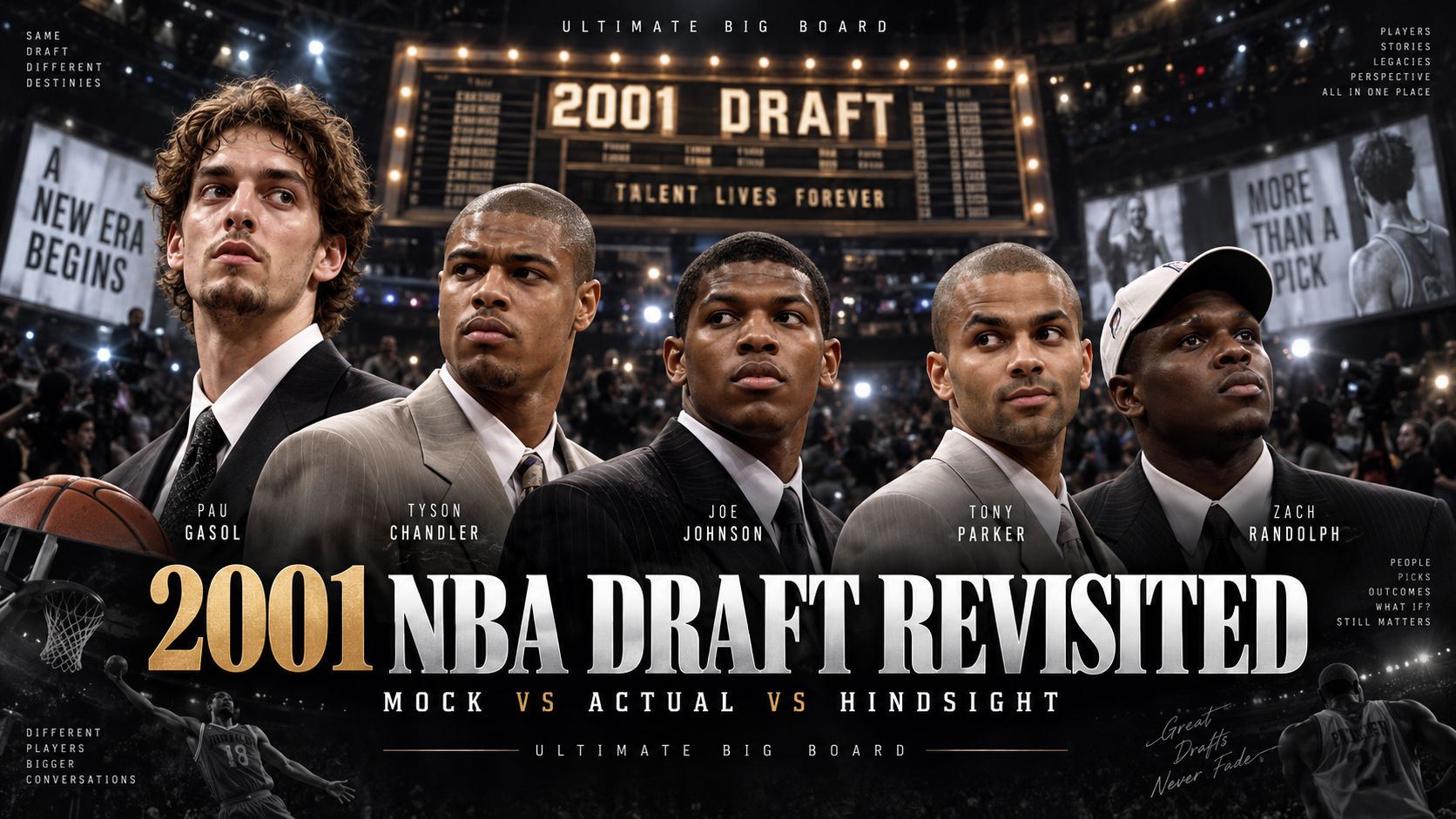
The 2001 draft is remembered for Kwame Brown, the first high school player ever taken No. 1, chosen by a Washington front office run by Michael Jordan. Thirteen of 15 mocks in The Draft Review's consensus had Brown going first, so the Wizards weren't going against the public. The mocks and the team made the same bet, and it failed.
The rest of the class was deep, and much of its value came from players the public and the teams underrated. Pau Gasol was traded on draft night and became a six-time All-Star and a Hall of Famer. Tony Parker was the consensus rank No. 19, went 28th to San Antonio, and won four titles. Gilbert Arenas, Zach Randolph, Gerald Wallace and Joe Johnson all became All-Stars after going outside the top nine.
This article compares three timelines for every first-round pick. The first is what the public mock market expected, using The Draft Review's 15-mock consensus. The second is who teams actually took. The third is who they should have taken, knowing how every career turned out. Minnesota forfeited its first-round pick as a league penalty, so the 2001 first round had 28 picks.
Three-timeline overview
How to read the mock baseline: The Draft Review orders its archive by median projected pick, with average pick as a tiebreaker. Its consensus rank labels, including A/B groups, are separate from projected pick numbers. Each row below shows the actual selection's archive rank, median projected slot, earliest-to-latest projection band and number of mocks listing that player. Medians can be fractional and exclude mocks that omit the player. A missing projection is reported explicitly.
Using actual overall pick equal to median projected slot as the definition of a match, 6 of 28 first-round selections matched; 11 came earlier and 10 later. 1 selection has no archived projection. This is a slot comparison, not a claim that all mocks or a particular team agreed.
| Pick | Team | Actual player's archived mock profile | Actual pick (archive rank) | Hindsight pick |
|---|---|---|---|---|
| 1 | Wizards | Archive rank 1; median slot 1; band 1–3; 15/15 mocks | Kwame Brown (1) | Pau Gasol |
| 2 | Clippers | Archive rank 2; median slot 2; band 2–9; 15/15 mocks | Tyson Chandler (2) | Tony Parker |
| 3 | Hawks | Archive rank 5; median slot 6; band 3–10; 15/15 mocks | Pau Gasol (5) | Joe Johnson |
| 4 | Bulls | Archive rank 3-A; median slot 4; band 1–6; 15/15 mocks | Eddy Curry (3) | Tyson Chandler |
| 5 | Warriors | Archive rank 6-A; median slot 7; band 6–8; 15/15 mocks | Jason Richardson (6) | Zach Randolph |
| 6 | Grizzlies | Archive rank 3-B; median slot 4; band 3–10; 15/15 mocks | Shane Battier (3) | Gilbert Arenas |
| 7 | Nets | Archive rank 4; median slot 5; band 1–7; 15/15 mocks | Eddie Griffin (4) | Gerald Wallace |
| 8 | Cavaliers | Archive rank 8; median slot 10; band 4–19; 15/15 mocks | DeSagana Diop (8) | Richard Jefferson |
| 9 | Pistons | Archive rank 6-B; median slot 7; band 4–9; 15/15 mocks | Rodney White (6) | Shane Battier |
| 10 | Celtics | Archive rank 7; median slot 9; band 7–16; 15/15 mocks | Joe Johnson (7) | Jason Richardson |
| 11 | Celtics | Archive rank 9; median slot 11; band 10–24; 14/15 mocks | Kedrick Brown (9) | Mehmet Okur |
| 12 | SuperSonics | Archive rank 11; median slot 13; band 9–17; 15/15 mocks | Vladimir Radmanovic (11) | Troy Murphy |
| 13 | Rockets | Archive rank 13-A; median slot 16; band 13–19; 15/15 mocks | Richard Jefferson (13) | Samuel Dalembert |
| 14 | Warriors | Archive rank 10; median slot 12; band 9–18; 15/15 mocks | Troy Murphy (10) | Brendan Haywood |
| 15 | Magic | Archive rank 13-B; median slot 16; band 14–27; 15/15 mocks | Steven Hunter (13) | Jamaal Tinsley |
| 16 | Hornets | Archive rank 24-C; median slot 26; band 23–28; 8/15 mocks | Kirk Haston (24) | Vladimir Radmanovic |
| 17 | Raptors | Archive rank 15; median slot 18; band 14–20; 14/15 mocks | Michael Bradley (15) | Eddy Curry |
| 18 | Rockets | Archive rank 20-A; median slot 23; band 20–25; 14/15 mocks | Jason Collins (20) | Trenton Hassell |
| 19 | Trail Blazers | Archive rank 14; median slot 17; band 5–20; 15/15 mocks | Zach Randolph (14) | Earl Watson |
| 20 | Cavaliers | Archive rank 12-B; median slot 15; band 9–24; 15/15 mocks | Brendan Haywood (12) | Jason Collins |
| 21 | Celtics | Archive rank 16; median slot 19; band 16–24; 15/15 mocks | Joe Forte (16) | Kwame Brown |
| 22 | Magic | Archive rank 21-B; median slot 24; band 24; 2/15 mocks | Jeryl Sasser (21*) | DeSagana Diop |
| 23 | Rockets | No projection in the archived 15 mocks | Brandon Armstrong (not mocked) | Steven Hunter |
| 24 | Jazz | Archive rank 21-C; median slot 24; band 24; 1/15 mocks | Raul Lopez (21*) | Raul Lopez |
| 25 | Kings | Archive rank 24-A; median slot 26; band 19–28; 10/15 mocks | Gerald Wallace (24) | Brian Scalabrine |
| 26 | 76ers | Archive rank 24-B; median slot 26; band 23–28; 9/15 mocks | Samuel Dalembert (24) | Michael Bradley |
| 27 | Grizzlies | Archive rank 17; median slot 21; band 14–27; 15/15 mocks | Jamaal Tinsley (17) | Jeryl Sasser |
| 28 | Spurs | Archive rank 19; median slot 22; band 19–28; 11/15 mocks | Tony Parker (19) | Kirk Haston |
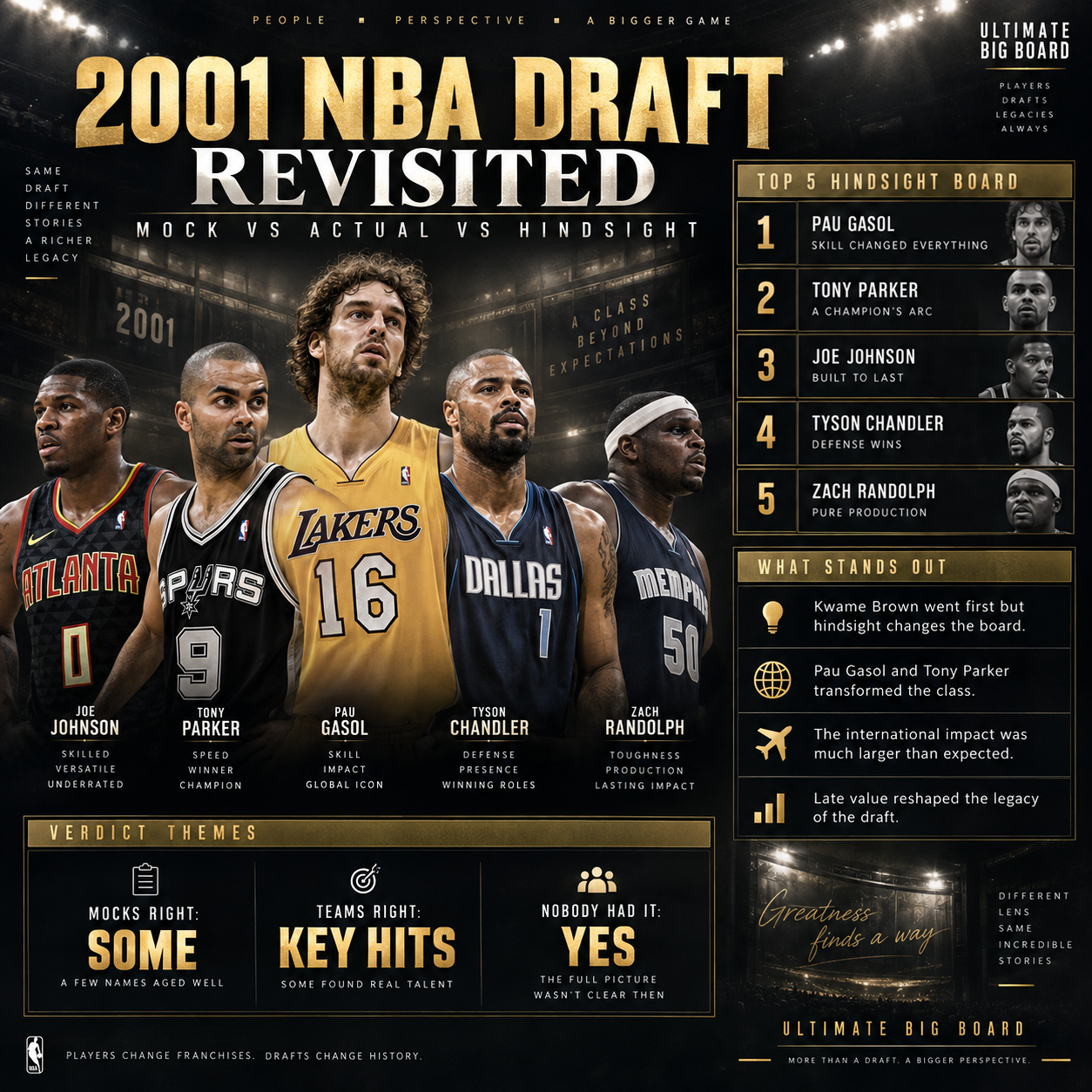
Ultimate Big Board infographic summarizing the 2001 NBA Draft hindsight board, mock-draft themes and major value stories.
Pick-by-pick: Mock vs Actual vs Hindsight
No. 1: Washington Wizards — Kwame Brown
What the mock market was saying: Kwame Brown: Archive rank 1; median slot 1; band 1–3; 15/15 mocks. He was a 6-11 senior from Glynn Academy in Georgia with a strong body and rare athleticism for his size. No high school player had ever gone first overall, and scouts questioned his offensive polish, but the class had no college star who clearly rated higher.
Why the Wizards made the pick: Michael Jordan was running Washington's basketball operations, and the Wizards wanted a franchise big man. Brown impressed the team in workouts, and his physical tools suggested a player who could become a star.
Actual pick versus mock median: The actual selection at No. 1 matched the median projected slot of 1. 13 of 15 listed mocks placed Kwame Brown at that exact pick. This compares overall slots, rather than inferring a team-specific prediction from the archive rank.
What hindsight changes: Brown struggled with the pressure of being the top pick and played 12 seasons as a journeyman big man. He ranks 21st on the hindsight board.
Pau Gasol is the hindsight pick. He was a 7-foot forward from FC Barcelona who could pass, shoot and score in the post. He became Rookie of the Year, a six-time All-Star, a two-time champion with the Lakers, and a Hall of Famer. Washington took the physically gifted big man. Gasol was the skilled one, and the skill lasted longer.
No. 2: Los Angeles Clippers — Tyson Chandler
What the mock market was saying: Tyson Chandler: Archive rank 2; median slot 2; band 2–9; 15/15 mocks. He was a 7-1 senior from Dominguez High School in California, long and athletic but very thin.
Why the Clippers made the pick: The Clippers drafted Chandler to trade him. They sent him and Brian Skinner to Chicago for Elton Brand, an established All-Star power forward.
Actual pick versus mock median: The actual selection at No. 2 matched the median projected slot of 2. 10 of 15 listed mocks placed Tyson Chandler at that exact pick. This compares overall slots, rather than inferring a team-specific prediction from the archive rank.
What hindsight changes: Chandler became an elite defensive center, won Defensive Player of the Year in 2012 and a title with Dallas in 2011. He ranks fourth. Tony Parker is the hindsight pick here.
No. 3: Atlanta Hawks — Pau Gasol
What the mock market was saying: Pau Gasol: Archive rank 5; median slot 6; band 3–10; 15/15 mocks. He was a skinny 20-year-old from FC Barcelona. Scouts liked his skill and worried about his strength.
Why the Hawks made the pick: Atlanta drafted Gasol to trade him. The Hawks sent his rights, Lorenzen Wright and Brevin Knight to the Grizzlies for Shareef Abdur-Rahim and the rights to Jamaal Tinsley, the No. 27 pick.
Actual pick versus mock median: The actual selection at No. 3 was 3 places earlier than the median projected slot of 6. 2 of 15 listed mocks placed Pau Gasol at that exact pick. This compares overall slots, rather than inferring a team-specific prediction from the archive rank.
What hindsight changes: Gasol became the Grizzlies' first star, then won two titles with the Lakers. He ranks first on the hindsight board. Joe Johnson is the hindsight pick here.
No. 4: Chicago Bulls — Eddy Curry
What the mock market was saying: Eddy Curry: Archive rank 3-A; median slot 4; band 1–6; 15/15 mocks. He was a 6-11, 285-pound senior from Thornwood High School near Chicago with soft hands and a strong post game.
Why the Bulls made the pick: Chicago wanted to build around two young centers, Chandler and Curry, and Curry was a local star.
Actual pick versus mock median: The actual selection at No. 4 matched the median projected slot of 4. 9 of 15 listed mocks placed Eddy Curry at that exact pick. This compares overall slots, rather than inferring a team-specific prediction from the archive rank.
What hindsight changes: Curry became a productive low-post scorer but struggled with conditioning. He ranks 17th. Tyson Chandler is the hindsight pick here.
No. 5: Golden State Warriors — Jason Richardson
What the mock market was saying: Jason Richardson: Archive rank 6-A; median slot 7; band 6–8; 15/15 mocks. He was an explosive sophomore wing from Michigan State's 2000 championship team.
Why the Warriors made the pick: Golden State wanted an athletic scorer.
Actual pick versus mock median: The actual selection at No. 5 was 2 places earlier than the median projected slot of 7. 0 of 15 listed mocks placed Jason Richardson at that exact pick. This compares overall slots, rather than inferring a team-specific prediction from the archive rank.
What hindsight changes: Richardson won two dunk contests and averaged around 20 points a game at his peak. He ranks 10th. Zach Randolph is the hindsight pick here.
No. 6: Vancouver Grizzlies — Shane Battier
What the mock market was saying: Shane Battier: Archive rank 3-B; median slot 4; band 3–10; 15/15 mocks. He was the 2001 national player of the year at Duke and had just won a national title.
Why the Grizzlies made the pick: Vancouver, about to move to Memphis, wanted a smart, polished forward who could help right away.
Actual pick versus mock median: The actual selection at No. 6 was 2 places later than the median projected slot of 4. 0 of 15 listed mocks placed Shane Battier at that exact pick. This compares overall slots, rather than inferring a team-specific prediction from the archive rank.
What hindsight changes: Battier became one of the league's best defensive role players and won two titles with Miami. He ranks ninth. Gilbert Arenas, a second-round pick who became a three-time All-Star, is the hindsight pick here.
No. 7: New Jersey Nets — Eddie Griffin
What the mock market was saying: Eddie Griffin: Archive rank 4; median slot 5; band 1–7; 15/15 mocks. He was a 6-10 freshman from Seton Hall who could block shots and shoot from outside.
Why the Nets made the pick: New Jersey drafted Griffin to trade him. The Nets sent his rights to Houston for the Rockets' three first-round picks: Richard Jefferson (No. 13), Jason Collins (No. 18) and Brandon Armstrong (No. 23).
Actual pick versus mock median: The actual selection at No. 7 was 2 places later than the median projected slot of 5. 1 of 15 listed mocks placed Eddie Griffin at that exact pick. This compares overall slots, rather than inferring a team-specific prediction from the archive rank.
What hindsight changes: Griffin's career was short. He falls outside the hindsight board's top 28. The Nets' trade paid off: Jefferson and Collins helped them reach two Finals. Gerald Wallace is the hindsight pick here.
No. 8: Cleveland Cavaliers — DeSagana Diop
What the mock market was saying: DeSagana Diop: Archive rank 8; median slot 10; band 4–19; 15/15 mocks. He was a seven-foot Senegalese center from Oak Hill Academy.
Why the Cavaliers made the pick: Cleveland wanted a defensive center with upside.
Actual pick versus mock median: The actual selection at No. 8 was 2 places earlier than the median projected slot of 10. 0 of 15 listed mocks placed DeSagana Diop at that exact pick. This compares overall slots, rather than inferring a team-specific prediction from the archive rank.
What hindsight changes: Diop had a long career as a backup center. He ranks 22nd. Richard Jefferson is the hindsight pick here.
No. 9: Detroit Pistons — Rodney White
What the mock market was saying: Rodney White: Archive rank 6-B; median slot 7; band 4–9; 15/15 mocks. He was a freshman forward from Charlotte who could score.
Why the Pistons made the pick: Detroit wanted a scorer.
Actual pick versus mock median: The actual selection at No. 9 was 2 places later than the median projected slot of 7. 2 of 15 listed mocks placed Rodney White at that exact pick. This compares overall slots, rather than inferring a team-specific prediction from the archive rank.
What hindsight changes: White played only a few NBA seasons. He falls outside the hindsight board's top 28. Shane Battier is the hindsight pick here.
No. 10: Boston Celtics — Joe Johnson
What the mock market was saying: Joe Johnson: Archive rank 7; median slot 9; band 7–16; 15/15 mocks. He was a 6-7 sophomore wing from Arkansas.
Why the Celtics made the pick: Boston had three first-round picks and wanted a wing.
Actual pick versus mock median: The actual selection at No. 10 was 1 place later than the median projected slot of 9. 3 of 15 listed mocks placed Joe Johnson at that exact pick. This compares overall slots, rather than inferring a team-specific prediction from the archive rank.
What hindsight changes: Boston traded Johnson to Phoenix midway through his rookie season. He became a seven-time All-Star. He ranks third. Jason Richardson is the hindsight pick here.
No. 11: Boston Celtics — Kedrick Brown
What the mock market was saying: Kedrick Brown: Archive rank 9; median slot 11; band 10–24; 14/15 mocks. He was an athletic wing from a Florida junior college.
Why the Celtics made the pick: Boston wanted an athletic wing with upside.
Actual pick versus mock median: The actual selection at No. 11 matched the median projected slot of 11. 8 of 14 listed mocks placed Kedrick Brown at that exact pick. This compares overall slots, rather than inferring a team-specific prediction from the archive rank.
What hindsight changes: Brown played only a few NBA seasons. He falls outside the hindsight board's top 28. Mehmet Okur, a second-round pick who became an All-Star with Utah, is the hindsight pick here.
No. 12: Seattle SuperSonics — Vladimir Radmanovic
What the mock market was saying: Vladimir Radmanovic: Archive rank 11; median slot 13; band 9–17; 15/15 mocks. He was a 6-10 Serbian forward who could shoot.
Why the SuperSonics made the pick: Seattle wanted a floor-spacing forward.
Actual pick versus mock median: The actual selection at No. 12 was 1 place earlier than the median projected slot of 13. 2 of 15 listed mocks placed Vladimir Radmanovic at that exact pick. This compares overall slots, rather than inferring a team-specific prediction from the archive rank.
What hindsight changes: Radmanovic had a long career as a stretch forward. He ranks 16th. Troy Murphy is the hindsight pick here.
No. 13: Houston Rockets — Richard Jefferson
What the mock market was saying: Richard Jefferson: Archive rank 13-A; median slot 16; band 13–19; 15/15 mocks. He was an athletic wing from Arizona.
Why the Rockets made the pick: Houston drafted Jefferson for New Jersey as part of the Griffin trade.
Actual pick versus mock median: The actual selection at No. 13 was 3 places earlier than the median projected slot of 16. 2 of 15 listed mocks placed Richard Jefferson at that exact pick. This compares overall slots, rather than inferring a team-specific prediction from the archive rank.
What hindsight changes: Jefferson was a key player on the Nets' 2002 and 2003 Finals teams and won a title with Cleveland in 2016. He ranks eighth. Samuel Dalembert is the hindsight pick here.
No. 14: Golden State Warriors — Troy Murphy
What the mock market was saying: Troy Murphy: Archive rank 10; median slot 12; band 9–18; 15/15 mocks. He was a skilled junior forward from Notre Dame.
Why the Warriors made the pick: With its second pick, Golden State took a skilled big man.
Actual pick versus mock median: The actual selection at No. 14 was 2 places later than the median projected slot of 12. 0 of 15 listed mocks placed Troy Murphy at that exact pick. This compares overall slots, rather than inferring a team-specific prediction from the archive rank.
What hindsight changes: Murphy became a double-double big man who could shoot from outside. He ranks 12th. Brendan Haywood is the hindsight pick here.
No. 15: Orlando Magic — Steven Hunter
What the mock market was saying: Steven Hunter: Archive rank 13-B; median slot 16; band 14–27; 15/15 mocks. He was a seven-foot center from DePaul.
Why the Magic made the pick: Orlando wanted a shot-blocker.
Actual pick versus mock median: The actual selection at No. 15 was 1 place earlier than the median projected slot of 16. 5 of 15 listed mocks placed Steven Hunter at that exact pick. This compares overall slots, rather than inferring a team-specific prediction from the archive rank.
What hindsight changes: Hunter had a long career as a backup. He ranks 23rd. Jamaal Tinsley is the hindsight pick here.
No. 16: Charlotte Hornets — Kirk Haston
What the mock market was saying: Kirk Haston: Archive rank 24-C; median slot 26; band 23–28; 8/15 mocks. He was a forward from Indiana.
Why the Hornets made the pick: Charlotte wanted a forward who could shoot.
Actual pick versus mock median: The actual selection at No. 16 was 10 places earlier than the median projected slot of 26. 0 of 8 listed mocks placed Kirk Haston at that exact pick. This compares overall slots, rather than inferring a team-specific prediction from the archive rank.
What hindsight changes: Haston played only briefly in the NBA. He ranks 28th. Radmanovic is the hindsight pick here.
No. 17: Toronto Raptors — Michael Bradley
What the mock market was saying: Michael Bradley: Archive rank 15; median slot 18; band 14–20; 14/15 mocks. He was a forward from Villanova.
Why the Raptors made the pick: Toronto wanted front-court depth.
Actual pick versus mock median: The actual selection at No. 17 was 1 place earlier than the median projected slot of 18. 0 of 14 listed mocks placed Michael Bradley at that exact pick. This compares overall slots, rather than inferring a team-specific prediction from the archive rank.
What hindsight changes: Bradley played a few NBA seasons. He ranks 26th. Eddy Curry is the hindsight pick here.
No. 18: Houston Rockets — Jason Collins
What the mock market was saying: Jason Collins: Archive rank 20-A; median slot 23; band 20–25; 14/15 mocks. He was a seven-foot center from Stanford.
Why the Rockets made the pick: Houston drafted Collins for New Jersey as part of the Griffin trade.
Actual pick versus mock median: The actual selection at No. 18 was 5 places earlier than the median projected slot of 23. 0 of 14 listed mocks placed Jason Collins at that exact pick. This compares overall slots, rather than inferring a team-specific prediction from the archive rank.
What hindsight changes: Collins played 13 seasons as a defensive center, including on the Nets' Finals teams. He ranks 20th. Trenton Hassell, a second-round defender, is the hindsight pick here.
No. 19: Portland Trail Blazers — Zach Randolph
What the mock market was saying: Zach Randolph: Archive rank 14; median slot 17; band 5–20; 15/15 mocks. He was a freshman power forward from Michigan State.
Why the Trail Blazers made the pick: Portland took Randolph at No. 19. His archive rank was 14, while his median projected slot was 17.
Actual pick versus mock median: The actual selection at No. 19 was 2 places later than the median projected slot of 17. 1 of 15 listed mocks placed Zach Randolph at that exact pick. This compares overall slots, rather than inferring a team-specific prediction from the archive rank.
What hindsight changes: Randolph won Most Improved Player in 2004, made two All-Star teams, and later became a leader of Memphis's "Grit and Grind" teams. He ranks fifth. Earl Watson, a second-round point guard, is the hindsight pick here.
No. 20: Cleveland Cavaliers — Brendan Haywood
What the mock market was saying: Brendan Haywood: Archive rank 12-B; median slot 15; band 9–24; 15/15 mocks. He was a seven-foot center from North Carolina.
Why the Cavaliers made the pick: Cleveland drafted Haywood and traded his rights to Orlando, which sent him to Washington.
Actual pick versus mock median: The actual selection at No. 20 was 5 places later than the median projected slot of 15. 0 of 15 listed mocks placed Brendan Haywood at that exact pick. This compares overall slots, rather than inferring a team-specific prediction from the archive rank.
What hindsight changes: Haywood played 13 seasons and won a title with Dallas in 2011. He ranks 14th. Jason Collins is the hindsight pick here.
No. 21: Boston Celtics — Joe Forte
What the mock market was saying: Joe Forte: Archive rank 16; median slot 19; band 16–24; 15/15 mocks. He was a scoring guard from North Carolina.
Why the Celtics made the pick: With its third pick, Boston took a scorer.
Actual pick versus mock median: The actual selection at No. 21 was 2 places later than the median projected slot of 19. 0 of 15 listed mocks placed Joe Forte at that exact pick. This compares overall slots, rather than inferring a team-specific prediction from the archive rank.
What hindsight changes: Forte played only briefly in the NBA. He falls outside the hindsight board's top 28. Kwame Brown is the hindsight pick here.
No. 22: Orlando Magic — Jeryl Sasser
What the mock market was saying: Jeryl Sasser: Archive rank 21-B; median slot 24; band 24; 2/15 mocks. He was a guard from SMU.
Why the Magic made the pick: Orlando wanted a big guard who could defend.
Actual pick versus mock median: The actual selection at No. 22 was 2 places earlier than the median projected slot of 24. 0 of 2 listed mocks placed Jeryl Sasser at that exact pick. This compares overall slots, rather than inferring a team-specific prediction from the archive rank.
What hindsight changes: Sasser played only a few NBA seasons. He ranks 27th. DeSagana Diop is the hindsight pick here.
No. 23: Houston Rockets — Brandon Armstrong
What the mock market was saying: Brandon Armstrong: No projection in the archived 15 mocks. He was a scoring guard from Pepperdine.
Why the Rockets made the pick: Houston drafted Armstrong for New Jersey as part of the Griffin trade.
Actual pick versus mock median: The archive does not list a projection for Brandon Armstrong, so no median-slot comparison is available for the actual selection at No. 23.
What hindsight changes: Armstrong played only a few NBA seasons. He falls outside the hindsight board's top 28. Steven Hunter is the hindsight pick here.
No. 24: Utah Jazz — Raul Lopez
What the mock market was saying: Raul Lopez: Archive rank 21-C; median slot 24; band 24; 1/15 mocks. He was a Spanish point guard from Real Madrid.
Why the Jazz made the pick: Utah wanted a future replacement for John Stockton.
Actual pick versus mock median: The actual selection at No. 24 matched the median projected slot of 24. 1 of 1 listed mock placed Raul Lopez at that exact pick. This compares overall slots, rather than inferring a team-specific prediction from the archive rank.
What hindsight changes: Lopez tore his ACL and played only two NBA seasons. He ranks 24th, and the sequential redraft keeps him here.
No. 25: Sacramento Kings — Gerald Wallace
What the mock market was saying: Gerald Wallace: Archive rank 24-A; median slot 26; band 19–28; 10/15 mocks. He was an explosive freshman forward from Alabama.
Why the Kings made the pick: Sacramento was a contender that could afford to develop an athletic teenager.
Actual pick versus mock median: The actual selection at No. 25 was 1 place earlier than the median projected slot of 26. 0 of 10 listed mocks placed Gerald Wallace at that exact pick. This compares overall slots, rather than inferring a team-specific prediction from the archive rank.
What hindsight changes: Wallace became an All-Star with Charlotte in 2010 and one of the league's best defensive forwards. He ranks seventh. Brian Scalabrine is the hindsight pick here.
No. 26: Philadelphia 76ers — Samuel Dalembert
What the mock market was saying: Samuel Dalembert: Archive rank 24-B; median slot 26; band 23–28; 9/15 mocks. He was a Haitian-born center from Seton Hall.
Why the 76ers made the pick: Philadelphia, which had just reached the Finals, wanted a young shot-blocker.
Actual pick versus mock median: The actual selection at No. 26 matched the median projected slot of 26. 2 of 9 listed mocks placed Samuel Dalembert at that exact pick. This compares overall slots, rather than inferring a team-specific prediction from the archive rank.
What hindsight changes: Dalembert played 13 seasons as a shot-blocking center. He ranks 13th. Michael Bradley is the hindsight pick here.
No. 27: Vancouver Grizzlies — Jamaal Tinsley
What the mock market was saying: Jamaal Tinsley: Archive rank 17; median slot 21; band 14–27; 15/15 mocks. He was a flashy point guard from Iowa State.
Why the Grizzlies made the pick: Vancouver drafted Tinsley and sent his rights to Atlanta as part of the Gasol trade. The Hawks then moved him to Indiana.
Actual pick versus mock median: The actual selection at No. 27 was 6 places later than the median projected slot of 21. 1 of 15 listed mocks placed Jamaal Tinsley at that exact pick. This compares overall slots, rather than inferring a team-specific prediction from the archive rank.
What hindsight changes: Tinsley was Indiana's starting point guard for several seasons. He ranks 15th. Jeryl Sasser is the hindsight pick here.
No. 28: San Antonio Spurs — Tony Parker
What the mock market was saying: Tony Parker: Archive rank 19; median slot 22; band 19–28; 11/15 mocks. He was a 19-year-old French point guard playing in Paris, quick but small and inexperienced.
Why the Spurs made the pick: San Antonio's international scouting was ahead of the league, and the Spurs saw a fast, fearless point guard. Parker needed two workouts to convince Gregg Popovich.
Actual pick versus mock median: The actual selection at No. 28 was 6 places later than the median projected slot of 22. 1 of 11 listed mocks placed Tony Parker at that exact pick. This compares overall slots, rather than inferring a team-specific prediction from the archive rank.
What hindsight changes: Parker became San Antonio's starting point guard as a rookie, won four titles and the 2007 Finals MVP, and entered the Hall of Fame. He ranks second. Kirk Haston is the hindsight pick here.
Why the three timelines split
The mocks and the teams agreed on the top two, and both were wrong. Brown and Chandler went exactly as projected. Brown never became the star his draft slot demanded.
Three draft-night trades shaped the lottery. Chandler went to Chicago for Elton Brand, Gasol went to Memphis for Abdur-Rahim, and New Jersey turned Griffin into three first-round picks.
International players were undervalued. Gasol went three places earlier than his median projected slot of 6; Parker went six places later than his median of 22. Mehmet Okur went in the second round.
The late first round and second round were deep. Randolph, Wallace, Parker and Arenas all went at No. 19 or later and became All-Stars.
What the mock market got right
The archive placed Gasol, Johnson, Battier, Richardson and Randolph in its top 15 rank groups. Those are ordering labels: Randolph's median projected slot was 17.
Where teams beat the mocks
New Jersey's trade for three picks and San Antonio's pick of Parker were the best decisions relative to the mocks.
Hindsight top five
- Pau Gasol
- Tony Parker
- Joe Johnson
- Tyson Chandler
- Zach Randolph
FAQ
Who should go No. 1 in a 2001 NBA redraft?
Pau Gasol. He was a six-time All-Star, a two-time champion and a Hall of Famer.
What did mock drafts predict in the 2001 NBA Draft?
The Draft Review's archive separates rank labels from median projected slots. Using actual overall pick equal to median projected slot as the definition of a match, 6 of 28 first-round selections matched; 11 came earlier and 10 later. 1 selection has no archived projection. This is a slot comparison, not a claim that all mocks or a particular team agreed.
Who was the biggest draft-night slide in 2001?
Among first-round selections with an archived projection, the largest difference below the mock median was 6 places: Jamaal Tinsley (median slot 21, actual No. 27, archive rank 17; 15 mocks) and Tony Parker (median slot 22, actual No. 28, archive rank 19; 11 mocks). This uses median projected slot, not the archive rank number.
What is the biggest lesson from the 2001 NBA Draft?
The mocks and the teams can agree on the top pick and both be wrong. Skill aged better than raw physical tools.
Full hindsight board
| Hindsight rank | Player |
|---|---|
| 1 | Pau Gasol |
| 2 | Tony Parker |
| 3 | Joe Johnson |
| 4 | Tyson Chandler |
| 5 | Zach Randolph |
| 6 | Gilbert Arenas |
| 7 | Gerald Wallace |
| 8 | Richard Jefferson |
| 9 | Shane Battier |
| 10 | Jason Richardson |
| 11 | Mehmet Okur |
| 12 | Troy Murphy |
| 13 | Samuel Dalembert |
| 14 | Brendan Haywood |
| 15 | Jamaal Tinsley |
| 16 | Vladimir Radmanovic |
| 17 | Eddy Curry |
| 18 | Trenton Hassell |
| 19 | Earl Watson |
| 20 | Jason Collins |
| 21 | Kwame Brown |
| 22 | DeSagana Diop |
| 23 | Steven Hunter |
| 24 | Raul Lopez |
| 25 | Brian Scalabrine |
| 26 | Michael Bradley |
| 27 | Jeryl Sasser |
| 28 | Kirk Haston |
Sources and methodology
- Historical mock baseline: The Draft Review's 2001 consensus mock draft, built from 15 mock drafts. https://www.thedraftreview.com/consensus-mock-draft-archive/2001-nba-draft-consensus-mock-draft
- Actual first-round order and transaction context: historical NBA draft records.
- Hindsight rankings are Ultimate Big Board editorial judgments built around peak value, longevity, two-way impact, postseason utility, role portability, and overall career production.
- Alternate-history notes are interpretive and do not assume every downstream roster move remains unchanged.