
2002 NBA Draft Revisited: Mock vs Actual vs Hindsight
Revisit every first-round pick from the 2002 NBA Draft through historical mock expectations, actual decisions and full-career hindsight.
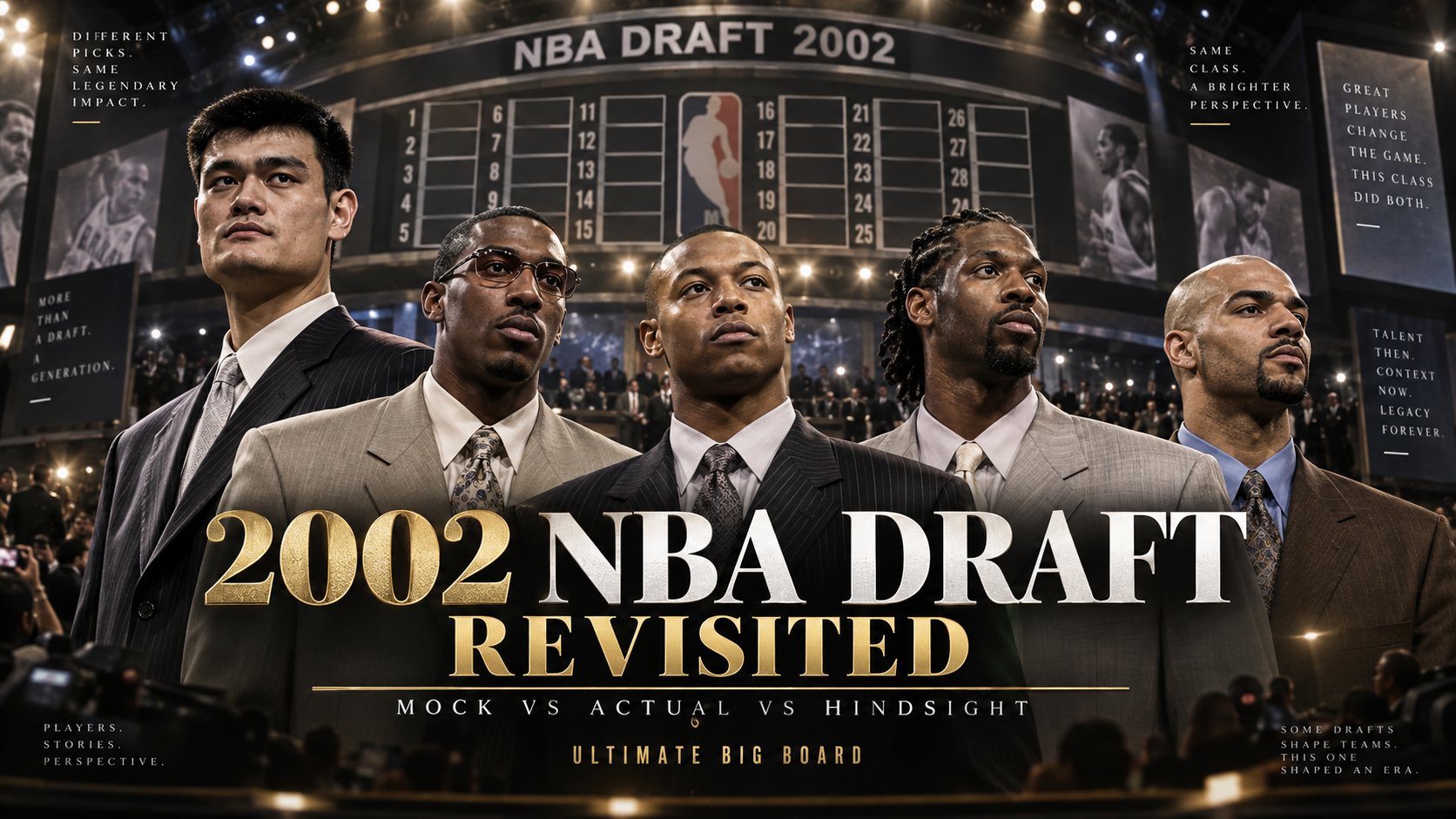
The top of the 2002 draft was one of the most predictable in history. All 15 mocks in The Draft Review's consensus had Jay Williams going second and Mike Dunleavy third, and 14 had Yao Ming first. All three went exactly where expected. Yao became a Hall of Famer. Williams's career ended after one season when he was badly injured in a motorcycle accident.
The draft's best value came from players the public underrated. Amar'e Stoudemire, a high schooler with median projected slot 12 (archive rank 11-A), went ninth and became Rookie of the Year and a six-time All-Star. Carlos Boozer had median projected slot 21.5 (archive rank 20), went 35th, and made two All-Star teams. Tayshaun Prince, projected near the end of the first round, became a starter on Detroit's 2004 title team.
This article compares three timelines for every first-round pick. The first is what the public mock market expected, using The Draft Review's 15-mock consensus. The second is who teams actually took. The third is who they should have taken, knowing how every career turned out. Minnesota forfeited its first-round pick as a league penalty, so the 2002 first round had 28 picks.
Three-timeline overview
How to read the mock baseline: The Draft Review orders its archive by median projected pick, with average pick as a tiebreaker. Its consensus rank labels, including A/B groups, are separate from projected pick numbers. Each row below shows the actual selection's archive rank, median projected slot, earliest-to-latest projection band and number of mocks listing that player. Medians can be fractional and exclude mocks that omit the player. A missing projection is reported explicitly.
Using actual overall pick equal to median projected slot as the definition of a match, 6 of 28 first-round selections matched; 11 came earlier and 10 later. 1 selection has no archived projection. This is a slot comparison, not a claim that all mocks or a particular team agreed.
| Pick | Team | Actual player's archived mock profile | Actual pick (archive rank) | Hindsight pick |
|---|---|---|---|---|
| 1 | Rockets | Archive rank 1; median slot 1; band 1–4; 15/15 mocks | Yao Ming (1) | Yao Ming |
| 2 | Bulls | Archive rank 2; median slot 2; band 2; 15/15 mocks | Jay Williams (2) | Amar'e Stoudemire |
| 3 | Warriors | Archive rank 3; median slot 3; band 3; 15/15 mocks | Mike Dunleavy (3) | Carlos Boozer |
| 4 | Grizzlies | Archive rank 4; median slot 4; band 4–5; 15/15 mocks | Drew Gooden (4) | Caron Butler |
| 5 | Nuggets | Archive rank 5; median slot 5; band 5–13; 15/15 mocks | Nikoloz Tskitishvili (5) | Nene |
| 6 | Cavaliers | Archive rank 8-B; median slot 8; band 5–11; 15/15 mocks | Dajuan Wagner (8) | Tayshaun Prince |
| 7 | Knicks | Archive rank 8-A; median slot 8; band 5–13; 15/15 mocks | Nene (8) | Luis Scola |
| 8 | Clippers | Archive rank 7; median slot 7; band 6–8; 15/15 mocks | Chris Wilcox (7) | Matt Barnes |
| 9 | Suns | Archive rank 11-A; median slot 12; band 8–16; 15/15 mocks | Amar'e Stoudemire (11) | Mike Dunleavy |
| 10 | Heat | Archive rank 6; median slot 6; band 1–10; 15/15 mocks | Caron Butler (6) | Drew Gooden |
| 11 | Wizards | Archive rank 9; median slot 9; band 7–14; 15/15 mocks | Jared Jeffries (9) | John Salmons |
| 12 | Clippers | Archive rank 12; median slot 13; band 12–19; 15/15 mocks | Melvin Ely (12) | Nenad Krstic |
| 13 | Bucks | Archive rank 16-B; median slot 18; band 15–23; 15/15 mocks | Marcus Haislip (16) | Roger Mason Jr. |
| 14 | Pacers | Archive rank 21; median slot 22; band 21–26; 4/15 mocks | Fred Jones (21*) | Dan Gadzuric |
| 15 | Rockets | Archive rank 14; median slot 15; band 11–23; 15/15 mocks | Bostjan Nachbar (14) | Rasual Butler |
| 16 | 76ers | Archive rank 17; median slot 19; band 14–28; 15/15 mocks | Jiri Welsch (17) | Ronald "Flip" Murray |
| 17 | Wizards | Archive rank 23-A; median slot 24; band 14–27; 8/15 mocks | Juan Dixon (23) | Juan Dixon |
| 18 | Magic | Archive rank 11-B; median slot 12; band 7–18; 15/15 mocks | Curtis Borchardt (11) | Fred Jones |
| 19 | Jazz | No projection in the archived 15 mocks | Ryan Humphrey (not mocked) | Bostjan Nachbar |
| 20 | Raptors | Archive rank 13; median slot 14; band 14–24; 15/15 mocks | Kareem Rush (13) | Kareem Rush |
| 21 | Trail Blazers | Archive rank 10; median slot 11; band 10–17; 15/15 mocks | Qyntel Woods (10) | Casey Jacobsen |
| 22 | Suns | Archive rank 22-A; median slot 23; band 16–24; 13/15 mocks | Casey Jacobsen (22) | Jiri Welsch |
| 23 | Pistons | Archive rank 28-A; median slot 27; band 14–28; 10/15 mocks | Tayshaun Prince (28) | Melvin Ely |
| 24 | Nets | Archive rank 26-A; median slot 26; band 21–28; 13/15 mocks | Nenad Krstic (26) | Dan Dickau |
| 25 | Nuggets | Archive rank 18; median slot 20; band 17–23; 14/15 mocks | Frank Williams (18) | Chris Wilcox |
| 26 | Spurs | Archive rank 22-B; median slot 23; band 22–26; 6/15 mocks | John Salmons (22) | Dajuan Wagner |
| 27 | Lakers | Archive rank 22-C; median slot 23; band 17–25; 4/15 mocks | Chris Jefferies (22) | Jared Jeffries |
| 28 | Kings | Archive rank 16-A; median slot 18; band 16–20; 15/15 mocks | Dan Dickau (16) | Frank Williams |
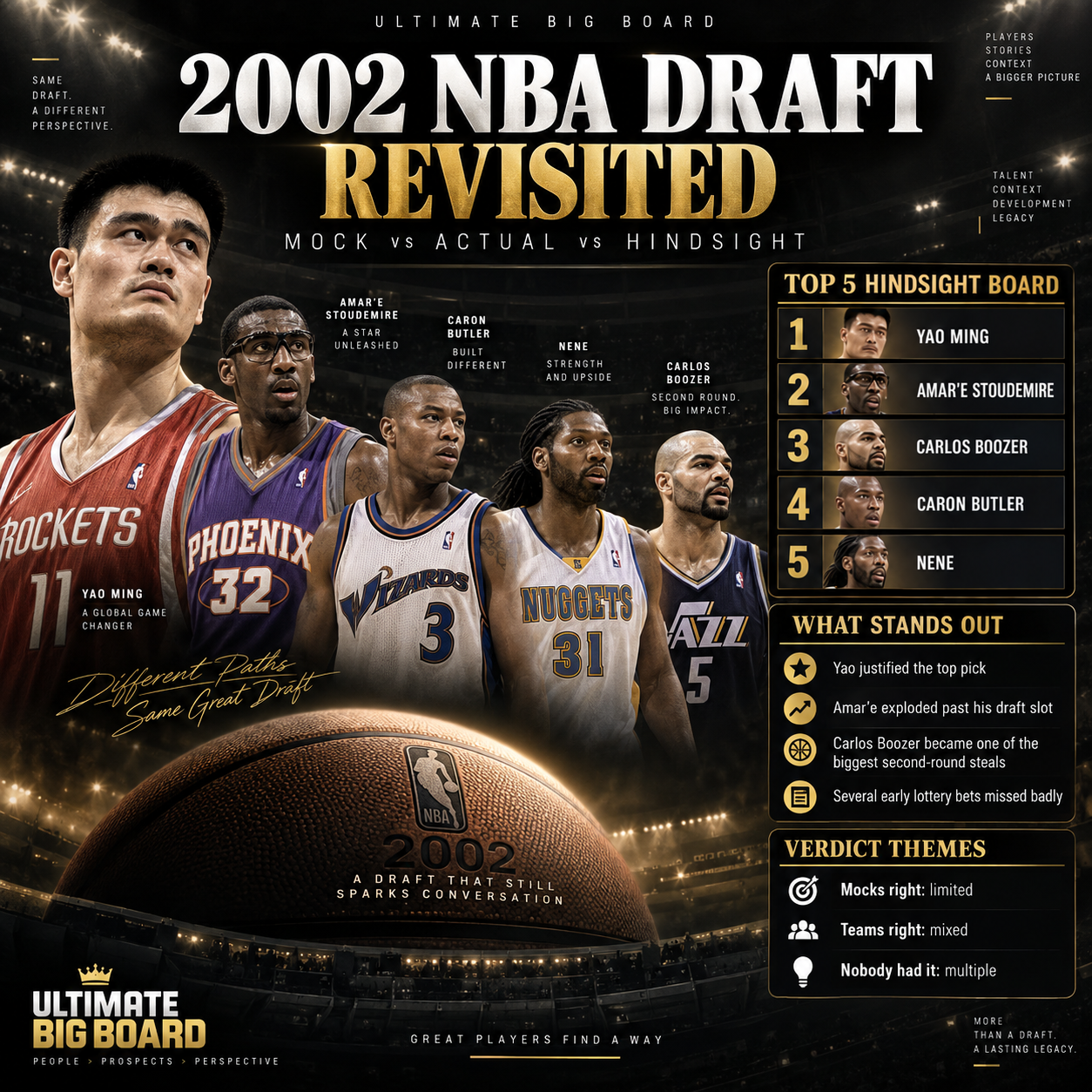
Ultimate Big Board infographic summarizing the 2002 NBA Draft hindsight board, mock-draft themes and major value stories.
Pick-by-pick: Mock vs Actual vs Hindsight
No. 1: Houston Rockets — Yao Ming
What the mock market was saying: Yao Ming: Archive rank 1; median slot 1; band 1–4; 15/15 mocks. He was a 7-5 center from the Shanghai Sharks with soft hands, a good shooting touch and passing skills unusual for his size. The questions were whether China's basketball federation would release him and how quickly he would adjust to NBA physicality.
Why the Rockets made the pick: Houston won the lottery with less than a 9 percent chance and chose the most unusual prospect in years. The Rockets had worked with Chinese officials before the draft to make sure Yao would be allowed to play.
Actual pick versus mock median: The actual selection at No. 1 matched the median projected slot of 1. 14 of 15 listed mocks placed Yao Ming at that exact pick. This compares overall slots, rather than inferring a team-specific prediction from the archive rank.
What hindsight changes: Nothing. Yao made eight All-Star teams and entered the Hall of Fame, though foot injuries ended his career after eight seasons. He's No. 1 on the hindsight board.
No. 2: Chicago Bulls — Jay Williams
What the mock market was saying: Jay Williams: Archive rank 2; median slot 2; band 2; 15/15 mocks. He was a national player of the year at Duke, a quick, confident scorer who had helped the Blue Devils win the 2001 title.
Why the Bulls made the pick: Chicago was rebuilding around young big men Tyson Chandler and Eddy Curry and needed a point guard.
Actual pick versus mock median: The actual selection at No. 2 matched the median projected slot of 2. 15 of 15 listed mocks placed Jay Williams at that exact pick. This compares overall slots, rather than inferring a team-specific prediction from the archive rank.
What hindsight changes: Williams played one promising season before a motorcycle accident in June 2003 ended his career. He falls outside the hindsight board's top 28. Amar'e Stoudemire is the hindsight pick here.
No. 3: Golden State Warriors — Mike Dunleavy
What the mock market was saying: Mike Dunleavy: Archive rank 3; median slot 3; band 3; 15/15 mocks. He was a 6-9 junior wing from Duke, a skilled passer and shooter and the son of an NBA coach.
Why the Warriors made the pick: Golden State wanted a versatile wing.
Actual pick versus mock median: The actual selection at No. 3 matched the median projected slot of 3. 15 of 15 listed mocks placed Mike Dunleavy at that exact pick. This compares overall slots, rather than inferring a team-specific prediction from the archive rank.
What hindsight changes: Dunleavy had a solid 15-season career as a shooter and passer. He ranks ninth. Carlos Boozer is the hindsight pick here.
No. 4: Memphis Grizzlies — Drew Gooden
What the mock market was saying: Drew Gooden: Archive rank 4; median slot 4; band 4–5; 15/15 mocks. He was a productive power forward from Kansas.
Why the Grizzlies made the pick: Memphis, after its first season in the city, wanted a productive power forward to play with Pau Gasol.
Actual pick versus mock median: The actual selection at No. 4 matched the median projected slot of 4. 14 of 15 listed mocks placed Drew Gooden at that exact pick. This compares overall slots, rather than inferring a team-specific prediction from the archive rank.
What hindsight changes: Gooden played 14 seasons for 10 teams as a reliable rebounder. He ranks 10th. Caron Butler is the hindsight pick here.
No. 5: Denver Nuggets — Nikoloz Tskitishvili
What the mock market was saying: Nikoloz Tskitishvili: Archive rank 5; median slot 5; band 5–13; 15/15 mocks. He was a 7-foot, 19-year-old Georgian forward from Benetton Treviso who could shoot from outside.
Why the Nuggets made the pick: Denver was rebuilding and took the highest-upside international player available.
Actual pick versus mock median: The actual selection at No. 5 matched the median projected slot of 5. 9 of 15 listed mocks placed Nikoloz Tskitishvili at that exact pick. This compares overall slots, rather than inferring a team-specific prediction from the archive rank.
What hindsight changes: Tskitishvili played only a few NBA seasons and never developed. He falls outside the hindsight board's top 28. Nene is the hindsight pick here.
No. 6: Cleveland Cavaliers — Dajuan Wagner
What the mock market was saying: Dajuan Wagner: Archive rank 8-B; median slot 8; band 5–11; 15/15 mocks. He was a freshman scoring guard from Memphis who had scored 100 points in a high school game.
Why the Cavaliers made the pick: Cleveland wanted a scorer.
Actual pick versus mock median: The actual selection at No. 6 was 2 places earlier than the median projected slot of 8. 0 of 15 listed mocks placed Dajuan Wagner at that exact pick. This compares overall slots, rather than inferring a team-specific prediction from the archive rank.
What hindsight changes: Wagner averaged more than 13 points a game as a rookie, but a serious illness cut his career short. He ranks 26th. Tayshaun Prince is the hindsight pick here.
No. 7: New York Knicks — Nene
What the mock market was saying: Nene: Archive rank 8-A; median slot 8; band 5–13; 15/15 mocks. He was a 6-11 Brazilian forward from Vasco da Gama, strong and athletic.
Why the Knicks made the pick: New York drafted Nene to trade him. The Knicks sent his rights, Marcus Camby and Mark Jackson to Denver for Antonio McDyess and the rights to Frank Williams, the No. 25 pick.
Actual pick versus mock median: The actual selection at No. 7 was 1 place earlier than the median projected slot of 8. 2 of 15 listed mocks placed Nene at that exact pick. This compares overall slots, rather than inferring a team-specific prediction from the archive rank.
What hindsight changes: Nene played 17 seasons as a strong, versatile big man. McDyess broke his kneecap before playing a regular-season game for the Knicks. Nene ranks fifth. Luis Scola, a second-round pick who stayed in Spain until 2007, is the hindsight pick here.
No. 8: Los Angeles Clippers — Chris Wilcox
What the mock market was saying: Chris Wilcox: Archive rank 7; median slot 7; band 6–8; 15/15 mocks. He was an athletic sophomore forward from Maryland's 2002 championship team.
Why the Clippers made the pick: The Clippers wanted an athletic power forward.
Actual pick versus mock median: The actual selection at No. 8 was 1 place later than the median projected slot of 7. 1 of 15 listed mocks placed Chris Wilcox at that exact pick. This compares overall slots, rather than inferring a team-specific prediction from the archive rank.
What hindsight changes: Wilcox had a long career as a backup forward. He ranks 25th. Matt Barnes, a second-round pick who won a title with Golden State in 2017, is the hindsight pick here.
No. 9: Phoenix Suns — Amar'e Stoudemire
What the mock market was saying: Amar'e Stoudemire: Archive rank 11-A; median slot 12; band 8–16; 15/15 mocks. He was an explosive 6-10 high school forward from Florida who had moved through several high schools. Scouts saw a rare athlete with limited polish.
Why the Suns made the pick: Phoenix saw the most explosive athlete in the draft and took him.
Actual pick versus mock median: The actual selection at No. 9 was 3 places earlier than the median projected slot of 12. 4 of 15 listed mocks placed Amar'e Stoudemire at that exact pick. This compares overall slots, rather than inferring a team-specific prediction from the archive rank.
What hindsight changes: Stoudemire won Rookie of the Year in 2003 and made six All-Star teams. He ranks second, the best value in the lottery. Dunleavy is the redraft pick here.
No. 10: Miami Heat — Caron Butler
What the mock market was saying: Caron Butler: Archive rank 6; median slot 6; band 1–10; 15/15 mocks. He was a tough sophomore wing from Connecticut.
Why the Heat made the pick: Pat Riley's Heat got a consensus top-six talent at No. 10.
Actual pick versus mock median: The actual selection at No. 10 was 4 places later than the median projected slot of 6. 6 of 15 listed mocks placed Caron Butler at that exact pick. This compares overall slots, rather than inferring a team-specific prediction from the archive rank.
What hindsight changes: Butler made two All-Star teams and played 14 seasons. He ranks fourth. Gooden is the redraft pick here.
No. 11: Washington Wizards — Jared Jeffries
What the mock market was saying: Jared Jeffries: Archive rank 9; median slot 9; band 7–14; 15/15 mocks. He was a 6-11 sophomore forward from Indiana, which had just reached the national title game.
Why the Wizards made the pick: Washington wanted a versatile forward.
Actual pick versus mock median: The actual selection at No. 11 was 2 places later than the median projected slot of 9. 1 of 15 listed mocks placed Jared Jeffries at that exact pick. This compares overall slots, rather than inferring a team-specific prediction from the archive rank.
What hindsight changes: Jeffries played 11 seasons as a defensive role player. He ranks 27th. John Salmons is the redraft pick here.
No. 12: Los Angeles Clippers — Melvin Ely
What the mock market was saying: Melvin Ely: Archive rank 12; median slot 13; band 12–19; 15/15 mocks. He was a strong senior center from Fresno State.
Why the Clippers made the pick: With their second pick, the Clippers took a big man.
Actual pick versus mock median: The actual selection at No. 12 was 1 place earlier than the median projected slot of 13. 2 of 15 listed mocks placed Melvin Ely at that exact pick. This compares overall slots, rather than inferring a team-specific prediction from the archive rank.
What hindsight changes: Ely had a long career as a backup. He ranks 23rd. Nenad Krstic is the redraft pick here.
No. 13: Milwaukee Bucks — Marcus Haislip
What the mock market was saying: Marcus Haislip: Archive rank 16-B; median slot 18; band 15–23; 15/15 mocks. He was an athletic forward from Tennessee.
Why the Bucks made the pick: Milwaukee wanted an athletic forward.
Actual pick versus mock median: The actual selection at No. 13 was 5 places earlier than the median projected slot of 18. 0 of 15 listed mocks placed Marcus Haislip at that exact pick. This compares overall slots, rather than inferring a team-specific prediction from the archive rank.
What hindsight changes: Haislip played only a few NBA seasons. He falls outside the hindsight board's top 28. Roger Mason Jr., a second-round pick who became a reliable shooter, is the redraft pick here.
No. 14: Indiana Pacers — Fred Jones
What the mock market was saying: Fred Jones: Archive rank 21; median slot 22; band 21–26; 4/15 mocks. He was an athletic senior guard from Oregon.
Why the Pacers made the pick: Indiana liked Jones's athleticism and defense.
Actual pick versus mock median: The actual selection at No. 14 was 8 places earlier than the median projected slot of 22. 0 of 4 listed mocks placed Fred Jones at that exact pick. This compares overall slots, rather than inferring a team-specific prediction from the archive rank.
What hindsight changes: Jones won the 2004 dunk contest and played several seasons as a rotation guard. He ranks 18th. Dan Gadzuric is the redraft pick here.
No. 15: Houston Rockets — Bostjan Nachbar
What the mock market was saying: Bostjan Nachbar: Archive rank 14; median slot 15; band 11–23; 15/15 mocks. He was a Slovenian forward from Benetton Treviso.
Why the Rockets made the pick: Houston took a skilled international forward.
Actual pick versus mock median: The actual selection at No. 15 matched the median projected slot of 15. 7 of 15 listed mocks placed Bostjan Nachbar at that exact pick. This compares overall slots, rather than inferring a team-specific prediction from the archive rank.
What hindsight changes: Nachbar played several NBA seasons before returning to Europe. He ranks 19th. Rasual Butler is the redraft pick here.
No. 16: Philadelphia 76ers — Jiri Welsch
What the mock market was saying: Jiri Welsch: Archive rank 17; median slot 19; band 14–28; 15/15 mocks. He was a Czech guard from Olimpija Ljubljana.
Why the 76ers made the pick: Philadelphia drafted Welsch and traded his rights to Golden State.
Actual pick versus mock median: The actual selection at No. 16 was 3 places earlier than the median projected slot of 19. 0 of 15 listed mocks placed Jiri Welsch at that exact pick. This compares overall slots, rather than inferring a team-specific prediction from the archive rank.
What hindsight changes: Welsch played a few NBA seasons. He ranks 22nd. Ronald "Flip" Murray, a second-round scorer, is the redraft pick here.
No. 17: Washington Wizards — Juan Dixon
What the mock market was saying: Juan Dixon: Archive rank 23-A; median slot 24; band 14–27; 8/15 mocks. He had just led Maryland to the national title and was named the Final Four's Most Outstanding Player.
Why the Wizards made the pick: Washington took a local star who had won a title a few miles away.
Actual pick versus mock median: The actual selection at No. 17 was 7 places earlier than the median projected slot of 24. 0 of 8 listed mocks placed Juan Dixon at that exact pick. This compares overall slots, rather than inferring a team-specific prediction from the archive rank.
What hindsight changes: Dixon played eight seasons as a scoring guard. He ranks 17th, and the sequential redraft keeps him here.
No. 18: Orlando Magic — Curtis Borchardt
What the mock market was saying: Curtis Borchardt: Archive rank 11-B; median slot 12; band 7–18; 15/15 mocks. He was a seven-foot center from Stanford with a history of foot injuries.
Why the Magic made the pick: Orlando drafted Borchardt and swapped him for Ryan Humphrey, Utah's pick at No. 19.
Actual pick versus mock median: The actual selection at No. 18 was 6 places later than the median projected slot of 12. 1 of 15 listed mocks placed Curtis Borchardt at that exact pick. This compares overall slots, rather than inferring a team-specific prediction from the archive rank.
What hindsight changes: Borchardt's injuries limited him to a brief NBA career. He falls outside the hindsight board's top 28. Fred Jones is the redraft pick here.
No. 19: Utah Jazz — Ryan Humphrey
What the mock market was saying: Ryan Humphrey: No projection in the archived 15 mocks. He was a forward from Notre Dame.
Why the Jazz made the pick: Utah drafted Humphrey for Orlando as part of the Borchardt swap.
Actual pick versus mock median: The archive does not list a projection for Ryan Humphrey, so no median-slot comparison is available for the actual selection at No. 19.
What hindsight changes: Humphrey played only briefly in the NBA. He falls outside the hindsight board's top 28. Nachbar is the redraft pick here.
No. 20: Toronto Raptors — Kareem Rush
What the mock market was saying: Kareem Rush: Archive rank 13; median slot 14; band 14–24; 15/15 mocks. He was a scoring guard from Missouri.
Why the Raptors made the pick: Toronto drafted Rush and traded his rights to the Lakers in a deal that sent Chris Jefferies, the No. 27 pick, to Toronto.
Actual pick versus mock median: The actual selection at No. 20 was 6 places later than the median projected slot of 14. 1 of 15 listed mocks placed Kareem Rush at that exact pick. This compares overall slots, rather than inferring a team-specific prediction from the archive rank.
What hindsight changes: Rush played several seasons as a shooter. He ranks 20th, and the sequential redraft keeps him here.
No. 21: Portland Trail Blazers — Qyntel Woods
What the mock market was saying: Qyntel Woods: Archive rank 10; median slot 11; band 10–17; 15/15 mocks. He was a skilled wing from a Mississippi junior college.
Why the Trail Blazers made the pick: Portland got a consensus lottery-level talent at No. 21.
Actual pick versus mock median: The actual selection at No. 21 was 10 places later than the median projected slot of 11. 0 of 15 listed mocks placed Qyntel Woods at that exact pick. This compares overall slots, rather than inferring a team-specific prediction from the archive rank.
What hindsight changes: Woods played only a few NBA seasons. He falls outside the hindsight board's top 28. Casey Jacobsen is the redraft pick here.
No. 22: Phoenix Suns — Casey Jacobsen
What the mock market was saying: Casey Jacobsen: Archive rank 22-A; median slot 23; band 16–24; 13/15 mocks. He was a shooter from Stanford.
Why the Suns made the pick: With their second pick, Phoenix took a shooter.
Actual pick versus mock median: The actual selection at No. 22 was 1 place earlier than the median projected slot of 23. 4 of 13 listed mocks placed Casey Jacobsen at that exact pick. This compares overall slots, rather than inferring a team-specific prediction from the archive rank.
What hindsight changes: Jacobsen played several NBA seasons. He ranks 21st. Welsch is the redraft pick here.
No. 23: Detroit Pistons — Tayshaun Prince
What the mock market was saying: Tayshaun Prince: Archive rank 28-A; median slot 27; band 14–28; 10/15 mocks. He was a long, skilled senior forward from Kentucky. Scouts worried he was too thin.
Why the Pistons made the pick: Joe Dumars's Pistons valued Prince's length and versatility.
Actual pick versus mock median: The actual selection at No. 23 was 4 places earlier than the median projected slot of 27. 1 of 10 listed mocks placed Tayshaun Prince at that exact pick. This compares overall slots, rather than inferring a team-specific prediction from the archive rank.
What hindsight changes: Prince was a starter on Detroit's 2004 title team, made four All-Defensive teams, and is remembered for his chase-down block of Reggie Miller in the 2004 playoffs. He ranks sixth. Melvin Ely is the redraft pick here.
No. 24: New Jersey Nets — Nenad Krstic
What the mock market was saying: Nenad Krstic: Archive rank 26-A; median slot 26; band 21–28; 13/15 mocks. He was a seven-foot Serbian center from Partizan.
Why the Nets made the pick: New Jersey could leave Krstic in Europe to develop.
Actual pick versus mock median: The actual selection at No. 24 was 2 places earlier than the median projected slot of 26. 0 of 13 listed mocks placed Nenad Krstic at that exact pick. This compares overall slots, rather than inferring a team-specific prediction from the archive rank.
What hindsight changes: Krstic joined the Nets in 2004 and became a productive starting center. He ranks 12th. Dan Dickau is the redraft pick here.
No. 25: Denver Nuggets — Frank Williams
What the mock market was saying: Frank Williams: Archive rank 18; median slot 20; band 17–23; 14/15 mocks. He was a point guard from Illinois.
Why the Nuggets made the pick: Denver drafted Williams for New York as part of the Nene trade.
Actual pick versus mock median: The actual selection at No. 25 was 5 places later than the median projected slot of 20. 0 of 14 listed mocks placed Frank Williams at that exact pick. This compares overall slots, rather than inferring a team-specific prediction from the archive rank.
What hindsight changes: Williams played a few seasons as a backup. He ranks 28th. Chris Wilcox is the redraft pick here.
No. 26: San Antonio Spurs — John Salmons
What the mock market was saying: John Salmons: Archive rank 22-B; median slot 23; band 22–26; 6/15 mocks. He was a versatile wing from Miami.
Why the Spurs made the pick: San Antonio drafted Salmons and traded his rights to Philadelphia.
Actual pick versus mock median: The actual selection at No. 26 was 3 places later than the median projected slot of 23. 1 of 6 listed mocks placed John Salmons at that exact pick. This compares overall slots, rather than inferring a team-specific prediction from the archive rank.
What hindsight changes: Salmons played 13 seasons as a versatile starter and scorer. He ranks 11th. Dajuan Wagner is the redraft pick here.
No. 27: Los Angeles Lakers — Chris Jefferies
What the mock market was saying: Chris Jefferies: Archive rank 22-C; median slot 23; band 17–25; 4/15 mocks. He was a forward from Fresno State.
Why the Lakers made the pick: The Lakers drafted Jefferies for Toronto as part of the Rush trade.
Actual pick versus mock median: The actual selection at No. 27 was 4 places later than the median projected slot of 23. 0 of 4 listed mocks placed Chris Jefferies at that exact pick. This compares overall slots, rather than inferring a team-specific prediction from the archive rank.
What hindsight changes: Jefferies played only briefly in the NBA. He falls outside the hindsight board's top 28. Jared Jeffries is the redraft pick here.
No. 28: Sacramento Kings — Dan Dickau
What the mock market was saying: Dan Dickau: Archive rank 16-A; median slot 18; band 16–20; 15/15 mocks. He was a shooter from Gonzaga.
Why the Kings made the pick: Sacramento drafted Dickau and traded his rights to Atlanta.
Actual pick versus mock median: The actual selection at No. 28 was 10 places later than the median projected slot of 18. 0 of 15 listed mocks placed Dan Dickau at that exact pick. This compares overall slots, rather than inferring a team-specific prediction from the archive rank.
What hindsight changes: Dickau played several seasons as a backup. He ranks 24th. Frank Williams is the redraft pick here.
Why the three timelines split
The mocks and the teams agreed on the top five. The first five picks went exactly as the consensus predicted. Only Yao became a star.
The best players were athletes the public couldn't rank. Stoudemire was a high schooler with a wide range in the mocks. Boozer and Prince were seniors whom teams underrated.
Draft-night trades moved players across the league. Nene went to Denver in the McDyess deal. Rush, Welsch, Salmons and Dickau were all traded that night.
International players were mixed bets. Tskitishvili was a miss at No. 5. Nene, Krstic and Scola became long-time contributors.
What the mock market got right
The consensus correctly predicted the top five picks and rated Butler, Nene and Stoudemire as lottery talents.
Where teams beat the mocks
Detroit's pick of Prince and Phoenix's pick of Stoudemire were the best decisions relative to the mocks. Cleveland found Boozer in the second round but lost him in free agency two years later.
Hindsight top five
- Yao Ming
- Amar'e Stoudemire
- Carlos Boozer
- Caron Butler
- Nene
FAQ
Who should go No. 1 in a 2002 NBA redraft?
Yao Ming. He was an eight-time All-Star and a Hall of Famer.
What did mock drafts predict in the 2002 NBA Draft?
The Draft Review's archive separates rank labels from median projected slots. Using actual overall pick equal to median projected slot as the definition of a match, 6 of 28 first-round selections matched; 11 came earlier and 10 later. 1 selection has no archived projection. This is a slot comparison, not a claim that all mocks or a particular team agreed.
Who was the biggest draft-night slide in 2002?
Among first-round selections with an archived projection, the largest difference below the mock median was 10 places: Qyntel Woods (median slot 11, actual No. 21, archive rank 10; 15 mocks) and Dan Dickau (median slot 18, actual No. 28, archive rank 16-A; 15 mocks). This uses median projected slot, not the archive rank number.
What is the biggest lesson from the 2002 NBA Draft?
The top of a draft can be predictable without being correct. The best players outside Yao were the ones the public ranked lower.
Full hindsight board
| Hindsight rank | Player |
|---|---|
| 1 | Yao Ming |
| 2 | Amar'e Stoudemire |
| 3 | Carlos Boozer |
| 4 | Caron Butler |
| 5 | Nene |
| 6 | Tayshaun Prince |
| 7 | Luis Scola |
| 8 | Matt Barnes |
| 9 | Mike Dunleavy |
| 10 | Drew Gooden |
| 11 | John Salmons |
| 12 | Nenad Krstic |
| 13 | Roger Mason Jr. |
| 14 | Dan Gadzuric |
| 15 | Rasual Butler |
| 16 | Ronald "Flip" Murray |
| 17 | Juan Dixon |
| 18 | Fred Jones |
| 19 | Bostjan Nachbar |
| 20 | Kareem Rush |
| 21 | Casey Jacobsen |
| 22 | Jiri Welsch |
| 23 | Melvin Ely |
| 24 | Dan Dickau |
| 25 | Chris Wilcox |
| 26 | Dajuan Wagner |
| 27 | Jared Jeffries |
| 28 | Frank Williams |
The board includes drafted players only. Udonis Haslem and Jannero Pargo, who went undrafted in 2002 and appeared on the previous version of this board, would rank near Matt Barnes and Flip Murray if undrafted players were included.
Sources and methodology
- Historical mock baseline: The Draft Review's 2002 consensus mock draft, built from 15 mock drafts. https://www.thedraftreview.com/consensus-mock-draft-archive/2002-nba-draft-consensus-mock-draft
- Actual first-round order and transaction context: historical NBA draft records.
- Hindsight rankings are Ultimate Big Board editorial judgments built around peak value, longevity, two-way impact, postseason utility, role portability, and overall career production.
- Alternate-history notes are interpretive and do not assume every downstream roster move remains unchanged.