
2006 NBA Draft Revisited: What the Mocks Predicted, What Teams Did, and What Hindsight Says
Revisit the 2006 NBA Draft with a full mock vs actual vs hindsight breakdown for all 30 first-round picks, plus verdicts, scorecards and franchise what-ifs.
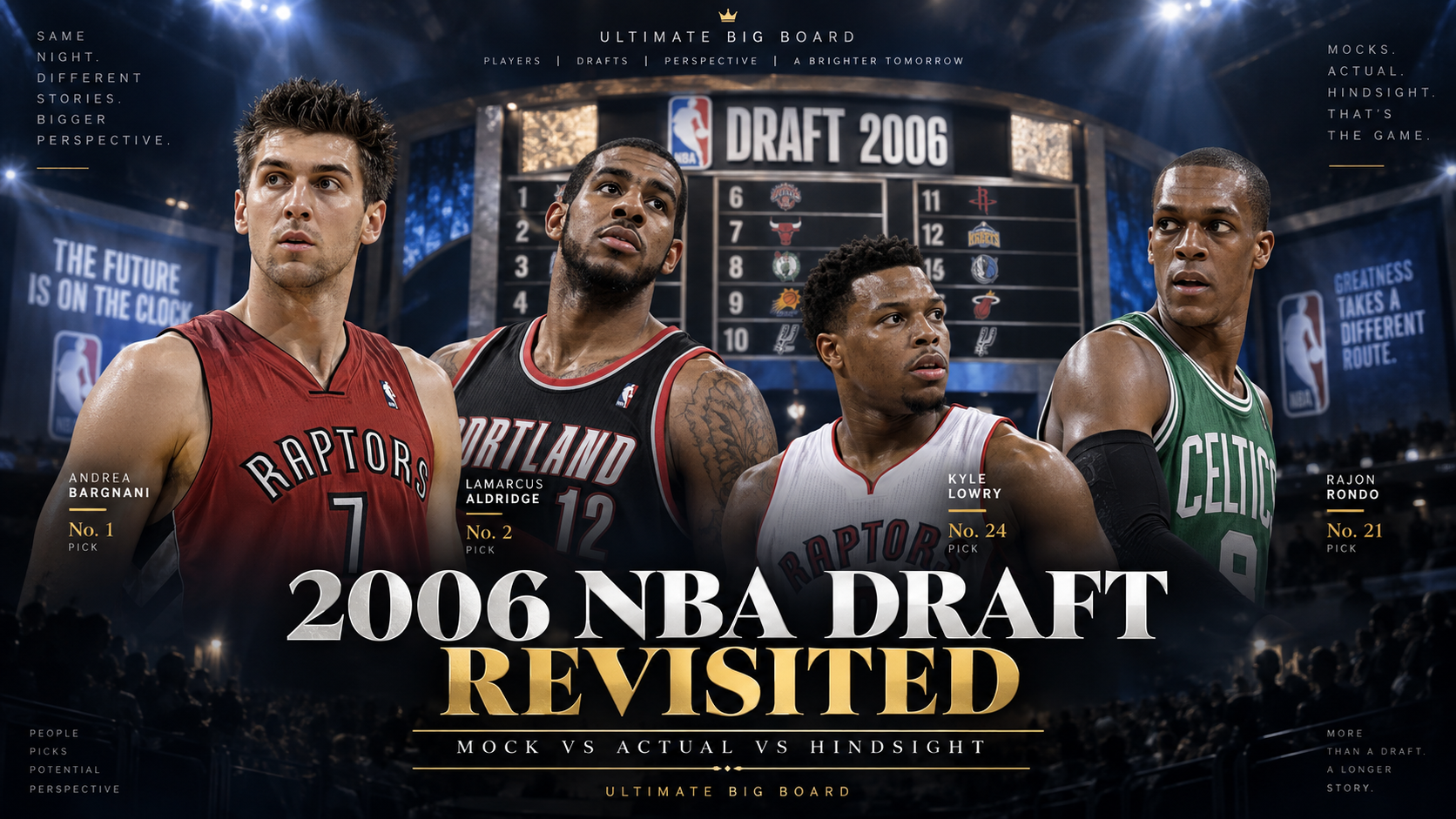
The most interesting way to revisit the 2006 NBA Draft is not to pretend the correct answer was obvious. It is to put three versions of the night beside one another: what contemporary mock drafts expected, what the teams actually did, and what a full career of evidence tells us now.
The historical baseline comes from The Draft Review's preserved 15-mock consensus. That archive is especially useful in 2006 because the top of the board was far less settled than later memory suggests: Bargnani led the No. 1 market, Aldridge still had real first-pick support, and Thomas, Gay, Morrison and Roy moved through very different team fits across the mocks.
The mock comparison asks whether the actual pick matched, preceded or followed the archived median projected slot. The sequential hindsight board reallocates the whole class using editorial judgments about career value. A median match is a measure of draft-night slot agreement, rather than a career grade.
The three timelines
How to read the mock baseline: The archive orders players by median projected pick, with average pick as a tiebreaker. Its rank labels, including A/B groups, are distinct from projected slots. Each row shows the actual selection's rank, median slot, earliest-to-latest band and number of mocks listing that player. Fractional medians and missing projections are preserved. The comparison verdict measures actual overall pick against that player's median; it does not grade career value or imply that every mock or a particular team agreed. The hindsight board remains a separate editorial judgment.
| Pick | Team | Actual player's archived mock profile | Actual pick | Sequential hindsight pick | Mock slot comparison |
|---|---|---|---|---|---|
| 1 | Toronto Raptors | Archive rank 1; median slot 1; band 1–8; 15/15 mocks | Andrea Bargnani | LaMarcus Aldridge | PICK MATCHED MEDIAN |
| 2 | Chicago Bulls | Archive rank 4-A; median slot 4; band 1–6; 15/15 mocks | LaMarcus Aldridge | Kyle Lowry | PICK EARLIER THAN MEDIAN |
| 3 | Charlotte Bobcats | Archive rank 4-B; median slot 4; band 3–8; 15/15 mocks | Adam Morrison | Rajon Rondo | PICK EARLIER THAN MEDIAN |
| 4 | Portland Trail Blazers | Archive rank 2; median slot 2; band 2–6; 15/15 mocks | Tyrus Thomas | Paul Millsap | PICK LATER THAN MEDIAN |
| 5 | Atlanta Hawks | Archive rank 5; median slot 5; band 5–8; 15/15 mocks | Shelden Williams | Brandon Roy | PICK MATCHED MEDIAN |
| 6 | Minnesota Timberwolves | Archive rank 6; median slot 6; band 3–8; 15/15 mocks | Brandon Roy | Rudy Gay | PICK MATCHED MEDIAN |
| 7 | Boston Celtics | Archive rank 7; median slot 7; band 6–13; 15/15 mocks | Randy Foye | J.J. Redick | PICK MATCHED MEDIAN |
| 8 | Houston Rockets | Archive rank 3; median slot 3; band 3–7; 14/15 mocks | Rudy Gay | Jose Juan Barea | PICK LATER THAN MEDIAN |
| 9 | Golden State Warriors | Archive rank 8-A; median slot 10; band 9–18; 15/15 mocks | Patrick O'Bryant | P.J. Tucker | PICK EARLIER THAN MEDIAN |
| 10 | Seattle SuperSonics | Archive rank 13-A; median slot 18; band 14–28; 15/15 mocks | Mouhamed Sene | Thabo Sefolosha | PICK EARLIER THAN MEDIAN |
| 11 | Orlando Magic | Archive rank 11-A; median slot 14; band 11–15; 15/15 mocks | J.J. Redick | Randy Foye | PICK EARLIER THAN MEDIAN |
| 12 | New Orleans/Oklahoma City Hornets | Archive rank 10-B; median slot 12; band 10–22; 15/15 mocks | Hilton Armstrong | Andrea Bargnani | PICK MATCHED MEDIAN |
| 13 | Philadelphia 76ers | Archive rank 12; median slot 16; band 16–28; 15/15 mocks | Thabo Sefolosha | Ronnie Brewer | PICK EARLIER THAN MEDIAN |
| 14 | Utah Jazz | Archive rank 10-A; median slot 12; band 8–15; 15/15 mocks | Ronnie Brewer | C.J. Watson | PICK LATER THAN MEDIAN |
| 15 | New Orleans/Oklahoma City Hornets | Archive rank 8-B; median slot 10; band 9–14; 15/15 mocks | Cedric Simmons | Jordan Farmar | PICK LATER THAN MEDIAN |
| 16 | Chicago Bulls | Archive rank 11-B; median slot 14; band 8–17; 15/15 mocks | Rodney Carney | Daniel Gibson | PICK LATER THAN MEDIAN |
| 17 | Indiana Pacers | Archive rank 14; median slot 20; band 18–25; 15/15 mocks | Shawne Williams | Steve Novak | PICK EARLIER THAN MEDIAN |
| 18 | Washington Wizards | Archive rank 15-B; median slot 21; band 18–30; 14/15 mocks | Oleksiy Pecherov | Shannon Brown | PICK EARLIER THAN MEDIAN |
| 19 | Sacramento Kings | Archive rank 17; median slot 23; band 19–29; 12/15 mocks | Quincy Douby | Ryan Hollins | PICK EARLIER THAN MEDIAN |
| 20 | New York Knicks | No projection in the archived 15 mocks | Renaldo Balkman | Louis Amundson | NO ARCHIVED PROJECTION |
| 21 | Phoenix Suns | Archive rank 13-B; median slot 18; band 13–27; 15/15 mocks | Rajon Rondo | Craig Smith | PICK LATER THAN MEDIAN |
| 22 | New Jersey Nets | Archive rank 9; median slot 11; band 7–17; 15/15 mocks | Marcus Williams | Leon Powe | PICK LATER THAN MEDIAN |
| 23 | New Jersey Nets | Archive rank 20-A; median slot 25.5; band 20–29; 8/15 mocks | Josh Boone | Tyrus Thomas | PICK EARLIER THAN MEDIAN |
| 24 | Memphis Grizzlies | Archive rank 16-B; median slot 22; band 15–30; 14/15 mocks | Kyle Lowry | Sergio Rodriguez | PICK LATER THAN MEDIAN |
| 25 | Cleveland Cavaliers | Archive rank 15-A; median slot 21; band 15–29; 15/15 mocks | Shannon Brown | Renaldo Balkman | PICK LATER THAN MEDIAN |
| 26 | Los Angeles Lakers | Archive rank 16-A; median slot 22; band 17–25; 15/15 mocks | Jordan Farmar | Walter Herrmann | PICK LATER THAN MEDIAN |
| 27 | Phoenix Suns | Archive rank 18; median slot 24.5; band 17–28; 14/15 mocks | Sergio Rodriguez | Josh Boone | PICK LATER THAN MEDIAN |
| 28 | Dallas Mavericks | Archive rank 22-A; median slot 27; band 16–28; 13/15 mocks | Maurice Ager | Marcus Williams | PICK LATER THAN MEDIAN |
| 29 | New York Knicks | Archive rank 21; median slot 26; band 16–29; 10/15 mocks | Mardy Collins | Shelden Williams | PICK LATER THAN MEDIAN |
| 30 | Portland Trail Blazers | Archive rank 25-A; median slot 30; band 26–30; 3/15 mocks | Joel Freeland | Hilton Armstrong | PICK MATCHED MEDIAN |
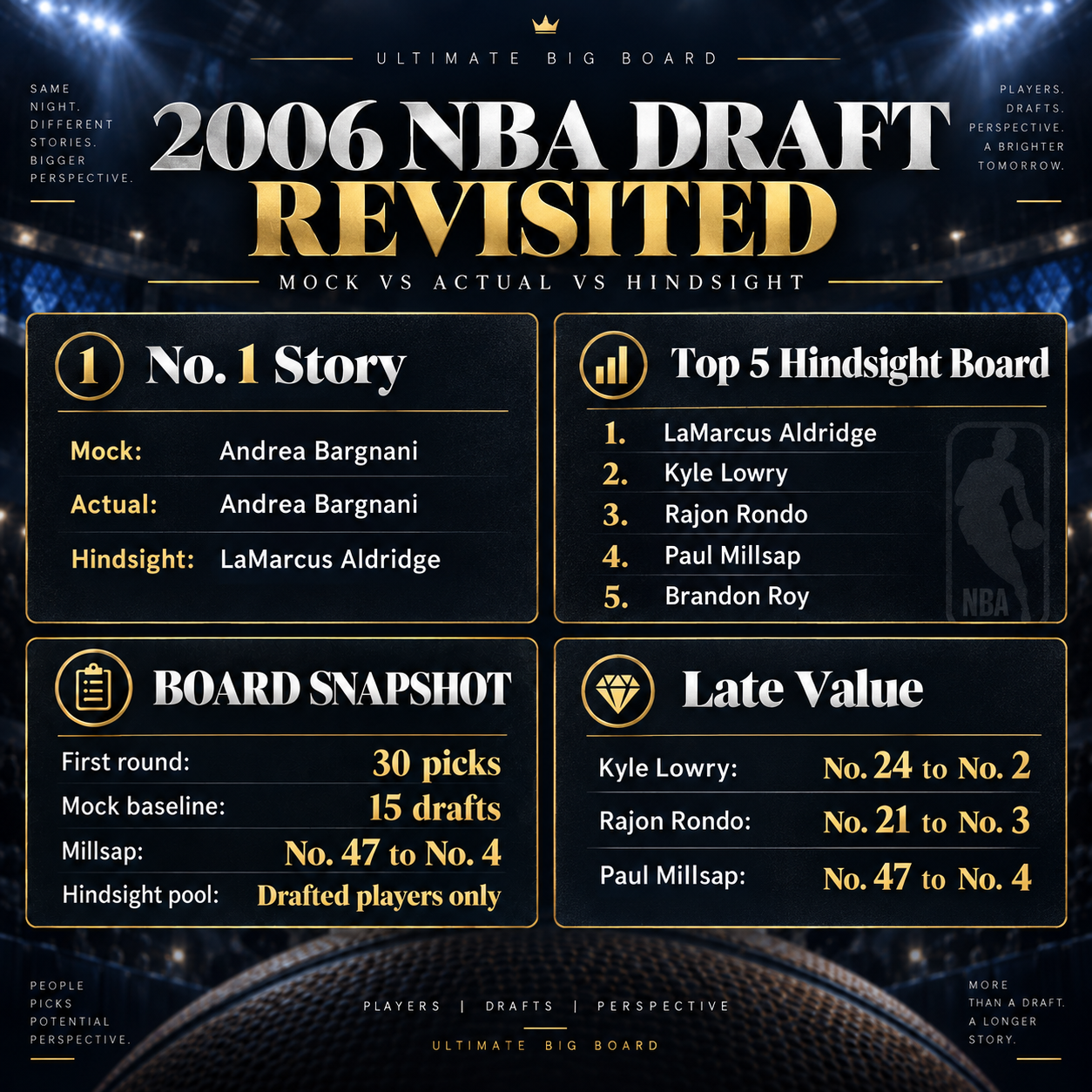
Mock Draft Scorecard
A match means the actual overall pick equals that player's median projected slot. Earlier and later picks use the same median; missing projections remain explicit. These counts do not grade career value.
| Actual pick versus mock median | First-round selections |
|---|---|
| PICK MATCHED MEDIAN | 6 |
| PICK EARLIER THAN MEDIAN | 10 |
| PICK LATER THAN MEDIAN | 13 |
| NO ARCHIVED PROJECTION | 1 |
Pick-by-pick: Mock vs. Actual vs. Hindsight
No. 1: Toronto Raptors
ARCHIVED MOCK PROFILE: Archive rank 1; median slot 1; band 1–8; 15/15 mocks ACTUAL PICK: Andrea Bargnani SEQUENTIAL HINDSIGHT PICK: LaMarcus Aldridge COMPARISON VERDICT: PICK MATCHED MEDIAN
What the mock drafts were saying
Andrea Bargnani: Archive rank 1; median slot 1; band 1–8; 15/15 mocks. The actual No. 1 selection matched the median. 11 of 15 listed mocks placed the player at that exact overall pick. This does not infer a team-specific prediction from the archive rank.
Why the team made the actual choice
Bryan Colangelo was not choosing from a LeBron-style consensus. Toronto already had Chris Bosh and wanted another skilled big who could stretch the floor, so Bargnani's shooting and face-up game offered a modern pairing on paper. The choice looks worse now, but it was not treated as a wild reach in June 2006.
What hindsight changes
A full-career redraft now prefers LaMarcus Aldridge at this slot. The career judgment is separate from the archived mock median.
Aldridge gives Toronto the cleaner long-term answer. His 16-season career, seven All-Star selections and ability to score without dominating the ball would have fit beside Bosh immediately. The real complication is 2010: a stronger Bosh-Aldridge core could change Bosh's free-agency calculus, Toronto's record and every later lottery slot. This is more than replacing one power forward with another. It potentially changes the franchise's pre-DeRozan timeline.
Career snapshot
| Player | NBA seasons | PPG | RPG | APG |
|---|---|---|---|---|
| Andrea Bargnani | 10 | 14.3 | 4.6 | 1.2 |
| LaMarcus Aldridge | 16 | 19.1 | 8.1 | 1.9 |
No. 2: Chicago Bulls
ARCHIVED MOCK PROFILE: Archive rank 4-A; median slot 4; band 1–6; 15/15 mocks ACTUAL PICK: LaMarcus Aldridge SEQUENTIAL HINDSIGHT PICK: Kyle Lowry COMPARISON VERDICT: PICK EARLIER THAN MEDIAN
What the mock drafts were saying
LaMarcus Aldridge: Archive rank 4-A; median slot 4; band 1–6; 15/15 mocks. The actual No. 2 selection was 2 places earlier than the median. 3 of 15 listed mocks placed the player at that exact overall pick. This does not infer a team-specific prediction from the archive rank.
Why the team made the actual choice
Chicago was coming off a playoff appearance with a young perimeter core and wanted explosiveness in the frontcourt. Thomas looked like a defensive playmaker whose LSU tournament run hinted at enormous upside. The Bulls did not simply 'miss' Aldridge at No. 2; they actively preferred Thomas enough to swap draft rights with Portland.
What hindsight changes
The actual selection aged better than the mock-market alternative. Even though the sequential redraft may move LaMarcus Aldridge earlier, this is a spot where the team saw more than the consensus did.
Lowry would have been a very different bet. In 2006 he was a rugged Villanova guard with questions about his jumper, not the six-time All-Star he became. Put him next to Ben Gordon, Luol Deng and Kirk Hinrich and the Bulls gain a pressure defender and second organizer. The long-term consequence could be enormous because Derrick Rose's 2008 path to Chicago depended on lottery luck after two more seasons of results.
Career snapshot
| Player | NBA seasons | PPG | RPG | APG |
|---|---|---|---|---|
| LaMarcus Aldridge | 16 | 19.1 | 8.1 | 1.9 |
| Kyle Lowry | 20 | 13.8 | 4.2 | 6.0 |
No. 3: Charlotte Bobcats
ARCHIVED MOCK PROFILE: Archive rank 4-B; median slot 4; band 3–8; 15/15 mocks ACTUAL PICK: Adam Morrison SEQUENTIAL HINDSIGHT PICK: Rajon Rondo COMPARISON VERDICT: PICK EARLIER THAN MEDIAN
What the mock drafts were saying
Adam Morrison: Archive rank 4-B; median slot 4; band 3–8; 15/15 mocks. The actual No. 3 selection was 1 place earlier than the median. 5 of 15 listed mocks placed the player at that exact overall pick. This does not infer a team-specific prediction from the archive rank.
Why the team made the actual choice
Charlotte needed offense and visibility. Morrison had just led college basketball in scoring and arrived as one of the draft's most recognizable players, so the appeal to an expansion-era roster was obvious. The weakness was positional: the Bobcats needed a creator who could make teammates better as much as they needed another scorer.
What hindsight changes
The mock market pointed to Rudy Gay, the team chose Adam Morrison, and the hindsight board now prefers Rajon Rondo. None of the three timelines line up.
Rondo changes the identity of the young roster. His shooting limitations would have cramped the floor, but his transition play, rebounding from the guard spot and elite passing could have accelerated Gerald Wallace and Emeka Okafor. Charlotte never develops the same Raymond Felton-centered backcourt, and Rondo's eventual championship-level defense gives the franchise a foundational skill it spent years trying to acquire.
Career snapshot
| Player | NBA seasons | PPG | RPG | APG |
|---|---|---|---|---|
| Adam Morrison | 3 | 7.5 | 2.1 | 1.4 |
| Rajon Rondo | 16 | 9.8 | 4.5 | 7.9 |
No. 4: Portland Trail Blazers
ARCHIVED MOCK PROFILE: Archive rank 2; median slot 2; band 2–6; 15/15 mocks ACTUAL PICK: Tyrus Thomas SEQUENTIAL HINDSIGHT PICK: Paul Millsap COMPARISON VERDICT: PICK LATER THAN MEDIAN
What the mock drafts were saying
Tyrus Thomas: Archive rank 2; median slot 2; band 2–6; 15/15 mocks. The actual No. 4 selection was 2 places later than the median. 1 of 15 listed mocks placed the player at that exact overall pick. This does not infer a team-specific prediction from the archive rank.
Why the team made the actual choice
Portland's recorded selection was part of a deal, not an endorsement of Thomas over Aldridge. The Trail Blazers used the fourth pick to obtain Aldridge at No. 2, then added Brandon Roy later that night. That distinction matters because the actual front office already turned this slot into one of the best players in the class.
What hindsight changes
In the editorial career comparison, LaMarcus Aldridge / Adam Morrison produced more long-term value than Tyrus Thomas, even though the sequential hindsight board ultimately prefers Paul Millsap. That career judgment is separate from the mock-slot comparison.
In a strict one-player-per-slot redraft Aldridge is gone, so Millsap becomes the prize. He fell to No. 47 after leading the nation in rebounding three straight years, then built a 16-season, four-All-Star career. Pairing Millsap with the Roy acquisition gives Portland a rugged, switchable forward whose durability could have mattered greatly once the Oden-Roy core began breaking down.
Career snapshot
| Player | NBA seasons | PPG | RPG | APG |
|---|---|---|---|---|
| Tyrus Thomas | 8 | 7.7 | 4.8 | 0.9 |
| Paul Millsap | 16 | 13.4 | 7.1 | 2.2 |
No. 5: Atlanta Hawks
ARCHIVED MOCK PROFILE: Archive rank 5; median slot 5; band 5–8; 15/15 mocks ACTUAL PICK: Shelden Williams SEQUENTIAL HINDSIGHT PICK: Brandon Roy COMPARISON VERDICT: PICK MATCHED MEDIAN
What the mock drafts were saying
Shelden Williams: Archive rank 5; median slot 5; band 5–8; 15/15 mocks. The actual No. 5 selection matched the median. 12 of 15 listed mocks placed the player at that exact overall pick. This does not infer a team-specific prediction from the archive rank.
Why the team made the actual choice
Atlanta had accumulated wings and forwards but lacked reliable interior defense and rebounding. Shelden Williams was older, productive and physically ready, which made him a logical attempt to stabilize a young roster rather than another upside swing. The problem was that his NBA role proved far smaller than projected.
What hindsight changes
A full-career redraft now prefers Brandon Roy at this slot. The career judgment is separate from the archived mock median.
Roy would have solved the harder problem. The Hawks had Joe Johnson, but another elite ballhandler and closer would have reduced the burden on Johnson while giving Atlanta a genuine second star. Roy's knees still make the timeline short, yet his peak was strong enough to alter the 2008 through 2010 playoff teams. Atlanta might trade differently, draft differently and approach the Joe Johnson contract from a position of far greater leverage.
Career snapshot
| Player | NBA seasons | PPG | RPG | APG |
|---|---|---|---|---|
| Shelden Williams | 6 | 4.5 | 4.3 | 0.5 |
| Brandon Roy | 6 | 18.8 | 4.3 | 4.7 |
No. 6: Minnesota Timberwolves
ARCHIVED MOCK PROFILE: Archive rank 6; median slot 6; band 3–8; 15/15 mocks ACTUAL PICK: Brandon Roy SEQUENTIAL HINDSIGHT PICK: Rudy Gay COMPARISON VERDICT: PICK MATCHED MEDIAN
What the mock drafts were saying
Brandon Roy: Archive rank 6; median slot 6; band 3–8; 15/15 mocks. The actual No. 6 selection matched the median. 5 of 15 listed mocks placed the player at that exact overall pick. This does not infer a team-specific prediction from the archive rank.
Why the team made the actual choice
The Timberwolves wanted perimeter creation around Kevin Garnett and ultimately preferred Foye's combo-guard profile. That decision was understandable in role terms, but the rights swap became painful almost immediately because Roy was Rookie of the Year and an All-NBA player by his third season.
What hindsight changes
A full-career redraft now prefers Rudy Gay at this slot. The career judgment is separate from the archived mock median.
Gay offers a longer runway than either Roy or Foye. He became a 17-season scorer with enough size to play both forward spots. Minnesota still faces the Garnett decision in 2007, but Gay would enter that rebuild as a legitimate young scoring piece rather than leaving the franchise searching for a wing every summer. He does not create Roy's peak, but he gives the Wolves continuity that the actual trade never did.
Career snapshot
| Player | NBA seasons | PPG | RPG | APG |
|---|---|---|---|---|
| Brandon Roy | 6 | 18.8 | 4.3 | 4.7 |
| Rudy Gay | 17 | 15.8 | 5.6 | 2.0 |
No. 7: Boston Celtics
ARCHIVED MOCK PROFILE: Archive rank 7; median slot 7; band 6–13; 15/15 mocks ACTUAL PICK: Randy Foye SEQUENTIAL HINDSIGHT PICK: J.J. Redick COMPARISON VERDICT: PICK MATCHED MEDIAN
What the mock drafts were saying
Randy Foye: Archive rank 7; median slot 7; band 6–13; 15/15 mocks. The actual No. 7 selection matched the median. 7 of 15 listed mocks placed the player at that exact overall pick. This does not infer a team-specific prediction from the archive rank.
Why the team made the actual choice
Boston's pick was transactional. Foye's rights moved to Portland in the Sebastian Telfair deal, so judging the slot as though the Celtics intended to develop Foye misses the point. Boston was trying to rework a roster around Paul Pierce and young frontcourt assets, not lock in a rookie guard.
What hindsight changes
A full-career redraft now prefers J.J. Redick at this slot. The career judgment is separate from the archived mock median.
Redick would have offered an unusually portable skill: elite shooting. On the pre-Garnett Celtics he could have developed beside Pierce, and on the 2008 title roster his movement shooting would have supplied spacing around Kevin Garnett and Rajon Rondo. The catch is asset math. If Boston keeps the player instead of using the pick in the Telfair transaction, the path to later trades changes. The redraft improves the player, but it cannot keep every real-world deal intact.
Career snapshot
| Player | NBA seasons | PPG | RPG | APG |
|---|---|---|---|---|
| Randy Foye | 11 | 10.3 | 2.2 | 2.8 |
| J.J. Redick | 15 | 12.8 | 2.0 | 2.0 |
No. 8: Houston Rockets
ARCHIVED MOCK PROFILE: Archive rank 3; median slot 3; band 3–7; 14/15 mocks ACTUAL PICK: Rudy Gay SEQUENTIAL HINDSIGHT PICK: Jose Juan Barea COMPARISON VERDICT: PICK LATER THAN MEDIAN
What the mock drafts were saying
Rudy Gay: Archive rank 3; median slot 3; band 3–7; 14/15 mocks. The actual No. 8 selection was 5 places later than the median. 0 of 14 listed mocks placed the player at that exact overall pick. This does not infer a team-specific prediction from the archive rank.
Why the team made the actual choice
This was a deliberate win-now decision. Houston had Yao Ming and Tracy McGrady and wanted a low-usage defender who could guard elite wings, hit open shots and help immediately. Battier did exactly that. Treating the transaction as a simple 'Gay over Battier' mistake ignores what the Rockets were optimizing for.
What hindsight changes
The actual selection aged better than the mock-market alternative. Even though the sequential redraft may move Rudy Gay earlier, this is a spot where the team saw more than the consensus did.
Barea gives Houston a different type of complementary value. He went undrafted, but became a fearless pick-and-roll guard and a championship contributor in Dallas. His size would create defensive issues, yet his penetration could relieve McGrady and give the bench a real creator. Houston probably still searches for a Battier-type wing, but it no longer has to spend this premium draft asset to add guard creation later.
Career snapshot
| Player | NBA seasons | PPG | RPG | APG |
|---|---|---|---|---|
| Rudy Gay | 17 | 15.8 | 5.6 | 2.0 |
| Jose Juan Barea | 14 | 8.9 | 2.1 | 3.9 |
No. 9: Golden State Warriors
ARCHIVED MOCK PROFILE: Archive rank 8-A; median slot 10; band 9–18; 15/15 mocks ACTUAL PICK: Patrick O'Bryant SEQUENTIAL HINDSIGHT PICK: P.J. Tucker COMPARISON VERDICT: PICK EARLIER THAN MEDIAN
What the mock drafts were saying
Patrick O'Bryant: Archive rank 8-A; median slot 10; band 9–18; 15/15 mocks. The actual No. 9 selection was 1 place earlier than the median. 7 of 15 listed mocks placed the player at that exact overall pick. This does not infer a team-specific prediction from the archive rank.
Why the team made the actual choice
The Warriors were still searching for reliable size, and O'Bryant's length plus flashes at Bradley made him an understandable upside gamble. The timing was awkward: Don Nelson's return soon pushed Golden State toward faster, smaller lineups in which a raw traditional center had little margin for developmental mistakes.
What hindsight changes
The mock market pointed to Marcus Williams, the team chose Patrick O'Bryant, and the hindsight board now prefers P.J. Tucker. None of the three timelines line up.
Tucker would have been nearly the opposite profile. He was undersized, older and fell to the second round before spending years overseas, but eventually became one of the league's most useful switchable defenders. In Nelson's system his toughness and small-ball versatility make far more sense. He also could have stayed useful through the later Curry era, creating an unusual bridge between two very different Warriors identities.
Career snapshot
| Player | NBA seasons | PPG | RPG | APG |
|---|---|---|---|---|
| Patrick O'Bryant | 4 | 2.1 | 1.4 | 0.3 |
| P.J. Tucker | 14 | 6.6 | 5.4 | 1.4 |
No. 10: Seattle SuperSonics
ARCHIVED MOCK PROFILE: Archive rank 13-A; median slot 18; band 14–28; 15/15 mocks ACTUAL PICK: Mouhamed Sene SEQUENTIAL HINDSIGHT PICK: Thabo Sefolosha COMPARISON VERDICT: PICK EARLIER THAN MEDIAN
What the mock drafts were saying
Mouhamed Sene: Archive rank 13-A; median slot 18; band 14–28; 15/15 mocks. The actual No. 10 selection was 8 places earlier than the median. 0 of 15 listed mocks placed the player at that exact overall pick. This does not infer a team-specific prediction from the archive rank.
Why the team made the actual choice
Seattle bet on a seven-footer with extraordinary length and very little high-level experience. The roster still featured Ray Allen and Rashard Lewis, so the front office was trying to manufacture a defensive anchor rather than add another scorer. It was a classic upside swing at the most difficult position to find.
What hindsight changes
There was no single mock favorite here, and the hindsight board moves in another direction with Thabo Sefolosha. This is a good example of genuine draft uncertainty rather than a simple miss.
Sefolosha provides the opposite kind of certainty. He never became a major scorer, but he defended elite wings for 14 seasons and later became an important piece of the Oklahoma City core. Drafting him in Seattle would mean the franchise carries a ready-made perimeter stopper into the Durant and Westbrook years. That could reduce the need for later defensive-wing moves without disturbing touches for the stars.
Career snapshot
| Player | NBA seasons | PPG | RPG | APG |
|---|---|---|---|---|
| Mouhamed Sene | 3 | 2.2 | 1.6 | 0.0 |
| Thabo Sefolosha | 14 | 5.7 | 3.7 | 1.4 |
No. 11: Orlando Magic
ARCHIVED MOCK PROFILE: Archive rank 11-A; median slot 14; band 11–15; 15/15 mocks ACTUAL PICK: J.J. Redick SEQUENTIAL HINDSIGHT PICK: Randy Foye COMPARISON VERDICT: PICK EARLIER THAN MEDIAN
What the mock drafts were saying
J.J. Redick: Archive rank 11-A; median slot 14; band 11–15; 15/15 mocks. The actual No. 11 selection was 3 places earlier than the median. 7 of 15 listed mocks placed the player at that exact overall pick. This does not infer a team-specific prediction from the archive rank.
Why the team made the actual choice
Orlando's logic was clean: Dwight Howard needed shooting around him, and Redick was one of the best shooters in college basketball history. His early minutes were limited because his defense and all-around game needed work, but the skill eventually translated exactly as expected.
What hindsight changes
A full-career redraft now prefers Randy Foye at this slot. The career judgment is separate from the archived mock median.
With Redick already gone in this redraft, Foye gives the Magic a sturdier on-ball guard. He was never an elite point guard, yet his ability to handle, shoot and defend bigger guards would have helped a team that cycled through backcourt combinations around Howard. Orlando loses some off-ball gravity but gains more self-creation, which could matter in playoff series when opponents stayed attached to the Magic's shooters.
Career snapshot
| Player | NBA seasons | PPG | RPG | APG |
|---|---|---|---|---|
| J.J. Redick | 15 | 12.8 | 2.0 | 2.0 |
| Randy Foye | 11 | 10.3 | 2.2 | 2.8 |
No. 12: New Orleans/Oklahoma City Hornets
ARCHIVED MOCK PROFILE: Archive rank 10-B; median slot 12; band 10–22; 15/15 mocks ACTUAL PICK: Hilton Armstrong SEQUENTIAL HINDSIGHT PICK: Andrea Bargnani COMPARISON VERDICT: PICK MATCHED MEDIAN
What the mock drafts were saying
Hilton Armstrong: Archive rank 10-B; median slot 12; band 10–22; 15/15 mocks. The actual No. 12 selection matched the median. 4 of 15 listed mocks placed the player at that exact overall pick. This does not infer a team-specific prediction from the archive rank.
Why the team made the actual choice
Chris Paul and David West gave the Hornets an emerging offensive core, so a mobile defensive center made sense. Armstrong's Connecticut pedigree and late college improvement suggested he could handle a narrow rim-running, rim-protecting job. He never secured that role at a high enough level.
What hindsight changes
In the editorial career comparison, Thabo Sefolosha produced more long-term value than Hilton Armstrong, even though the sequential hindsight board ultimately prefers Andrea Bargnani. That career judgment is separate from the mock-slot comparison.
Bargnani is imperfect but more useful here than he was as a No. 1 franchise bet. As a secondary scoring big, he could pull centers away from the paint and open driving lanes for Paul. New Orleans would have to cover for his rebounding and defense, especially next to West, but the offense becomes harder to load up against. At No. 12, Bargnani's career is value rather than disappointment.
Career snapshot
| Player | NBA seasons | PPG | RPG | APG |
|---|---|---|---|---|
| Hilton Armstrong | 6 | 3.0 | 2.6 | 0.3 |
| Andrea Bargnani | 10 | 14.3 | 4.6 | 1.2 |
No. 13: Philadelphia 76ers
ARCHIVED MOCK PROFILE: Archive rank 12; median slot 16; band 16–28; 15/15 mocks ACTUAL PICK: Thabo Sefolosha SEQUENTIAL HINDSIGHT PICK: Ronnie Brewer COMPARISON VERDICT: PICK EARLIER THAN MEDIAN
What the mock drafts were saying
Thabo Sefolosha: Archive rank 12; median slot 16; band 16–28; 15/15 mocks. The actual No. 13 selection was 3 places earlier than the median. 0 of 15 listed mocks placed the player at that exact overall pick. This does not infer a team-specific prediction from the archive rank.
Why the team made the actual choice
Philadelphia selected Sefolosha for Chicago and received Rodney Carney's rights in the trade. That means the real decision was partly about which athletic wing the 76ers preferred as they moved toward the post-Iverson era.
What hindsight changes
In the editorial career comparison, Mouhamed Sene / Rajon Rondo produced more long-term value than Thabo Sefolosha, even though the sequential hindsight board ultimately prefers Ronnie Brewer. That career judgment is separate from the mock-slot comparison.
Brewer gives Philadelphia a similar defense-first profile with more cutting and transition finishing. His unconventional jumper limits half-court spacing, but he would fit Andre Iguodala's athletic style and could take difficult perimeter assignments. The larger what-if is roster balance: two non-elite shooters on the wing might push Philadelphia to prioritize shooting sooner, perhaps changing the types of guards and forwards targeted after the Iverson trade.
Career snapshot
| Player | NBA seasons | PPG | RPG | APG |
|---|---|---|---|---|
| Thabo Sefolosha | 14 | 5.7 | 3.7 | 1.4 |
| Ronnie Brewer | 8 | 7.8 | 2.8 | 1.6 |
No. 14: Utah Jazz
ARCHIVED MOCK PROFILE: Archive rank 10-A; median slot 12; band 8–15; 15/15 mocks ACTUAL PICK: Ronnie Brewer SEQUENTIAL HINDSIGHT PICK: C.J. Watson COMPARISON VERDICT: PICK LATER THAN MEDIAN
What the mock drafts were saying
Ronnie Brewer: Archive rank 10-A; median slot 12; band 8–15; 15/15 mocks. The actual No. 14 selection was 2 places later than the median. 0 of 15 listed mocks placed the player at that exact overall pick. This does not infer a team-specific prediction from the archive rank.
Why the team made the actual choice
Utah got real value from Brewer. Beside Deron Williams, Carlos Boozer and Mehmet Okur, he did not need to create shots. He could defend, run the floor and punish back cuts in Jerry Sloan's offense. The original pick is better than its lack of All-Star honors suggests.
What hindsight changes
The actual selection aged better than the mock-market alternative. Even though the sequential redraft may move Ronnie Brewer earlier, this is a spot where the team saw more than the consensus did.
Watson went undrafted but became a dependable 10-season guard. For Utah he would offer a low-cost secondary ballhandler behind Williams, something playoff teams always need. This is not a claim that Watson was a better pure player than Brewer at his peak. It is a fit-based redistribution after Brewer has already been selected, and it gives Sloan another guard who can keep the offense organized when Williams sits.
Career snapshot
| Player | NBA seasons | PPG | RPG | APG |
|---|---|---|---|---|
| Ronnie Brewer | 8 | 7.8 | 2.8 | 1.6 |
| C.J. Watson | 10 | 7.2 | 1.9 | 2.5 |
No. 15: New Orleans/Oklahoma City Hornets
ARCHIVED MOCK PROFILE: Archive rank 8-B; median slot 10; band 9–14; 15/15 mocks ACTUAL PICK: Cedric Simmons SEQUENTIAL HINDSIGHT PICK: Jordan Farmar COMPARISON VERDICT: PICK LATER THAN MEDIAN
What the mock drafts were saying
Cedric Simmons: Archive rank 8-B; median slot 10; band 9–14; 15/15 mocks. The actual No. 15 selection was 5 places later than the median. 0 of 15 listed mocks placed the player at that exact overall pick. This does not infer a team-specific prediction from the archive rank.
Why the team made the actual choice
The Hornets doubled down on frontcourt athleticism after taking Armstrong at No. 12. That was defensible roster construction around Paul, but using two first-round picks on similar developmental bets magnified the downside when neither became a long-term starter.
What hindsight changes
There was no single mock favorite here, and the hindsight board moves in another direction with Jordan Farmar. This is a good example of genuine draft uncertainty rather than a simple miss.
Farmar gives the team a second creator and eventually proved he could play real minutes on championship teams. He would not displace Paul, but he could keep pace high, organize bench units and play occasional two-guard possessions. More importantly, using one of the two first-rounders on a different position diversifies the risk of the 2006 class.
Career snapshot
| Player | NBA seasons | PPG | RPG | APG |
|---|---|---|---|---|
| Cedric Simmons | 3 | 2.2 | 1.9 | 0.2 |
| Jordan Farmar | 10 | 7.7 | 1.9 | 2.9 |
No. 16: Chicago Bulls
ARCHIVED MOCK PROFILE: Archive rank 11-B; median slot 14; band 8–17; 15/15 mocks ACTUAL PICK: Rodney Carney SEQUENTIAL HINDSIGHT PICK: Daniel Gibson COMPARISON VERDICT: PICK LATER THAN MEDIAN
What the mock drafts were saying
Rodney Carney: Archive rank 11-B; median slot 14; band 8–17; 15/15 mocks. The actual No. 16 selection was 2 places later than the median. 1 of 15 listed mocks placed the player at that exact overall pick. This does not infer a team-specific prediction from the archive rank.
Why the team made the actual choice
Chicago acquired Sefolosha's rights while Philadelphia ended with Carney, so the recorded pick again reflects a rights trade more than a simple scouting choice. The Bulls wanted perimeter length and defense for a young playoff roster.
What hindsight changes
In the editorial career comparison, Jordan Farmar / Kyle Lowry / Leon Powe produced more long-term value than Rodney Carney, even though the sequential hindsight board ultimately prefers Daniel Gibson. That career judgment is separate from the mock-slot comparison.
Gibson would add shooting and secondary guard play instead. He became a valuable playoff shooter next to LeBron James in Cleveland and could have served a similar floor-spacing role for Chicago. The downside is defensive size, but the Bulls already had Hinrich and Deng to take difficult assignments. Gibson's presence might also make later searches for bench shooting less urgent.
Career snapshot
| Player | NBA seasons | PPG | RPG | APG |
|---|---|---|---|---|
| Rodney Carney | 5 | 5.9 | 2.0 | 0.4 |
| Daniel Gibson | 7 | 7.8 | 2.0 | 2.0 |
No. 17: Indiana Pacers
ARCHIVED MOCK PROFILE: Archive rank 14; median slot 20; band 18–25; 15/15 mocks ACTUAL PICK: Shawne Williams SEQUENTIAL HINDSIGHT PICK: Steve Novak COMPARISON VERDICT: PICK EARLIER THAN MEDIAN
What the mock drafts were saying
Shawne Williams: Archive rank 14; median slot 20; band 18–25; 15/15 mocks. The actual No. 17 selection was 3 places earlier than the median. 0 of 15 listed mocks placed the player at that exact overall pick. This does not infer a team-specific prediction from the archive rank.
Why the team made the actual choice
Indiana was moving out of the Ron Artest chapter and took a long forward with perimeter skill who looked as if he might grow into a modern mismatch piece. The talent was visible, but consistency and off-court issues kept the bet from paying off.
What hindsight changes
The mock market pointed to Quincy Douby, the team chose Shawne Williams, and the hindsight board now prefers Steve Novak. None of the three timelines line up.
Novak offers a much narrower skill and much greater clarity. His shooting would have stretched defenses for Jermaine O'Neal post-ups and later for Danny Granger drives. He would not solve Indiana's need for a two-way wing, yet a specialist who knows exactly how he helps a lineup can be more valuable than unrealized versatility. The Pacers could then use other assets on defense rather than trying to develop Williams into everything at once.
Career snapshot
| Player | NBA seasons | PPG | RPG | APG |
|---|---|---|---|---|
| Shawne Williams | 7 | 5.6 | 3.0 | 0.7 |
| Steve Novak | 11 | 4.7 | 1.3 | 0.3 |
No. 18: Washington Wizards
ARCHIVED MOCK PROFILE: Archive rank 15-B; median slot 21; band 18–30; 14/15 mocks ACTUAL PICK: Oleksiy Pecherov SEQUENTIAL HINDSIGHT PICK: Shannon Brown COMPARISON VERDICT: PICK EARLIER THAN MEDIAN
What the mock drafts were saying
Oleksiy Pecherov: Archive rank 15-B; median slot 21; band 18–30; 14/15 mocks. The actual No. 18 selection was 3 places earlier than the median. 2 of 14 listed mocks placed the player at that exact overall pick. This does not infer a team-specific prediction from the archive rank.
Why the team made the actual choice
The Wizards were winning with Gilbert Arenas, Caron Butler and Antawn Jamison, so a stretch-capable frontcourt prospect made sense. Pecherov never became reliable enough defensively or physically to earn a stable role.
What hindsight changes
The mock market pointed to Sergio Rodriguez, the team chose Oleksiy Pecherov, and the hindsight board now prefers Shannon Brown. None of the three timelines line up.
Brown gives Washington athletic guard depth and a player who later handled real minutes for championship Lakers teams. He would not replace Arenas, but his transition finishing and point-of-attack strength fit the fast, scoring-heavy Wizards. A useful guard on a cheap rookie contract might also have reduced the need to chase short-term bench fixes during Washington's brief contention window.
Career snapshot
| Player | NBA seasons | PPG | RPG | APG |
|---|---|---|---|---|
| Oleksiy Pecherov | 3 | 3.9 | 2.4 | 0.2 |
| Shannon Brown | 9 | 7.6 | 1.9 | 1.1 |
No. 19: Sacramento Kings
ARCHIVED MOCK PROFILE: Archive rank 17; median slot 23; band 19–29; 12/15 mocks ACTUAL PICK: Quincy Douby SEQUENTIAL HINDSIGHT PICK: Ryan Hollins COMPARISON VERDICT: PICK EARLIER THAN MEDIAN
What the mock drafts were saying
Quincy Douby: Archive rank 17; median slot 23; band 19–29; 12/15 mocks. The actual No. 19 selection was 4 places earlier than the median. 1 of 12 listed mocks placed the player at that exact overall pick. This does not infer a team-specific prediction from the archive rank.
Why the team made the actual choice
The Kings could see Douby's shot-making as a future backcourt weapon, but his slight frame and in-between position made it difficult for him to create an NBA role once the scoring did not translate at a high level.
What hindsight changes
The mock market pointed to Dee Brown, the team chose Quincy Douby, and the hindsight board now prefers Ryan Hollins. None of the three timelines line up.
Hollins never became a star, yet he lasted 10 seasons because seven-foot size, mobility and willingness to fill a narrow center role travel. Sacramento was about to enter a long rebuilding period and would have benefited from a cheap rotation big while using higher-leverage assets on creators. This is a modest redraft improvement, not a franchise rescue.
Career snapshot
| Player | NBA seasons | PPG | RPG | APG |
|---|---|---|---|---|
| Quincy Douby | 3 | 4.1 | 1.1 | 0.7 |
| Ryan Hollins | 10 | 3.7 | 2.2 | 0.3 |
No. 20: New York Knicks
ARCHIVED MOCK PROFILE: No projection in the archived 15 mocks ACTUAL PICK: Renaldo Balkman SEQUENTIAL HINDSIGHT PICK: Louis Amundson COMPARISON VERDICT: NO ARCHIVED PROJECTION
What the mock drafts were saying
No projection for Renaldo Balkman is listed in this archive, so no median-slot comparison is available for the actual No. 20 selection.
Why the team made the actual choice
Isiah Thomas valued Balkman's energy, defense and rebounding, traits the roster badly needed. The problem was opportunity cost: a team with limited flexibility used a first-round pick on a player whose offensive ceiling was extremely low.
What hindsight changes
In the editorial career comparison, Josh Boone / Daniel Gibson produced more long-term value than Renaldo Balkman, even though the sequential hindsight board ultimately prefers Louis Amundson. That career judgment is separate from the mock-slot comparison.
Amundson was undrafted and built a 10-season career doing many of the same dirty-work jobs. Taking him here looks strange in a vacuum, but in hindsight it gives New York a comparable energy big while avoiding the illusion that the pick must become a featured wing. The larger lesson is that the Knicks needed creation and shooting elsewhere; this slot alone could not repair the roster.
Career snapshot
| Player | NBA seasons | PPG | RPG | APG |
|---|---|---|---|---|
| Renaldo Balkman | 6 | 4.0 | 3.5 | 0.6 |
| Louis Amundson | 10 | 3.7 | 3.6 | 0.4 |
No. 21: Phoenix Suns
ARCHIVED MOCK PROFILE: Archive rank 13-B; median slot 18; band 13–27; 15/15 mocks ACTUAL PICK: Rajon Rondo SEQUENTIAL HINDSIGHT PICK: Craig Smith COMPARISON VERDICT: PICK LATER THAN MEDIAN
What the mock drafts were saying
Rajon Rondo: Archive rank 13-B; median slot 18; band 13–27; 15/15 mocks. The actual No. 21 selection was 3 places later than the median. 0 of 15 listed mocks placed the player at that exact overall pick. This does not infer a team-specific prediction from the archive rank.
Why the team made the actual choice
That sale is one of the more painful examples of a contender prioritizing finances over depth. The Suns already had Steve Nash, so Rondo was not an obvious immediate fit, but a young defensive guard could have learned behind Nash and protected the team from backcourt aging.
What hindsight changes
The actual selection aged better than the mock-market alternative. Even though the sequential redraft may move Rajon Rondo earlier, this is a spot where the team saw more than the consensus did.
Rondo is gone in this redraft, leaving Craig Smith as a useful power reserve. Smith's strength and finishing would give Mike D'Antoni a bench big who could score without touches being called for him. He is nowhere near Rondo's eventual value, which is exactly why Phoenix's real transaction still looms over this slot: the bigger mistake was surrendering access to the upside.
Career snapshot
| Player | NBA seasons | PPG | RPG | APG |
|---|---|---|---|---|
| Rajon Rondo | 16 | 9.8 | 4.5 | 7.9 |
| Craig Smith | 6 | 7.6 | 3.9 | 0.8 |
No. 22: New Jersey Nets
ARCHIVED MOCK PROFILE: Archive rank 9; median slot 11; band 7–17; 15/15 mocks ACTUAL PICK: Marcus Williams SEQUENTIAL HINDSIGHT PICK: Leon Powe COMPARISON VERDICT: PICK LATER THAN MEDIAN
What the mock drafts were saying
Marcus Williams: Archive rank 9; median slot 11; band 7–17; 15/15 mocks. The actual No. 22 selection was 11 places later than the median. 0 of 15 listed mocks placed the player at that exact overall pick. This does not infer a team-specific prediction from the archive rank.
Why the team made the actual choice
The Nets had a clear succession logic. Williams could pass, had led UConn and would not be forced to run a team immediately. His conditioning, defense and overall efficiency prevented him from turning the opportunity into a long career.
What hindsight changes
In the editorial career comparison, Maurice Ager / Steve Novak produced more long-term value than Marcus Williams, even though the sequential hindsight board ultimately prefers Leon Powe. That career judgment is separate from the mock-slot comparison.
Powe gives the veteran Nets something more immediate: interior scoring, rebounding and physicality. Knee problems shortened his career, but he became a meaningful contributor on the 2008 champion Celtics. New Jersey's Kidd-Carter-Jefferson core needed playoff frontcourt depth more than another long-term guard project, so Powe's short peak fits the competitive window.
Career snapshot
| Player | NBA seasons | PPG | RPG | APG |
|---|---|---|---|---|
| Marcus Williams | 4 | 5.6 | 1.8 | 2.8 |
| Leon Powe | 5 | 6.2 | 3.8 | 0.3 |
No. 23: New Jersey Nets
ARCHIVED MOCK PROFILE: Archive rank 20-A; median slot 25.5; band 20–29; 8/15 mocks ACTUAL PICK: Josh Boone SEQUENTIAL HINDSIGHT PICK: Tyrus Thomas COMPARISON VERDICT: PICK EARLIER THAN MEDIAN
What the mock drafts were saying
Josh Boone: Archive rank 20-A; median slot 25.5; band 20–29; 8/15 mocks. The actual No. 23 selection was 2.5 places earlier than the median. 0 of 8 listed mocks placed the player at that exact overall pick. This does not infer a team-specific prediction from the archive rank.
Why the team made the actual choice
The Nets used consecutive picks on Williams and Boone, spreading risk across point guard and center. Boone actually provided useful rebounding for stretches, but neither pick became a lasting starter.
What hindsight changes
The mock market pointed to Marcus Vinicius, the team chose Josh Boone, and the hindsight board now prefers Tyrus Thomas. None of the three timelines line up.
Thomas is the upside reclamation play here. His career was disappointing for a top-four selection, yet his shot blocking, speed and above-the-rim game still exceeded what many late-first picks produced. On a veteran team with defined stars, New Jersey could ask him to defend and run rather than create. A more constrained role might not fix his development, but it gives the Nets a higher defensive ceiling.
Career snapshot
| Player | NBA seasons | PPG | RPG | APG |
|---|---|---|---|---|
| Josh Boone | 4 | 5.2 | 4.9 | 0.5 |
| Tyrus Thomas | 8 | 7.7 | 4.8 | 0.9 |
No. 24: Memphis Grizzlies
ARCHIVED MOCK PROFILE: Archive rank 16-B; median slot 22; band 15–30; 14/15 mocks ACTUAL PICK: Kyle Lowry SEQUENTIAL HINDSIGHT PICK: Sergio Rodriguez COMPARISON VERDICT: PICK LATER THAN MEDIAN
What the mock drafts were saying
Kyle Lowry: Archive rank 16-B; median slot 22; band 15–30; 14/15 mocks. The actual No. 24 selection was 2 places later than the median. 1 of 14 listed mocks placed the player at that exact overall pick. This does not infer a team-specific prediction from the archive rank.
Why the team made the actual choice
The original pick was excellent. Lowry's toughness and defense were visible immediately, but Memphis later chose Mike Conley as its long-term point guard and eventually moved Lowry. The draft evaluation was not the failure; the franchise simply had two guards whose timelines overlapped.
What hindsight changes
The actual selection aged better than the mock-market alternative. Even though the sequential redraft may move Kyle Lowry earlier, this is a spot where the team saw more than the consensus did.
With Lowry gone near the top, Rodriguez is the best remaining lead guard. His creativity would help a roster searching for pace and structure, though his defense and shooting limited his first NBA stint. Memphis could still draft Conley in 2007 if the board unfolds similarly, making Rodriguez a bridge rather than a future obstacle.
Career snapshot
| Player | NBA seasons | PPG | RPG | APG |
|---|---|---|---|---|
| Kyle Lowry | 20 | 13.8 | 4.2 | 6.0 |
| Sergio Rodriguez | 5 | 4.9 | 1.5 | 3.4 |
No. 25: Cleveland Cavaliers
ARCHIVED MOCK PROFILE: Archive rank 15-A; median slot 21; band 15–29; 15/15 mocks ACTUAL PICK: Shannon Brown SEQUENTIAL HINDSIGHT PICK: Renaldo Balkman COMPARISON VERDICT: PICK LATER THAN MEDIAN
What the mock drafts were saying
Shannon Brown: Archive rank 15-A; median slot 21; band 15–29; 15/15 mocks. The actual No. 25 selection was 4 places later than the median. 0 of 15 listed mocks placed the player at that exact overall pick. This does not infer a team-specific prediction from the archive rank.
Why the team made the actual choice
The Cavaliers needed guards who could defend, run and eventually shoot well enough to stay on the floor with James. Brown had the physical tools but did not establish a stable role in Cleveland before becoming more useful elsewhere.
What hindsight changes
The actual selection aged better than the mock-market alternative. Even though the sequential redraft may move Shannon Brown earlier, this is a spot where the team saw more than the consensus did.
Balkman adds size and defensive energy, but he creates the same spacing problem that often hurt early LeBron teams. The value is defensive versatility rather than offense. Cleveland would still need to acquire shooters urgently, and the redraft underlines how thin the class becomes by this point once the second-round gems have been pulled forward.
Career snapshot
| Player | NBA seasons | PPG | RPG | APG |
|---|---|---|---|---|
| Shannon Brown | 9 | 7.6 | 1.9 | 1.1 |
| Renaldo Balkman | 6 | 4.0 | 3.5 | 0.6 |
No. 26: Los Angeles Lakers
ARCHIVED MOCK PROFILE: Archive rank 16-A; median slot 22; band 17–25; 15/15 mocks ACTUAL PICK: Jordan Farmar SEQUENTIAL HINDSIGHT PICK: Walter Herrmann COMPARISON VERDICT: PICK LATER THAN MEDIAN
What the mock drafts were saying
Jordan Farmar: Archive rank 16-A; median slot 22; band 17–25; 15/15 mocks. The actual No. 26 selection was 4 places later than the median. 0 of 15 listed mocks placed the player at that exact overall pick. This does not infer a team-specific prediction from the archive rank.
Why the team made the actual choice
The Lakers needed point-guard depth behind Smush Parker, and Farmar became a genuine rotation piece on two championship teams. For a pick this late, the actual outcome was strong and fit the triangle better as Farmar matured.
What hindsight changes
The useful comparison becomes the actual pick against the hindsight redraft choice, Walter Herrmann.
Herrmann gives Los Angeles a different bench weapon. The 2007 All-Rookie forward could stretch the floor, cut and play either forward spot. He had a much shorter NBA career than Farmar, so this is not a pure value upgrade. It is what remains after Farmar has already been selected in the redraft, and it gives Phil Jackson another frontcourt shooter around Kobe Bryant and Pau Gasol.
Career snapshot
| Player | NBA seasons | PPG | RPG | APG |
|---|---|---|---|---|
| Jordan Farmar | 10 | 7.7 | 1.9 | 2.9 |
| Walter Herrmann | 3 | 5.4 | 2.1 | 0.4 |
No. 27: Phoenix Suns
ARCHIVED MOCK PROFILE: Archive rank 18; median slot 24.5; band 17–28; 14/15 mocks ACTUAL PICK: Sergio Rodriguez SEQUENTIAL HINDSIGHT PICK: Josh Boone COMPARISON VERDICT: PICK LATER THAN MEDIAN
What the mock drafts were saying
Sergio Rodriguez: Archive rank 18; median slot 24.5; band 17–28; 14/15 mocks. The actual No. 27 selection was 2.5 places later than the median. 2 of 14 listed mocks placed the player at that exact overall pick. This does not infer a team-specific prediction from the archive rank.
Why the team made the actual choice
Again, the Suns treated the pick as an asset more than a roster spot. Rodriguez's passing flair suited an up-tempo team, although Nash's presence limited any immediate pathway to a major role.
What hindsight changes
The useful comparison becomes the actual pick against the hindsight redraft choice, Josh Boone.
Boone gives Phoenix inexpensive rebounding and center minutes during a period when the frontcourt rotation behind Amar'e Stoudemire was constantly changing. He would not fix the defensive problems that surfaced in the playoffs, but a cheap big who can absorb regular-season minutes has value for a contender managing veterans.
Career snapshot
| Player | NBA seasons | PPG | RPG | APG |
|---|---|---|---|---|
| Sergio Rodriguez | 5 | 4.9 | 1.5 | 3.4 |
| Josh Boone | 4 | 5.2 | 4.9 | 0.5 |
No. 28: Dallas Mavericks
ARCHIVED MOCK PROFILE: Archive rank 22-A; median slot 27; band 16–28; 13/15 mocks ACTUAL PICK: Maurice Ager SEQUENTIAL HINDSIGHT PICK: Marcus Williams COMPARISON VERDICT: PICK LATER THAN MEDIAN
What the mock drafts were saying
Maurice Ager: Archive rank 22-A; median slot 27; band 16–28; 13/15 mocks. The actual No. 28 selection was 1 place later than the median. 4 of 13 listed mocks placed the player at that exact overall pick. This does not infer a team-specific prediction from the archive rank.
Why the team made the actual choice
The Mavericks were not drafting for a savior. They wanted a player who could defend, run and eventually hit shots around Dirk Nowitzki. Ager never developed enough offensively to stay in the rotation.
What hindsight changes
The useful comparison becomes the actual pick against the hindsight redraft choice, Marcus Williams.
Marcus Williams gives Dallas a more natural backup organizer. His own career was brief, but his passing would have been useful on second units that often leaned heavily on Jason Terry for creation. The change is modest, yet it better matches what a veteran contender usually needs from the 28th pick.
Career snapshot
| Player | NBA seasons | PPG | RPG | APG |
|---|---|---|---|---|
| Maurice Ager | 4 | 2.1 | 0.6 | 0.2 |
| Marcus Williams | 4 | 5.6 | 1.8 | 2.8 |
No. 29: New York Knicks
ARCHIVED MOCK PROFILE: Archive rank 21; median slot 26; band 16–29; 10/15 mocks ACTUAL PICK: Mardy Collins SEQUENTIAL HINDSIGHT PICK: Shelden Williams COMPARISON VERDICT: PICK LATER THAN MEDIAN
What the mock drafts were saying
Mardy Collins: Archive rank 21; median slot 26; band 16–29; 10/15 mocks. The actual No. 29 selection was 3 places later than the median. 2 of 10 listed mocks placed the player at that exact overall pick. This does not infer a team-specific prediction from the archive rank.
Why the team made the actual choice
New York had already made the Balkman surprise at No. 20, then used another first-rounder on a defense-oriented player who did not provide enough shooting. The combined offensive limitations mattered more than either pick in isolation.
What hindsight changes
The useful comparison becomes the actual pick against the hindsight redraft choice, Shelden Williams.
Williams gives the Knicks a physical rebounder who can absorb frontcourt minutes and set screens without demanding the ball. His career did not justify a top-five selection, but at No. 29 the same six seasons of service are acceptable. It also diversifies the two first-round picks instead of doubling down on low-shooting perimeter profiles.
Career snapshot
| Player | NBA seasons | PPG | RPG | APG |
|---|---|---|---|---|
| Mardy Collins | 4 | 3.9 | 1.8 | 1.7 |
| Shelden Williams | 6 | 4.5 | 4.3 | 0.5 |
No. 30: Portland Trail Blazers
ARCHIVED MOCK PROFILE: Archive rank 25-A; median slot 30; band 26–30; 3/15 mocks ACTUAL PICK: Joel Freeland SEQUENTIAL HINDSIGHT PICK: Hilton Armstrong COMPARISON VERDICT: PICK MATCHED MEDIAN
What the mock drafts were saying
Joel Freeland: Archive rank 25-A; median slot 30; band 26–30; 3/15 mocks. The actual No. 30 selection matched the median. 2 of 3 listed mocks placed the player at that exact overall pick. This does not infer a team-specific prediction from the archive rank.
Why the team made the actual choice
The Trail Blazers could afford patience after landing Aldridge and Roy. Freeland stayed overseas for years, then eventually supplied three NBA seasons as a reserve. The opportunity cost was low because the roster did not need another rookie immediately.
What hindsight changes
The useful comparison becomes the actual pick against the hindsight redraft choice, Hilton Armstrong.
Armstrong is a similarly limited big, but he could have joined sooner and filled backup center minutes while Portland waited for Greg Oden. That matters because Oden's availability became the central roster problem. Armstrong would not replace Oden's ceiling, but a ready-made reserve center could reduce the strain on the rest of the frontcourt.
Career snapshot
| Player | NBA seasons | PPG | RPG | APG |
|---|---|---|---|---|
| Joel Freeland | 3 | 3.2 | 3.4 | 0.4 |
| Hilton Armstrong | 6 | 3.0 | 2.6 | 0.3 |
What the mock market got right
The 2006 mocks deserve more credit than the final draft order alone suggests. Bargnani really was the market leader at No. 1, Shelden Williams was heavily tied to Atlanta, and several of the lottery names landed close to their projected range. The market was not random. It simply underestimated how much career value would emerge later from Lowry, Rondo and Millsap.
Where the teams beat the mocks
The strongest front-office wins came where teams identified value that the consensus had lower. Memphis taking Lowry at No. 24 and Boston ultimately ending up with Rondo are reminders that the back half of a draft can matter more than small disagreements near the top.
Where nobody had it
The defining 2006 miss was not one team making a bizarre decision. It was the class-wide failure to value Lowry, Rondo and Millsap like future championship-level players. That makes the year useful for studying the limits of prospect archetypes and the difficulty of forecasting late development.
Why this matters for Ultimate Big Board
For Ultimate Big Board, the 2006 class is valuable because the historical mock record can become structured data rather than a footnote. Saving the publication, writer, projected slot, actual slot and hindsight rank makes it possible to build future features such as historical mock accuracy, team-versus-consensus performance, biggest draft-night surprises and long-term prospect movement.
Sources and methodology
- Historical mock consensus: The Draft Review, https://www.thedraftreview.com/consensus-mock-draft-archive/2006-consensus-mock-draft
- The Draft Review states that the consensus is derived from 15 preserved mock drafts and ordered primarily by median projected slot, then average projected slot.
- Actual draft order and career data: Basketball-Reference, https://www.basketball-reference.com/draft/NBA_2006.html
- Draft-night rights trades are discussed in the pick commentary when the team shown in the official draft ledger was selecting for another club.
- The verdict and hindsight redraft are Ultimate Big Board editorial judgments based on career value, peak, longevity, defense, playoff usefulness, role portability and franchise context.
- Tied mock-market slots are preserved as split consensus tiers. Late first-round slots without a stable aggregate signal are labeled accordingly rather than inventing a single prediction.
FAQ
What did mock drafts predict in the 2006 NBA Draft?
The source is The Draft Review's archived 15-mock consensus. This article reports each actual selection's archive rank separately from its median projected slot and projection band, then compares the actual pick with that median.
Is the hindsight pick the same thing as saying the team made the wrong decision?
No. The hindsight redraft uses information that was not available on draft night. The article separately evaluates whether the original choice was reasonable at the time, which is why a defensible pick can still move in a full-career redraft.
How does the mock comparison differ from the hindsight board?
The comparison verdict measures actual overall pick against the archived median projected slot. It does not grade career value. The sequential hindsight board reallocates the class using editorial judgments about careers, so the two measures answer different questions.