
2009 NBA Draft Revisited: Curry, Harden and the Year the Consensus Broke
Revisit the 2009 NBA Draft with a full mock vs actual vs hindsight breakdown for all 30 first-round picks, plus verdicts, scorecards and franchise what-ifs.
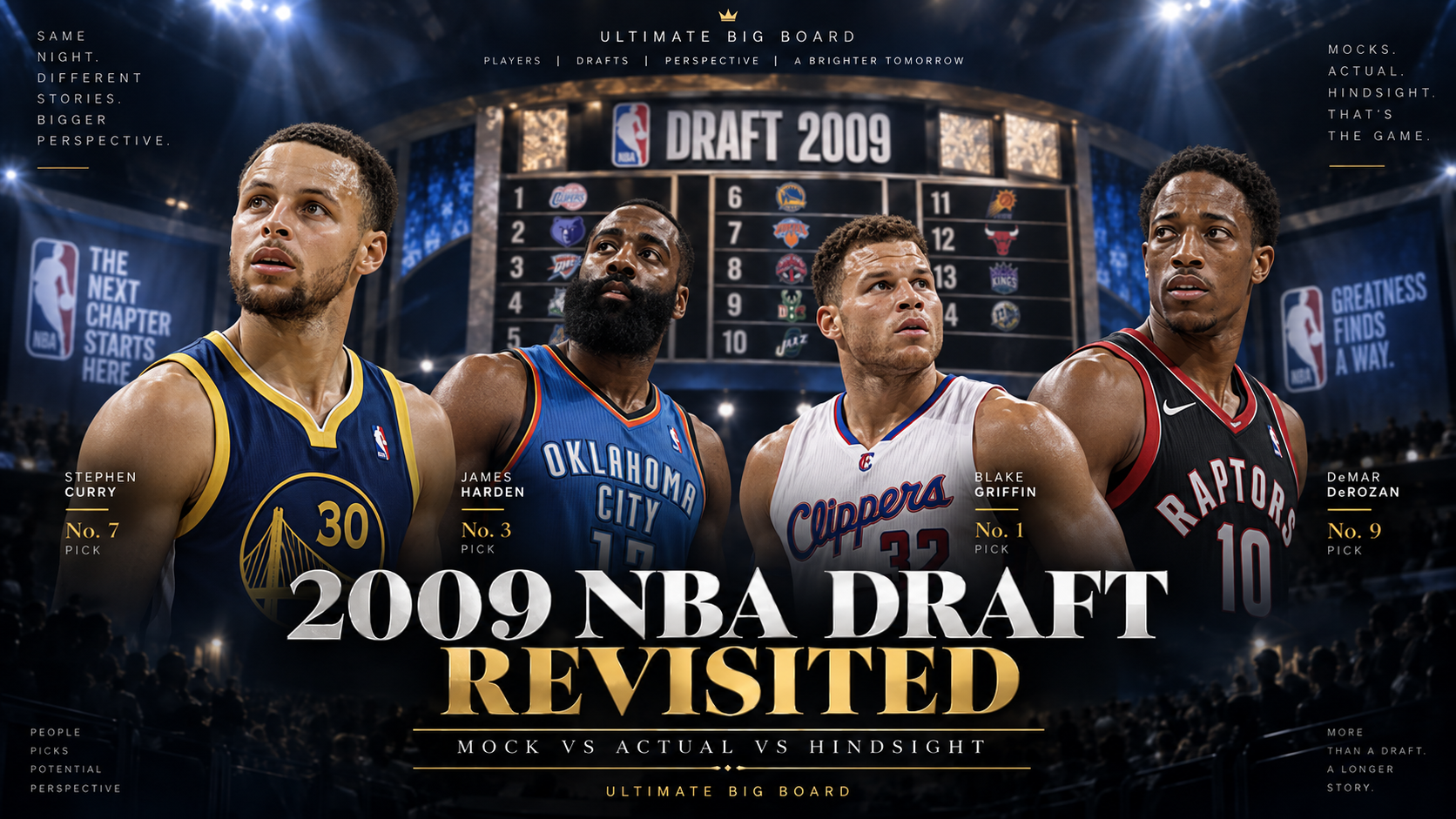
The most interesting way to revisit the 2009 NBA Draft is not to pretend the correct answer was obvious. It is to put three versions of the night beside one another: what contemporary mock drafts expected, what the teams actually did, and what a full career of evidence tells us now.
The historical baseline uses The Draft Review's preserved 15-mock consensus. Few years create a sharper contrast between consensus and career outcome: Griffin and Thabeet were unanimous in the first two slots, while Curry's range stretched from Oklahoma City at No. 3 to New York at No. 8 before Golden State took him seventh.
The mock comparison asks whether the actual pick matched, preceded or followed the archived median projected slot. The sequential hindsight board reallocates the whole class using editorial judgments about career value. A median match is a measure of draft-night slot agreement, rather than a career grade.
The three timelines
How to read the mock baseline: The archive orders players by median projected pick, with average pick as a tiebreaker. Its rank labels, including A/B groups, are distinct from projected slots. Each row shows the actual selection's rank, median slot, earliest-to-latest band and number of mocks listing that player. Fractional medians and missing projections are preserved. The comparison verdict measures actual overall pick against that player's median; it does not grade career value or imply that every mock or a particular team agreed. The hindsight board remains a separate editorial judgment.
| Pick | Team | Actual player's archived mock profile | Actual pick | Sequential hindsight pick | Mock slot comparison |
|---|---|---|---|---|---|
| 1 | Los Angeles Clippers | Archive rank 1; median slot 1; band 1; 15/15 mocks | Blake Griffin | Stephen Curry | PICK MATCHED MEDIAN |
| 2 | Memphis Grizzlies | Archive rank 2; median slot 2; band 2; 15/15 mocks | Hasheem Thabeet | James Harden | PICK MATCHED MEDIAN |
| 3 | Oklahoma City Thunder | Archive rank 5; median slot 5; band 3–8; 15/15 mocks | James Harden | Blake Griffin | PICK EARLIER THAN MEDIAN |
| 4 | Sacramento Kings | Archive rank 4; median slot 4; band 4–7; 15/15 mocks | Tyreke Evans | DeMar DeRozan | PICK MATCHED MEDIAN |
| 5 | Minnesota Timberwolves | Archive rank 3; median slot 3; band 3–7; 15/15 mocks | Ricky Rubio | Jrue Holiday | PICK LATER THAN MEDIAN |
| 6 | Minnesota Timberwolves | Archive rank 8-A; median slot 9; band 5–14; 15/15 mocks | Jonny Flynn | Taj Gibson | PICK EARLIER THAN MEDIAN |
| 7 | Golden State Warriors | Archive rank 6; median slot 6; band 3–8; 15/15 mocks | Stephen Curry | Jeff Teague | PICK LATER THAN MEDIAN |
| 8 | New York Knicks | Archive rank 7; median slot 7; band 6–8; 15/15 mocks | Jordan Hill | Ricky Rubio | PICK LATER THAN MEDIAN |
| 9 | Toronto Raptors | Archive rank 8-B; median slot 9; band 6–15; 15/15 mocks | DeMar DeRozan | Tyreke Evans | PICK MATCHED MEDIAN |
| 10 | Milwaukee Bucks | Archive rank 10-B; median slot 13; band 8–22; 15/15 mocks | Brandon Jennings | Wesley Matthews | PICK EARLIER THAN MEDIAN |
| 11 | New Jersey Nets | Archive rank 9-B; median slot 12; band 11–22; 15/15 mocks | Terrence Williams | Danny Green | PICK EARLIER THAN MEDIAN |
| 12 | Charlotte Bobcats | Archive rank 9-A; median slot 12; band 8–17; 15/15 mocks | Gerald Henderson | Brandon Jennings | PICK MATCHED MEDIAN |
| 13 | Indiana Pacers | Archive rank 12-B; median slot 16; band 10–22; 15/15 mocks | Tyler Hansbrough | Darren Collison | PICK EARLIER THAN MEDIAN |
| 14 | Phoenix Suns | Archive rank 11; median slot 15; band 11–22; 15/15 mocks | Earl Clark | Patrick Beverley | PICK EARLIER THAN MEDIAN |
| 15 | Detroit Pistons | Archive rank 15; median slot 22; band 15–30; 15/15 mocks | Austin Daye | Patty Mills | PICK EARLIER THAN MEDIAN |
| 16 | Chicago Bulls | Archive rank 12-A; median slot 16; band 9–23; 15/15 mocks | James Johnson | Joe Ingles | PICK MATCHED MEDIAN |
| 17 | Philadelphia 76ers | Archive rank 10-A; median slot 13; band 8–20; 15/15 mocks | Jrue Holiday | Ty Lawson | PICK LATER THAN MEDIAN |
| 18 | Minnesota Timberwolves | Archive rank 13; median slot 17; band 13–21; 15/15 mocks | Ty Lawson | DeMarre Carroll | PICK LATER THAN MEDIAN |
| 19 | Atlanta Hawks | Archive rank 14-B; median slot 19; band 11–24; 14/15 mocks | Jeff Teague | Gerald Henderson | PICK MATCHED MEDIAN |
| 20 | Utah Jazz | Archive rank 14-A; median slot 19; band 17–27; 15/15 mocks | Eric Maynor | Marcus Thornton | PICK LATER THAN MEDIAN |
| 21 | New Orleans Hornets | Archive rank 20; median slot 26; band 22–29; 5/15 mocks | Darren Collison | Jodie Meeks | PICK EARLIER THAN MEDIAN |
| 22 | Portland Trail Blazers | Archive rank 19; median slot 25.5; band 22–29; 2/15 mocks | Victor Claver | Omri Casspi | PICK EARLIER THAN MEDIAN |
| 23 | Sacramento Kings | Archive rank 17-B; median slot 23; band 20–29; 14/15 mocks | Omri Casspi | Wayne Ellington | PICK MATCHED MEDIAN |
| 24 | Dallas Mavericks | Archive rank 12-D; median slot 16; band 15–23; 15/15 mocks | B.J. Mullens | DeJuan Blair | PICK LATER THAN MEDIAN |
| 25 | Oklahoma City Thunder | Archive rank 25-B; median slot 29; band 25–30; 3/15 mocks | Rodrigue Beaubois | Garrett Temple | PICK EARLIER THAN MEDIAN |
| 26 | Chicago Bulls | Archive rank 22-B; median slot 27; band 26–30; 7/15 mocks | Taj Gibson | Jordan Hill | PICK EARLIER THAN MEDIAN |
| 27 | Memphis Grizzlies | Archive rank 22-D; median slot 27; band 24–27; 3/15 mocks | DeMarre Carroll | Jonas Jerebko | PICK MATCHED MEDIAN |
| 28 | Minnesota Timberwolves | Archive rank 21; median slot 26.5; band 23–30; 10/15 mocks | Wayne Ellington | Chase Budinger | PICK LATER THAN MEDIAN |
| 29 | Los Angeles Lakers | Archive rank 25-A; median slot 29; band 23–29; 7/15 mocks | Toney Douglas | Tyler Hansbrough | PICK MATCHED MEDIAN |
| 30 | Cleveland Cavaliers | No projection in the archived 15 mocks | Christian Eyenga | Toney Douglas | NO ARCHIVED PROJECTION |
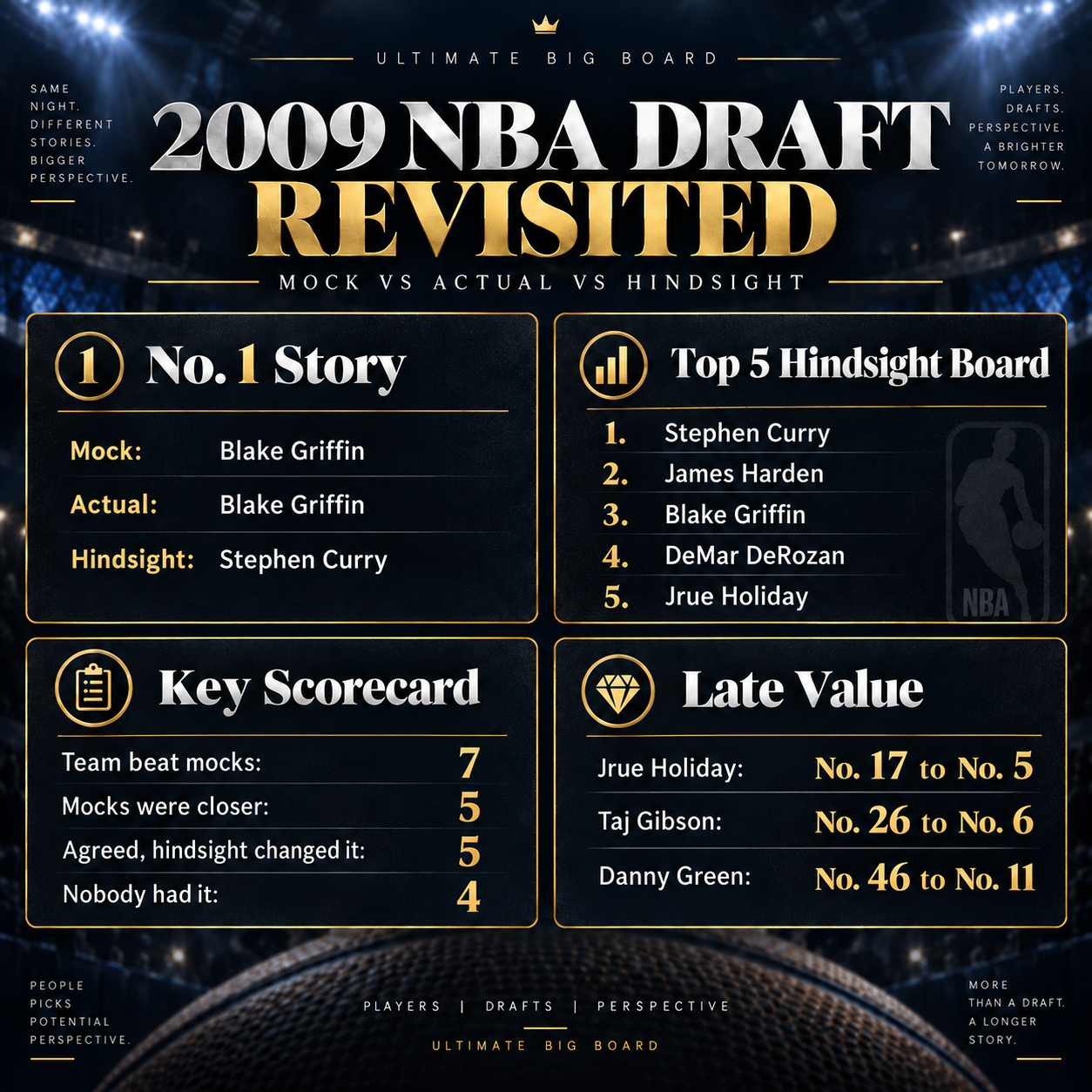
Mock Draft Scorecard
A match means the actual overall pick equals that player's median projected slot. Earlier and later picks use the same median; missing projections remain explicit. These counts do not grade career value.
| Actual pick versus mock median | First-round selections |
|---|---|
| PICK MATCHED MEDIAN | 10 |
| PICK EARLIER THAN MEDIAN | 11 |
| PICK LATER THAN MEDIAN | 8 |
| NO ARCHIVED PROJECTION | 1 |
Pick-by-pick: Mock vs. Actual vs. Hindsight
No. 1: Los Angeles Clippers
ARCHIVED MOCK PROFILE: Archive rank 1; median slot 1; band 1; 15/15 mocks ACTUAL PICK: Blake Griffin SEQUENTIAL HINDSIGHT PICK: Stephen Curry COMPARISON VERDICT: PICK MATCHED MEDIAN
What the mock drafts were saying
Blake Griffin: Archive rank 1; median slot 1; band 1; 15/15 mocks. The actual No. 1 selection matched the median. 15 of 15 listed mocks placed the player at that exact overall pick. This does not infer a team-specific prediction from the archive rank.
Why the team made the actual choice
Los Angeles made the obvious decision. Griffin was an explosive, productive Oklahoma star with the body, athleticism and passing instincts to become a franchise power forward. Nothing about taking him first was reckless. He later validated the evaluation with six All-Star selections and became the player who made the Clippers relevant before injuries shortened his prime.
What hindsight changes
A full-career redraft now prefers Stephen Curry at this slot. The career judgment is separate from the archived mock median.
Curry is still the hindsight choice because the gap created by his shooting, playmaking, longevity and championship impact is too large. The fascinating part is what disappears. Without Griffin, there is no identical Lob City timeline and no guarantee the Clippers become the destination Chris Paul pushed to join in 2011. Curry would give the franchise a transformational guard, but the alternate Clippers should not be handed both Curry and the exact Paul-era roster that Griffin helped create.
Career snapshot
| Player | NBA seasons | PPG | RPG | APG |
|---|---|---|---|---|
| Blake Griffin | 13 | 19.0 | 8.0 | 4.0 |
| Stephen Curry | 17 | 24.8 | 4.7 | 6.3 |
No. 2: Memphis Grizzlies
ARCHIVED MOCK PROFILE: Archive rank 2; median slot 2; band 2; 15/15 mocks ACTUAL PICK: Hasheem Thabeet SEQUENTIAL HINDSIGHT PICK: James Harden COMPARISON VERDICT: PICK MATCHED MEDIAN
What the mock drafts were saying
Hasheem Thabeet: Archive rank 2; median slot 2; band 2; 15/15 mocks. The actual No. 2 selection matched the median. 15 of 15 listed mocks placed the player at that exact overall pick. This does not infer a team-specific prediction from the archive rank.
Why the team made the actual choice
The process was understandable in one narrow sense. Seven-foot-three centers with Thabeet's shot-blocking production were rare, and Memphis could imagine pairing his rim protection with a young frontcourt. The roster concern was more serious than the mocks suggested, however. Gasol had just completed a strong rookie season, so the Grizzlies were spending a premium asset on overlapping size instead of badly needed perimeter creation.
What hindsight changes
A full-career redraft now prefers James Harden at this slot. The career judgment is separate from the archived mock median.
Harden solves the harder problem immediately. He could begin as a secondary creator beside O.J. Mayo and Mike Conley, then grow into the primary offensive engine his career proved he could become. That changes the entire Grit and Grind build. Memphis may never need to search for the same wing creation, and a Conley-Harden-Gasol core could pair elite half-court offense with the defense the franchise already knew how to build.
Career snapshot
| Player | NBA seasons | PPG | RPG | APG |
|---|---|---|---|---|
| Hasheem Thabeet | 5 | 2.2 | 2.7 | 0.1 |
| James Harden | 17 | 24.0 | 5.6 | 7.3 |
No. 3: Oklahoma City Thunder
ARCHIVED MOCK PROFILE: Archive rank 5; median slot 5; band 3–8; 15/15 mocks ACTUAL PICK: James Harden SEQUENTIAL HINDSIGHT PICK: Blake Griffin COMPARISON VERDICT: PICK EARLIER THAN MEDIAN
What the mock drafts were saying
James Harden: Archive rank 5; median slot 5; band 3–8; 15/15 mocks. The actual No. 3 selection was 2 places earlier than the median. 6 of 15 listed mocks placed the player at that exact overall pick. This does not infer a team-specific prediction from the archive rank.
Why the team made the actual choice
The Thunder correctly identified a guard whose decision-making and strength fit Kevin Durant and Russell Westbrook. Harden won Sixth Man of the Year, helped Oklahoma City reach the 2012 Finals and then became an MVP after the franchise traded him. The draft evaluation was not the mistake. The later contract and trade decision created the regret.
What hindsight changes
The actual selection aged better than the mock-market alternative. Even though the sequential redraft may move James Harden earlier, this is a spot where the team saw more than the consensus did.
With Harden gone to Memphis in this redraft, Griffin gives Oklahoma City a devastating frontcourt scorer and passer. He would run the floor with Westbrook, create from the elbows and take pressure off Durant. The fit is spectacular, but there is a major historical cost: the 2012 Finals team no longer has Harden's bench creation, and the famous 2012 trade never happens. Oklahoma City might be stronger in one dimension while losing the three-guard structure that made its original young core special.
Career snapshot
| Player | NBA seasons | PPG | RPG | APG |
|---|---|---|---|---|
| James Harden | 17 | 24.0 | 5.6 | 7.3 |
| Blake Griffin | 13 | 19.0 | 8.0 | 4.0 |
No. 4: Sacramento Kings
ARCHIVED MOCK PROFILE: Archive rank 4; median slot 4; band 4–7; 15/15 mocks ACTUAL PICK: Tyreke Evans SEQUENTIAL HINDSIGHT PICK: DeMar DeRozan COMPARISON VERDICT: PICK MATCHED MEDIAN
What the mock drafts were saying
Tyreke Evans: Archive rank 4; median slot 4; band 4–7; 15/15 mocks. The actual No. 4 selection matched the median. 11 of 15 listed mocks placed the player at that exact overall pick. This does not infer a team-specific prediction from the archive rank.
Why the team made the actual choice
Sacramento wanted a new lead perimeter player after the Mike Bibby and Ron Artest era, and Evans delivered immediately. His 20.1 points, 5.3 rebounds and 5.8 assists as a rookie earned Rookie of the Year. The problem was not that the Kings imagined talent that was not there. They struggled to decide whether Evans was a point guard, shooting guard or wing, and his shooting development never created a clean answer.
What hindsight changes
A full-career redraft now prefers DeMar DeRozan at this slot. The career judgment is separate from the archived mock median.
DeRozan gives Sacramento a more stable positional identity and a far longer scoring runway. He needed time to become a polished creator, but the Kings were rebuilding and could afford it. A DeRozan-centered perimeter attack would also make later decisions around DeMarcus Cousins different if Sacramento still reaches him in 2010. The franchise gains continuity, but it may lose Evans' immediate rookie impact and therefore land in a different lottery position one year later.
Career snapshot
| Player | NBA seasons | PPG | RPG | APG |
|---|---|---|---|---|
| Tyreke Evans | 10 | 15.7 | 4.6 | 4.8 |
| DeMar DeRozan | 17 | 21.1 | 4.3 | 4.1 |
No. 5: Minnesota Timberwolves
ARCHIVED MOCK PROFILE: Archive rank 3; median slot 3; band 3–7; 15/15 mocks ACTUAL PICK: Ricky Rubio SEQUENTIAL HINDSIGHT PICK: Jrue Holiday COMPARISON VERDICT: PICK LATER THAN MEDIAN
What the mock drafts were saying
Ricky Rubio: Archive rank 3; median slot 3; band 3–7; 15/15 mocks. The actual No. 5 selection was 2 places later than the median. 2 of 15 listed mocks placed the player at that exact overall pick. This does not infer a team-specific prediction from the archive rank.
Why the team made the actual choice
Rubio gave the Wolves vision, defense and a genuine organizing identity once he arrived from Spain in 2011. Waiting two seasons was part of the bargain, and Minnesota believed his ceiling justified it. In isolation, this was a defensible selection.
What hindsight changes
In the editorial career comparison, James Harden produced more long-term value than Ricky Rubio, even though the sequential hindsight board ultimately prefers Jrue Holiday. That career judgment is separate from the mock-slot comparison.
Holiday removes the wait and supplies more scoring without sacrificing two-way value. He became an All-Star, elite defender and championship-level guard who could play on or off the ball. For a Minnesota team entering the Kevin Love era, Holiday offers a cleaner long-term partner and more flexibility in roster construction. The next pick then becomes available for a different position instead of duplicating point guards.
Career snapshot
| Player | NBA seasons | PPG | RPG | APG |
|---|---|---|---|---|
| Ricky Rubio | 12 | 10.8 | 4.1 | 7.4 |
| Jrue Holiday | 17 | 15.9 | 4.2 | 6.2 |
No. 6: Minnesota Timberwolves
ARCHIVED MOCK PROFILE: Archive rank 8-A; median slot 9; band 5–14; 15/15 mocks ACTUAL PICK: Jonny Flynn SEQUENTIAL HINDSIGHT PICK: Taj Gibson COMPARISON VERDICT: PICK EARLIER THAN MEDIAN
What the mock drafts were saying
Jonny Flynn: Archive rank 8-A; median slot 9; band 5–14; 15/15 mocks. The actual No. 6 selection was 3 places earlier than the median. 2 of 15 listed mocks placed the player at that exact overall pick. This does not infer a team-specific prediction from the archive rank.
Why the team made the actual choice
Minnesota tried to hedge Rubio's delayed arrival by drafting a second point guard who could play right away. Flynn had speed and produced 13.5 points as a rookie, but a hip injury and limited efficiency quickly derailed the plan. More importantly, using back-to-back top-six picks on the same position reduced the franchise's margin for error.
What hindsight changes
In the editorial career comparison, Stephen Curry produced more long-term value than Jonny Flynn, even though the sequential hindsight board ultimately prefers Taj Gibson. That career judgment is separate from the mock-slot comparison.
Gibson is the fit correction. He became a 17-season defender, rebounder and low-maintenance frontcourt player. Pairing him with Love gives Minnesota a rugged big who can protect difficult matchups while Love scores and rebounds. Holiday at No. 5 plus Gibson at No. 6 turns a famously redundant draft night into a balanced backcourt-frontcourt foundation.
Career snapshot
| Player | NBA seasons | PPG | RPG | APG |
|---|---|---|---|---|
| Jonny Flynn | 3 | 9.2 | 1.9 | 3.9 |
| Taj Gibson | 17 | 8.3 | 5.7 | 0.9 |
No. 7: Golden State Warriors
ARCHIVED MOCK PROFILE: Archive rank 6; median slot 6; band 3–8; 15/15 mocks ACTUAL PICK: Stephen Curry SEQUENTIAL HINDSIGHT PICK: Jeff Teague COMPARISON VERDICT: PICK LATER THAN MEDIAN
What the mock drafts were saying
Stephen Curry: Archive rank 6; median slot 6; band 3–8; 15/15 mocks. The actual No. 7 selection was 1 place later than the median. 2 of 15 listed mocks placed the player at that exact overall pick. This does not infer a team-specific prediction from the archive rank.
Why the team made the actual choice
The Warriors made the defining selection of the class and eventually of the franchise. Curry's shooting stretched what teams thought an NBA offense could look like, and his career became the center of four championship teams. Nothing available in a redraft can reproduce the organizational value of the actual pick.
What hindsight changes
The actual selection aged better than the mock-market alternative. Even though the sequential redraft may move Stephen Curry earlier, this is a spot where the team saw more than the consensus did.
Because Curry is already gone first, Teague is the best remaining lead guard. He became an All-Star and a 12-year starter-level player, which would be solid value at No. 7 in most drafts. Here it feels catastrophic because the alternate history erases the Warriors dynasty as we know it. Klay Thompson and Draymond Green might still arrive, but the offensive ecosystem that turned them into a historic trio no longer exists.
Career snapshot
| Player | NBA seasons | PPG | RPG | APG |
|---|---|---|---|---|
| Stephen Curry | 17 | 24.8 | 4.7 | 6.3 |
| Jeff Teague | 12 | 12.2 | 2.4 | 5.6 |
No. 8: New York Knicks
ARCHIVED MOCK PROFILE: Archive rank 7; median slot 7; band 6–8; 15/15 mocks ACTUAL PICK: Jordan Hill SEQUENTIAL HINDSIGHT PICK: Ricky Rubio COMPARISON VERDICT: PICK LATER THAN MEDIAN
What the mock drafts were saying
Jordan Hill: Archive rank 7; median slot 7; band 6–8; 15/15 mocks. The actual No. 8 selection was 1 place later than the median. 2 of 15 listed mocks placed the player at that exact overall pick. This does not infer a team-specific prediction from the archive rank.
Why the team made the actual choice
The Knicks had just begun building around Mike D'Antoni and wanted athletic frontcourt help after missing their preferred guard target. Hill lasted only part of one season before being included in the Tracy McGrady trade. The pick never became a meaningful part of the 2010 cap-space plan.
What hindsight changes
In the editorial career comparison, Jonny Flynn / DeMar DeRozan produced more long-term value than Jordan Hill, even though the sequential hindsight board ultimately prefers Ricky Rubio. That career judgment is separate from the mock-slot comparison.
Rubio is a fascinating D'Antoni alternative even though he would remain in Spain until 2011. His passing, pace and pick-and-roll vision fit the coach's philosophy, and his delayed arrival preserves short-term cap flexibility. The timing is awkward because the Knicks wanted to attract stars in 2010, but Rubio's rights would at minimum be a premium trade asset. If New York keeps him, the franchise enters the Carmelo Anthony period with a true pass-first point guard already under team control.
Career snapshot
| Player | NBA seasons | PPG | RPG | APG |
|---|---|---|---|---|
| Jordan Hill | 8 | 7.9 | 5.8 | 0.8 |
| Ricky Rubio | 12 | 10.8 | 4.1 | 7.4 |
No. 9: Toronto Raptors
ARCHIVED MOCK PROFILE: Archive rank 8-B; median slot 9; band 6–15; 15/15 mocks ACTUAL PICK: DeMar DeRozan SEQUENTIAL HINDSIGHT PICK: Tyreke Evans COMPARISON VERDICT: PICK MATCHED MEDIAN
What the mock drafts were saying
DeMar DeRozan: Archive rank 8-B; median slot 9; band 6–15; 15/15 mocks. The actual No. 9 selection matched the median. 8 of 15 listed mocks placed the player at that exact overall pick. This does not infer a team-specific prediction from the archive rank.
Why the team made the actual choice
The Raptors got this pick right. DeRozan became a four-time All-Star in Toronto, helped create the Lowry-DeRozan playoff era and eventually became the centerpiece of the trade for Kawhi Leonard. His value to the franchise extends beyond his individual statistics because the final transaction helped produce the 2019 championship.
What hindsight changes
The actual selection aged better than the mock-market alternative. Even though the sequential redraft may move DeMar DeRozan earlier, this is a spot where the team saw more than the consensus did.
With DeRozan already gone, Evans supplies immediate creation during Chris Bosh's final Toronto season. His rookie production would reduce the burden on Bosh and Jose Calderon, but it might also improve Toronto enough to alter its 2010 draft position. The larger loss is asset history. Without DeRozan, there is no identical Kawhi trade eight years later, so even a productive Evans career cannot simply be added to the championship timeline.
Career snapshot
| Player | NBA seasons | PPG | RPG | APG |
|---|---|---|---|---|
| DeMar DeRozan | 17 | 21.1 | 4.3 | 4.1 |
| Tyreke Evans | 10 | 15.7 | 4.6 | 4.8 |
No. 10: Milwaukee Bucks
ARCHIVED MOCK PROFILE: Archive rank 10-B; median slot 13; band 8–22; 15/15 mocks ACTUAL PICK: Brandon Jennings SEQUENTIAL HINDSIGHT PICK: Wesley Matthews COMPARISON VERDICT: PICK EARLIER THAN MEDIAN
What the mock drafts were saying
Brandon Jennings: Archive rank 10-B; median slot 13; band 8–22; 15/15 mocks. The actual No. 10 selection was 3 places earlier than the median. 4 of 15 listed mocks placed the player at that exact overall pick. This does not infer a team-specific prediction from the archive rank.
Why the team made the actual choice
Milwaukee needed a dynamic guard and got one immediately. Jennings scored 55 points in his seventh NBA game and helped the Bucks make the playoffs as a rookie. His efficiency was inconsistent, but the original pick injected badly needed shot creation.
What hindsight changes
A full-career redraft now prefers Wesley Matthews at this slot. The career judgment is separate from the archived mock median.
Matthews went undrafted and became exactly the kind of durable two-way wing contenders value. He shot 37.5 percent from three for his career, defended bigger guards and played 15 seasons. Next to Andrew Bogut, Milwaukee would gain spacing and perimeter defense without needing Matthews to dominate the ball. The Bucks would still need a lead creator, but they would own a stable wing instead of cycling through that role for years.
Career snapshot
| Player | NBA seasons | PPG | RPG | APG |
|---|---|---|---|---|
| Brandon Jennings | 9 | 14.1 | 3.0 | 5.7 |
| Wesley Matthews | 15 | 11.4 | 2.8 | 1.9 |
No. 11: New Jersey Nets
ARCHIVED MOCK PROFILE: Archive rank 9-B; median slot 12; band 11–22; 15/15 mocks ACTUAL PICK: Terrence Williams SEQUENTIAL HINDSIGHT PICK: Danny Green COMPARISON VERDICT: PICK EARLIER THAN MEDIAN
What the mock drafts were saying
Terrence Williams: Archive rank 9-B; median slot 12; band 11–22; 15/15 mocks. The actual No. 11 selection was 1 place earlier than the median. 5 of 15 listed mocks placed the player at that exact overall pick. This does not infer a team-specific prediction from the archive rank.
Why the team made the actual choice
The Nets were about to begin a deep rebuild and liked the idea of a multi-skill wing who could handle the ball. Williams flashed those tools, but his shooting, consistency and off-court issues kept him from lasting beyond four seasons.
What hindsight changes
The mock market pointed to Earl Clark, the team chose Terrence Williams, and the hindsight board now prefers Danny Green. None of the three timelines line up.
Green offers much less self-creation and far more portability. He became a high-level 3-and-D wing, won three championships and could fit beside nearly any star New Jersey or Brooklyn later acquired. That is especially valuable for a franchise whose roster changed dramatically around the move to Brooklyn. Green would survive those transitions instead of forcing each new roster to solve the wing-defense problem again.
Career snapshot
| Player | NBA seasons | PPG | RPG | APG |
|---|---|---|---|---|
| Terrence Williams | 4 | 7.1 | 3.6 | 2.4 |
| Danny Green | 15 | 8.7 | 3.4 | 1.5 |
No. 12: Charlotte Bobcats
ARCHIVED MOCK PROFILE: Archive rank 9-A; median slot 12; band 8–17; 15/15 mocks ACTUAL PICK: Gerald Henderson SEQUENTIAL HINDSIGHT PICK: Brandon Jennings COMPARISON VERDICT: PICK MATCHED MEDIAN
What the mock drafts were saying
Gerald Henderson: Archive rank 9-A; median slot 12; band 8–17; 15/15 mocks. The actual No. 12 selection matched the median. 6 of 15 listed mocks placed the player at that exact overall pick. This does not infer a team-specific prediction from the archive rank.
Why the team made the actual choice
Charlotte wanted a physical perimeter defender who could eventually add scoring around Gerald Wallace. Henderson became an eight-year starter-level wing and was a respectable outcome, particularly for a team that valued defense.
What hindsight changes
There was no single mock favorite here, and the hindsight board moves in another direction with Brandon Jennings. This is a good example of genuine draft uncertainty rather than a simple miss.
Jennings raises the offensive ceiling. Larry Brown's structure could have challenged his shot selection while giving Charlotte a guard capable of creating late in the clock. The Bobcats reached the playoffs in 2010 behind Wallace and Stephen Jackson but lacked dynamic point-guard play. Jennings could make that team more dangerous, although his higher usage might also clash with Brown's preference for control.
Career snapshot
| Player | NBA seasons | PPG | RPG | APG |
|---|---|---|---|---|
| Gerald Henderson | 8 | 11.2 | 3.2 | 1.9 |
| Brandon Jennings | 9 | 14.1 | 3.0 | 5.7 |
No. 13: Indiana Pacers
ARCHIVED MOCK PROFILE: Archive rank 12-B; median slot 16; band 10–22; 15/15 mocks ACTUAL PICK: Tyler Hansbrough SEQUENTIAL HINDSIGHT PICK: Darren Collison COMPARISON VERDICT: PICK EARLIER THAN MEDIAN
What the mock drafts were saying
Tyler Hansbrough: Archive rank 12-B; median slot 16; band 10–22; 15/15 mocks. The actual No. 13 selection was 3 places earlier than the median. 1 of 15 listed mocks placed the player at that exact overall pick. This does not infer a team-specific prediction from the archive rank.
Why the team made the actual choice
Indiana valued production, toughness and certainty. Hansbrough was never expected to become a primary NBA scorer, but he could run, rebound and compete immediately beside a young Danny Granger. The pick was conservative rather than inexplicable.
What hindsight changes
The mock market pointed to Ty Lawson, the team chose Tyler Hansbrough, and the hindsight board now prefers Darren Collison. None of the three timelines line up.
Collison would solve the point-guard problem one year early. Indiana actually acquired him from New Orleans in 2010, so this redraft eliminates the need for that later transaction. He gives the Pacers speed and pick-and-roll competence as the Paul George era begins. The ripple is practical: Indiana can use the 2010 trade assets and cap flexibility elsewhere because the starting point guard is already on the roster.
Career snapshot
| Player | NBA seasons | PPG | RPG | APG |
|---|---|---|---|---|
| Tyler Hansbrough | 7 | 6.7 | 4.2 | 0.4 |
| Darren Collison | 11 | 12.5 | 2.7 | 5.0 |
No. 14: Phoenix Suns
ARCHIVED MOCK PROFILE: Archive rank 11; median slot 15; band 11–22; 15/15 mocks ACTUAL PICK: Earl Clark SEQUENTIAL HINDSIGHT PICK: Patrick Beverley COMPARISON VERDICT: PICK EARLIER THAN MEDIAN
What the mock drafts were saying
Earl Clark: Archive rank 11; median slot 15; band 11–22; 15/15 mocks. The actual No. 14 selection was 1 place earlier than the median. 4 of 15 listed mocks placed the player at that exact overall pick. This does not infer a team-specific prediction from the archive rank.
Why the team made the actual choice
Phoenix was trying to stretch the final Steve Nash-Amar'e Stoudemire window while also preparing for what came next. Clark's size and ball skills hinted at a versatile forward, but he never turned those flashes into consistent production.
What hindsight changes
In the editorial career comparison, Eric Maynor / Jeff Teague produced more long-term value than Earl Clark, even though the sequential hindsight board ultimately prefers Patrick Beverley. That career judgment is separate from the mock-slot comparison.
Beverley is almost tailor-made for the veteran Suns. He can defend the opposing team's best guard, play without dominating the ball and bring an edge that complements Nash's offensive genius. His shooting eventually became respectable enough to stay on the floor. The Suns lose theoretical frontcourt upside, but they gain a playoff guard whose job is clear from day one.
Career snapshot
| Player | NBA seasons | PPG | RPG | APG |
|---|---|---|---|---|
| Earl Clark | 6 | 4.4 | 3.0 | 0.5 |
| Patrick Beverley | 12 | 8.3 | 4.1 | 3.4 |
No. 15: Detroit Pistons
ARCHIVED MOCK PROFILE: Archive rank 15; median slot 22; band 15–30; 15/15 mocks ACTUAL PICK: Austin Daye SEQUENTIAL HINDSIGHT PICK: Patty Mills COMPARISON VERDICT: PICK EARLIER THAN MEDIAN
What the mock drafts were saying
Austin Daye: Archive rank 15; median slot 22; band 15–30; 15/15 mocks. The actual No. 15 selection was 7 places earlier than the median. 1 of 15 listed mocks placed the player at that exact overall pick. This does not infer a team-specific prediction from the archive rank.
Why the team made the actual choice
Detroit was dismantling the Billups-era identity and bet on a long scoring forward who might grow into a mismatch weapon. The physical tools never translated into a large enough role, and the franchise remained unsettled at guard after trading Chauncey Billups.
What hindsight changes
A full-career redraft now prefers Patty Mills at this slot. The career judgment is separate from the archived mock median.
Mills gives Detroit a steady secondary organizer and shooter for 16 seasons. He would not become the next Billups, but he could stabilize bench units, stretch the floor and survive multiple coaching changes. For a team entering a long period without continuity, a reliable guard has more practical value than a developmental forward who never secures a position.
Career snapshot
| Player | NBA seasons | PPG | RPG | APG |
|---|---|---|---|---|
| Austin Daye | 6 | 5.2 | 2.6 | 0.7 |
| Patty Mills | 16 | 8.7 | 1.6 | 2.2 |
No. 16: Chicago Bulls
ARCHIVED MOCK PROFILE: Archive rank 12-A; median slot 16; band 9–23; 15/15 mocks ACTUAL PICK: James Johnson SEQUENTIAL HINDSIGHT PICK: Joe Ingles COMPARISON VERDICT: PICK MATCHED MEDIAN
What the mock drafts were saying
James Johnson: Archive rank 12-A; median slot 16; band 9–23; 15/15 mocks. The actual No. 16 selection matched the median. 5 of 15 listed mocks placed the player at that exact overall pick. This does not infer a team-specific prediction from the archive rank.
Why the team made the actual choice
Chicago was one year into the Derrick Rose era and wanted another defender and secondary creator. Johnson's versatility eventually became useful around the league, but it took years and several teams before his role fully settled.
What hindsight changes
The mock market pointed to Marcus Thornton, the team chose James Johnson, and the hindsight board now prefers Joe Ingles. None of the three timelines line up.
Ingles was not drafted at all and would not enter the NBA until 2014, so this choice requires patience. Once he arrived, his shooting, passing and size would have fit beautifully next to Rose, Joakim Noah and Luol Deng. The delay means he cannot help the 2011 contender immediately, but his rights could become a low-cost long-term asset. Chicago's front office would need to value a future connector over instant depth.
Career snapshot
| Player | NBA seasons | PPG | RPG | APG |
|---|---|---|---|---|
| James Johnson | 16 | 7.4 | 3.5 | 2.0 |
| Joe Ingles | 12 | 7.7 | 3.0 | 3.5 |
No. 17: Philadelphia 76ers
ARCHIVED MOCK PROFILE: Archive rank 10-A; median slot 13; band 8–20; 15/15 mocks ACTUAL PICK: Jrue Holiday SEQUENTIAL HINDSIGHT PICK: Ty Lawson COMPARISON VERDICT: PICK LATER THAN MEDIAN
What the mock drafts were saying
Jrue Holiday: Archive rank 10-A; median slot 13; band 8–20; 15/15 mocks. The actual No. 17 selection was 4 places later than the median. 2 of 15 listed mocks placed the player at that exact overall pick. This does not infer a team-specific prediction from the archive rank.
Why the team made the actual choice
The Sixers made an excellent pick. Holiday became an All-Star in Philadelphia and was later traded to New Orleans in the deal that launched the Sam Hinkie rebuild by bringing back Nerlens Noel's rights and a future first-round pick.
What hindsight changes
The actual selection aged better than the mock-market alternative. Even though the sequential redraft may move Jrue Holiday earlier, this is a spot where the team saw more than the consensus did.
With Holiday gone earlier, Lawson is the closest stylistic replacement. His speed and pick-and-roll play would help Andre Iguodala and a young athletic roster attack before defenses are set. Lawson's prime was shorter, so Philadelphia loses the future trade asset Holiday became, but it gains several seasons of quality starting point-guard production at No. 17.
Career snapshot
| Player | NBA seasons | PPG | RPG | APG |
|---|---|---|---|---|
| Jrue Holiday | 17 | 15.9 | 4.2 | 6.2 |
| Ty Lawson | 9 | 12.7 | 2.7 | 6.0 |
No. 18: Minnesota Timberwolves
ARCHIVED MOCK PROFILE: Archive rank 13; median slot 17; band 13–21; 15/15 mocks ACTUAL PICK: Ty Lawson SEQUENTIAL HINDSIGHT PICK: DeMarre Carroll COMPARISON VERDICT: PICK LATER THAN MEDIAN
What the mock drafts were saying
Ty Lawson: Archive rank 13; median slot 17; band 13–21; 15/15 mocks. The actual No. 18 selection was 1 place later than the median. 1 of 15 listed mocks placed the player at that exact overall pick. This does not infer a team-specific prediction from the archive rank.
Why the team made the actual choice
The Timberwolves had already invested Nos. 5 and 6 in guards, which made converting Lawson into a future asset understandable. Denver received the better immediate player and eventually a long-term starter.
What hindsight changes
The actual selection aged better than the mock-market alternative. Even though the sequential redraft may move Ty Lawson earlier, this is a spot where the team saw more than the consensus did.
Carroll diversifies the roster. He developed into a physical 3-and-D forward who played 11 seasons and started on strong Atlanta and Toronto teams. Minnesota would need patience because Carroll's best years came later, but the Wolves badly needed two-way wings around their young guards and Kevin Love. He fills a structural need instead of extending the point-guard logjam.
Career snapshot
| Player | NBA seasons | PPG | RPG | APG |
|---|---|---|---|---|
| Ty Lawson | 9 | 12.7 | 2.7 | 6.0 |
| DeMarre Carroll | 11 | 8.9 | 4.2 | 1.3 |
No. 19: Atlanta Hawks
ARCHIVED MOCK PROFILE: Archive rank 14-B; median slot 19; band 11–24; 14/15 mocks ACTUAL PICK: Jeff Teague SEQUENTIAL HINDSIGHT PICK: Gerald Henderson COMPARISON VERDICT: PICK MATCHED MEDIAN
What the mock drafts were saying
Jeff Teague: Archive rank 14-B; median slot 19; band 11–24; 14/15 mocks. The actual No. 19 selection matched the median. 7 of 14 listed mocks placed the player at that exact overall pick. This does not infer a team-specific prediction from the archive rank.
Why the team made the actual choice
The Hawks made a strong long-term pick. Teague became an All-Star and eventually took over the offense during the 60-win 2014-15 season. He was exactly the sort of patient succession selection a good team should make.
What hindsight changes
The actual selection aged better than the mock-market alternative. Even though the sequential redraft may move Jeff Teague earlier, this is a spot where the team saw more than the consensus did.
With Teague already gone to Golden State, Henderson gives Atlanta a sturdy defensive wing who can score enough to stay on the floor. He would complement Joe Johnson and Josh Smith without needing many possessions. The Hawks lose future point-guard continuity, so they would have to solve Bibby's succession elsewhere, but Henderson strengthens the perimeter defense of an already competitive roster.
Career snapshot
| Player | NBA seasons | PPG | RPG | APG |
|---|---|---|---|---|
| Jeff Teague | 12 | 12.2 | 2.4 | 5.6 |
| Gerald Henderson | 8 | 11.2 | 3.2 | 1.9 |
No. 20: Utah Jazz
ARCHIVED MOCK PROFILE: Archive rank 14-A; median slot 19; band 17–27; 15/15 mocks ACTUAL PICK: Eric Maynor SEQUENTIAL HINDSIGHT PICK: Marcus Thornton COMPARISON VERDICT: PICK LATER THAN MEDIAN
What the mock drafts were saying
Eric Maynor: Archive rank 14-A; median slot 19; band 17–27; 15/15 mocks. The actual No. 20 selection was 1 place later than the median. 0 of 15 listed mocks placed the player at that exact overall pick. This does not infer a team-specific prediction from the archive rank.
Why the team made the actual choice
The fit was logical. Maynor could organize bench units and play under control, but Utah traded him during his rookie season, so the selection never became part of the long-term roster.
What hindsight changes
In the editorial career comparison, Darren Collison produced more long-term value than Eric Maynor, even though the sequential hindsight board ultimately prefers Marcus Thornton. That career judgment is separate from the mock-slot comparison.
Thornton supplies instant scoring instead. He averaged double figures over an eight-year career and could create shots when Williams rested. Utah's structured offense could also simplify his decision-making. The Jazz would sacrifice some traditional point-guard organization, but gain a bench player capable of changing a game with scoring bursts.
Career snapshot
| Player | NBA seasons | PPG | RPG | APG |
|---|---|---|---|---|
| Eric Maynor | 5 | 4.3 | 1.3 | 2.8 |
| Marcus Thornton | 8 | 11.9 | 2.8 | 1.4 |
No. 21: New Orleans Hornets
ARCHIVED MOCK PROFILE: Archive rank 20; median slot 26; band 22–29; 5/15 mocks ACTUAL PICK: Darren Collison SEQUENTIAL HINDSIGHT PICK: Jodie Meeks COMPARISON VERDICT: PICK EARLIER THAN MEDIAN
What the mock drafts were saying
Darren Collison: Archive rank 20; median slot 26; band 22–29; 5/15 mocks. The actual No. 21 selection was 5 places earlier than the median. 0 of 5 listed mocks placed the player at that exact overall pick. This does not infer a team-specific prediction from the archive rank.
Why the team made the actual choice
New Orleans got excellent value. Collison averaged 18.8 points and 9.1 assists in 37 rookie starts, then became the central asset the Hornets used in a 2010 four-team trade. His value exceeded the slot even though he spent only one season with the team.
What hindsight changes
The actual selection aged better than the mock-market alternative. Even though the sequential redraft may move Darren Collison earlier, this is a spot where the team saw more than the consensus did.
With Collison gone, Meeks gives Paul a low-usage shooter who can run off screens and punish help defense. That addresses a persistent problem for the Hornets: creating space around Paul's pick-and-roll game without taking the ball out of his hands. Meeks is less valuable as a trade chip, but his role on the roster is unusually clean.
Career snapshot
| Player | NBA seasons | PPG | RPG | APG |
|---|---|---|---|---|
| Darren Collison | 11 | 12.5 | 2.7 | 5.0 |
| Jodie Meeks | 10 | 9.3 | 2.1 | 1.1 |
No. 22: Portland Trail Blazers
ARCHIVED MOCK PROFILE: Archive rank 19; median slot 25.5; band 22–29; 2/15 mocks ACTUAL PICK: Victor Claver SEQUENTIAL HINDSIGHT PICK: Omri Casspi COMPARISON VERDICT: PICK EARLIER THAN MEDIAN
What the mock drafts were saying
Victor Claver: Archive rank 19; median slot 25.5; band 22–29; 2/15 mocks. The actual No. 22 selection was 3.5 places earlier than the median. 1 of 2 listed mocks placed the player at that exact overall pick. This does not infer a team-specific prediction from the archive rank.
Why the team made the actual choice
Portland could afford to wait, but Claver never developed into more than a limited NBA reserve. The strategy was sensible; the return was small.
What hindsight changes
The mock market pointed to Nick Calathes, the team chose Victor Claver, and the hindsight board now prefers Omri Casspi. None of the three timelines line up.
Casspi gives the Blazers an NBA-ready forward who runs the floor, shoots adequately and plays with energy. That matters during the fragile Brandon Roy and Greg Oden years, when Portland needed inexpensive rotation players who could step into bigger roles unexpectedly. Casspi does not alter the franchise ceiling, but he gives the roster more immediate depth.
Career snapshot
| Player | NBA seasons | PPG | RPG | APG |
|---|---|---|---|---|
| Victor Claver | 3 | 3.2 | 2.2 | 0.7 |
| Omri Casspi | 10 | 7.9 | 4.0 | 1.1 |
No. 23: Sacramento Kings
ARCHIVED MOCK PROFILE: Archive rank 17-B; median slot 23; band 20–29; 14/15 mocks ACTUAL PICK: Omri Casspi SEQUENTIAL HINDSIGHT PICK: Wayne Ellington COMPARISON VERDICT: PICK MATCHED MEDIAN
What the mock drafts were saying
Omri Casspi: Archive rank 17-B; median slot 23; band 20–29; 14/15 mocks. The actual No. 23 selection matched the median. 5 of 14 listed mocks placed the player at that exact overall pick. This does not infer a team-specific prediction from the archive rank.
Why the team made the actual choice
Sacramento found a useful rotation wing. Casspi's energy and shooting translated quickly, and he became a fan favorite even though his first Kings stint was short.
What hindsight changes
The useful comparison becomes the actual pick against the hindsight redraft choice, Wayne Ellington.
With Casspi gone, Ellington offers a more specialized shooting profile. He played 13 seasons because teams trusted him to space the floor and move without the ball. That would help a Sacramento roster built around Evans in reality or DeRozan in this redraft. The Kings give up size and rebounding but gain a clearer offensive skill.
Career snapshot
| Player | NBA seasons | PPG | RPG | APG |
|---|---|---|---|---|
| Omri Casspi | 10 | 7.9 | 4.0 | 1.1 |
| Wayne Ellington | 13 | 8.0 | 2.1 | 1.1 |
No. 24: Dallas Mavericks
ARCHIVED MOCK PROFILE: Archive rank 12-D; median slot 16; band 15–23; 15/15 mocks ACTUAL PICK: B.J. Mullens SEQUENTIAL HINDSIGHT PICK: DeJuan Blair COMPARISON VERDICT: PICK LATER THAN MEDIAN
What the mock drafts were saying
B.J. Mullens: Archive rank 12-D; median slot 16; band 15–23; 15/15 mocks. The actual No. 24 selection was 8 places later than the median. 0 of 15 listed mocks placed the player at that exact overall pick. This does not infer a team-specific prediction from the archive rank.
Why the team made the actual choice
The Mavericks were manipulating the board rather than investing in Mullens. They ended with Beaubois, whose speed and scoring flashes made him an intriguing bench guard on a veteran contender.
What hindsight changes
The useful comparison becomes the actual pick against the hindsight redraft choice, DeJuan Blair.
Blair is a better immediate fit for Dallas. His knees scared teams into the second round, but he became a productive rebounder from day one in San Antonio. The 2011 champion Mavericks could use his interior energy behind Dirk Nowitzki and Tyson Chandler. His physical limitations are real, yet a contender choosing at No. 24 can value two or three useful playoff seasons more than distant upside.
Career snapshot
| Player | NBA seasons | PPG | RPG | APG |
|---|---|---|---|---|
| B.J. Mullens | 5 | 7.4 | 4.2 | 0.8 |
| DeJuan Blair | 7 | 6.8 | 5.1 | 0.8 |
No. 25: Oklahoma City Thunder
ARCHIVED MOCK PROFILE: Archive rank 25-B; median slot 29; band 25–30; 3/15 mocks ACTUAL PICK: Rodrigue Beaubois SEQUENTIAL HINDSIGHT PICK: Garrett Temple COMPARISON VERDICT: PICK EARLIER THAN MEDIAN
What the mock drafts were saying
Rodrigue Beaubois: Archive rank 25-B; median slot 29; band 25–30; 3/15 mocks. The actual No. 25 selection was 4 places earlier than the median. 1 of 3 listed mocks placed the player at that exact overall pick. This does not infer a team-specific prediction from the archive rank.
Why the team made the actual choice
The transaction helped the Thunder reshape the end of the first round around its roster plan. Beaubois later flashed major scoring ability in Dallas but never stayed healthy enough to secure a long career.
What hindsight changes
The useful comparison becomes the actual pick against the hindsight redraft choice, Garrett Temple.
Temple went undrafted and ultimately played 16 seasons because he defended multiple perimeter positions and accepted low-usage roles. That archetype is ideal beside Durant and Westbrook. Oklahoma City does not need another star here. It needs someone who can guard, make the extra pass and survive playoff possessions without demanding the ball.
Career snapshot
| Player | NBA seasons | PPG | RPG | APG |
|---|---|---|---|---|
| Rodrigue Beaubois | 4 | 7.1 | 1.9 | 2.1 |
| Garrett Temple | 16 | 5.8 | 2.2 | 1.6 |
No. 26: Chicago Bulls
ARCHIVED MOCK PROFILE: Archive rank 22-B; median slot 27; band 26–30; 7/15 mocks ACTUAL PICK: Taj Gibson SEQUENTIAL HINDSIGHT PICK: Jordan Hill COMPARISON VERDICT: PICK EARLIER THAN MEDIAN
What the mock drafts were saying
Taj Gibson: Archive rank 22-B; median slot 27; band 26–30; 7/15 mocks. The actual No. 26 selection was 1 place earlier than the median. 2 of 7 listed mocks placed the player at that exact overall pick. This does not infer a team-specific prediction from the archive rank.
Why the team made the actual choice
The Bulls made a terrific pick. Gibson became a 17-season professional, a core reserve on elite defensive teams and one of Tom Thibodeau's most trusted bigs. His screen setting, rebounding and defense mattered far more than his scoring average.
What hindsight changes
The useful comparison becomes the actual pick against the hindsight redraft choice, Jordan Hill.
Because Gibson is gone at No. 6, Hill becomes the available big. He had an eight-year career as a rebounder and energy reserve and would fit behind Noah. The downgrade is meaningful, especially once Chicago becomes a contender in 2011. This is a slot where the real front office found better value than the alternate board can provide.
Career snapshot
| Player | NBA seasons | PPG | RPG | APG |
|---|---|---|---|---|
| Taj Gibson | 17 | 8.3 | 5.7 | 0.9 |
| Jordan Hill | 8 | 7.9 | 5.8 | 0.8 |
No. 27: Memphis Grizzlies
ARCHIVED MOCK PROFILE: Archive rank 22-D; median slot 27; band 24–27; 3/15 mocks ACTUAL PICK: DeMarre Carroll SEQUENTIAL HINDSIGHT PICK: Jonas Jerebko COMPARISON VERDICT: PICK MATCHED MEDIAN
What the mock drafts were saying
DeMarre Carroll: Archive rank 22-D; median slot 27; band 24–27; 3/15 mocks. The actual No. 27 selection matched the median. 2 of 3 listed mocks placed the player at that exact overall pick. This does not infer a team-specific prediction from the archive rank.
Why the team made the actual choice
The Grizzlies identified the right type of player but did not receive his best years. Carroll later developed into a high-level defensive forward in Atlanta and Toronto.
What hindsight changes
The useful comparison becomes the actual pick against the hindsight redraft choice, Jonas Jerebko.
Jerebko gives Memphis another durable, physical forward with some shooting range. He is not Carroll's defender at peak, but he can play either forward spot and function without touches. On a roster already taking shape around Conley, Zach Randolph and Marc Gasol, that kind of bench versatility has practical value.
Career snapshot
| Player | NBA seasons | PPG | RPG | APG |
|---|---|---|---|---|
| DeMarre Carroll | 11 | 8.9 | 4.2 | 1.3 |
| Jonas Jerebko | 9 | 6.2 | 4.0 | 0.8 |
No. 28: Minnesota Timberwolves
ARCHIVED MOCK PROFILE: Archive rank 21; median slot 26.5; band 23–30; 10/15 mocks ACTUAL PICK: Wayne Ellington SEQUENTIAL HINDSIGHT PICK: Chase Budinger COMPARISON VERDICT: PICK LATER THAN MEDIAN
What the mock drafts were saying
Wayne Ellington: Archive rank 21; median slot 26.5; band 23–30; 10/15 mocks. The actual No. 28 selection was 1.5 places later than the median. 0 of 10 listed mocks placed the player at that exact overall pick. This does not infer a team-specific prediction from the archive rank.
Why the team made the actual choice
The skill made sense. Ellington eventually became a long-career shooter, though most of that value came after leaving Minnesota.
What hindsight changes
The useful comparison becomes the actual pick against the hindsight redraft choice, Chase Budinger.
Budinger offers similar shooting with more size and cutting. The irony is that Minnesota later traded for him in 2012. Drafting him here saves that future asset expenditure and gives the Wolves an athletic wing earlier. He is not a star, but this is exactly the kind of small transaction ripple a full redraft should capture.
Career snapshot
| Player | NBA seasons | PPG | RPG | APG |
|---|---|---|---|---|
| Wayne Ellington | 13 | 8.0 | 2.1 | 1.1 |
| Chase Budinger | 7 | 7.9 | 3.0 | 1.2 |
No. 29: Los Angeles Lakers
ARCHIVED MOCK PROFILE: Archive rank 25-A; median slot 29; band 23–29; 7/15 mocks ACTUAL PICK: Toney Douglas SEQUENTIAL HINDSIGHT PICK: Tyler Hansbrough COMPARISON VERDICT: PICK MATCHED MEDIAN
What the mock drafts were saying
Toney Douglas: Archive rank 25-A; median slot 29; band 23–29; 7/15 mocks. The actual No. 29 selection matched the median. 4 of 7 listed mocks placed the player at that exact overall pick. This does not infer a team-specific prediction from the archive rank.
Why the team made the actual choice
Los Angeles was coming off a championship and did not need another rookie guard badly enough to keep the selection. The pick's value was therefore financial and transactional.
What hindsight changes
The useful comparison becomes the actual pick against the hindsight redraft choice, Tyler Hansbrough.
Hansbrough would be a useful win-now reserve if the Lakers keep the slot. His rebounding, physical play and willingness to do dirty work fit behind Pau Gasol and Lamar Odom. He would not play huge minutes, but a contender can extract real value from a cheap big who can absorb regular-season contact and preserve veterans.
Career snapshot
| Player | NBA seasons | PPG | RPG | APG |
|---|---|---|---|---|
| Toney Douglas | 8 | 7.6 | 2.2 | 2.3 |
| Tyler Hansbrough | 7 | 6.7 | 4.2 | 0.4 |
No. 30: Cleveland Cavaliers
ARCHIVED MOCK PROFILE: No projection in the archived 15 mocks ACTUAL PICK: Christian Eyenga SEQUENTIAL HINDSIGHT PICK: Toney Douglas COMPARISON VERDICT: NO ARCHIVED PROJECTION
What the mock drafts were saying
No projection for Christian Eyenga is listed in this archive, so no median-slot comparison is available for the actual No. 30 selection.
Why the team made the actual choice
Cleveland was trying to find upside at the end of the round while LeBron James was entering the final year of his contract. The problem was timing. A raw prospect did little to help a team under immediate championship pressure.
What hindsight changes
The useful comparison becomes the actual pick against the hindsight redraft choice, Toney Douglas.
Douglas is the more useful win-now choice. He can defend point guards, hit spot-up threes and handle secondary possessions while LeBron runs the offense. He would not solve Cleveland's larger roster problems against Orlando or Boston, but he offers a rotation skill set the 2010 playoff team could actually use. That makes him a better match for the franchise's urgent timeline.
Career snapshot
| Player | NBA seasons | PPG | RPG | APG |
|---|---|---|---|---|
| Christian Eyenga | 2 | 6.3 | 2.7 | 0.8 |
| Toney Douglas | 8 | 7.6 | 2.2 | 2.3 |
What the mock market got right
The mock market nailed the certainty around Griffin and Thabeet, but those two unanimous calls aged in opposite ways. Griffin justified being viewed as a franchise talent. Thabeet became the clearest example in this five-year set of consensus and team agreement failing together.
Where the teams beat the mocks
Golden State taking Curry at No. 7 is the signature team win. Oklahoma City also deserves credit for choosing Harden third when the aggregate board leaned Rubio. Those decisions matter because the teams did not merely benefit from players falling to obvious slots; they made evaluations that were better than the market around them.
Where nobody had it
The class also produced value that neither mocks nor teams fully priced: Danny Green, Patty Mills, Wesley Matthews and several other long-term contributors came from the second round or went undrafted. Any history of 2009 that stops at Curry and Thabeet misses how deep the evaluation failures ran.
Why this matters for Ultimate Big Board
For Ultimate Big Board, the 2009 class is valuable because the historical mock record can become structured data rather than a footnote. Saving the publication, writer, projected slot, actual slot and hindsight rank makes it possible to build future features such as historical mock accuracy, team-versus-consensus performance, biggest draft-night surprises and long-term prospect movement.
Sources and methodology
- Historical mock consensus: The Draft Review, https://www.thedraftreview.com/consensus-mock-draft-archive/2009-consensus-mock-draft
- The Draft Review states that the consensus is derived from 15 preserved mock drafts and ordered primarily by median projected slot, then average projected slot.
- Actual draft order and career data: Basketball-Reference, https://www.basketball-reference.com/draft/NBA_2009.html
- Draft-night rights trades are discussed in the pick commentary when the team shown in the official draft ledger was selecting for another club.
- The verdict and hindsight redraft are Ultimate Big Board editorial judgments based on career value, peak, longevity, defense, playoff usefulness, role portability and franchise context.
- Tied mock-market slots are preserved as split consensus tiers. Late first-round slots without a stable aggregate signal are labeled accordingly rather than inventing a single prediction.
FAQ
What did mock drafts predict in the 2009 NBA Draft?
The source is The Draft Review's archived 15-mock consensus. This article reports each actual selection's archive rank separately from its median projected slot and projection band, then compares the actual pick with that median.
Is the hindsight pick the same thing as saying the team made the wrong decision?
No. The hindsight redraft uses information that was not available on draft night. The article separately evaluates whether the original choice was reasonable at the time, which is why a defensible pick can still move in a full-career redraft.
How does the mock comparison differ from the hindsight board?
The comparison verdict measures actual overall pick against the archived median projected slot. It does not grade career value. The sequential hindsight board reallocates the class using editorial judgments about careers, so the two measures answer different questions.